

F1 Testing: Ferrari unveils radical rotating active rear wing

Ferrari's rear wing's active aerodynamics in play
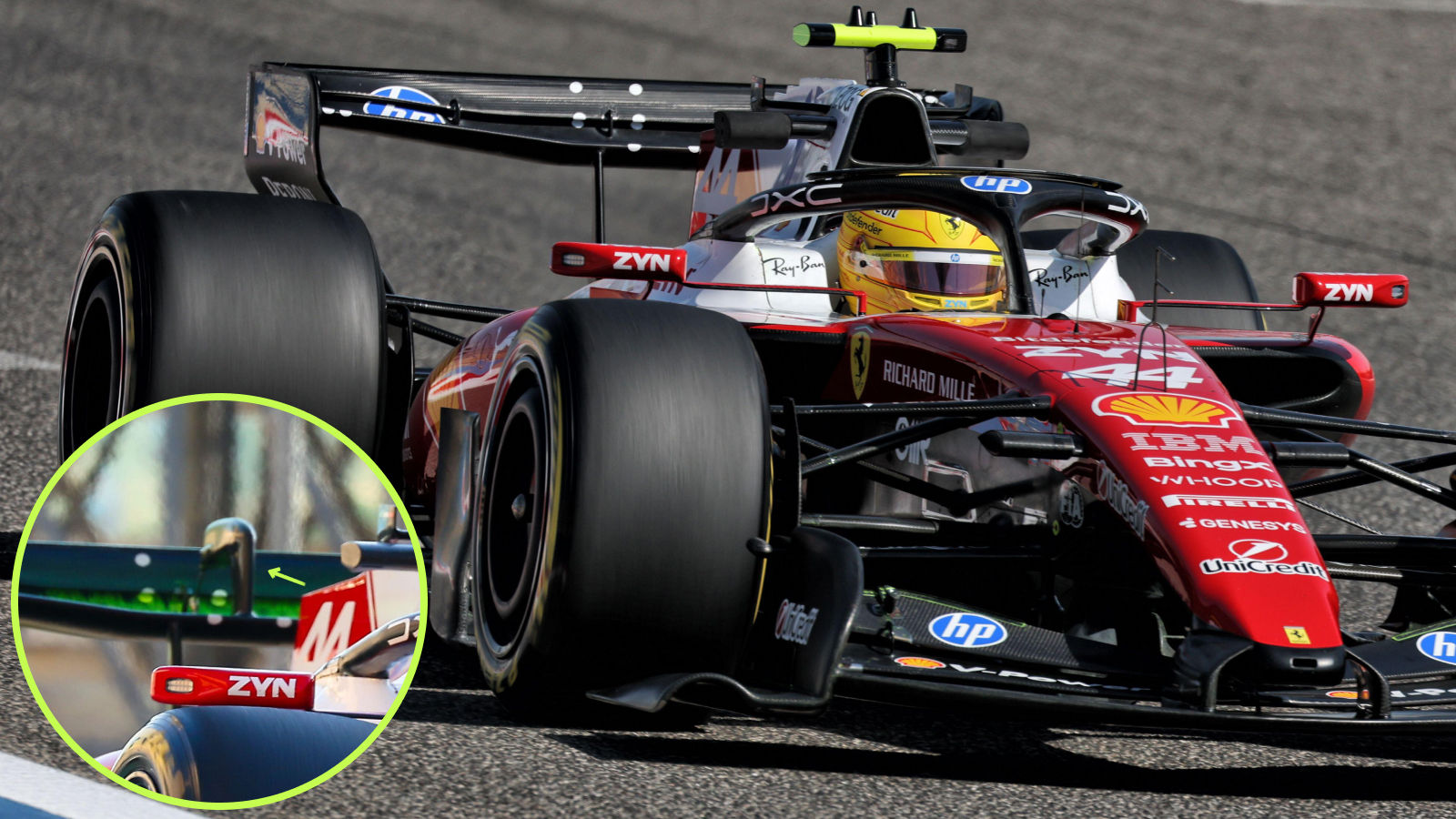
Ferrari has debuted a radical new active rear wing on the Day 2 of the second pre-season test in Bahrain.
The solution, which rotates the upper elements through a full inversion rather than adopting a conventional DRS-style opening, marks a radical departure from the approach taken by its paddock rivals.
Ferrari rotating active rear wing revealed during F1 testing
Want more PlanetF1.com coverage? Add us as a preferred source on Google for news you can trust.
The majority of teams have continued to employ a DRS-style solution for their rear wing active aerodynamics, with only Alpine and Audi having been the exceptions.
The Ferrari solution, much like the Audi one, appears to rotate around a central pivot point between the two upper elements but, rather than stop in a semi DRS-style position, the Ferrari wing continues to rotate, flipping completely over onto its back.
This completely alters the airflow’s behaviour, as the curvature of the two elements are now reversed; the trailing edge of the upper flap is also essentially the leading edge, which also brings into question how this alters the wing’s behaviour if there’s a Gurney flap attached to the trailing edge.
Ferrari’s designers haven’t come up with this solution for no good reason, as there’s other technical obstacles that have to be overcome to employ such an arrangement. That includes the mechanisms used to deploy the system having to be housed within the endplate of the rear wing, rather than having a centrally mounted pod.
It’s understood other teams in the paddock considered its use, but opted not to spend time and resources on developing a solution that also had some perceived drawbacks.
Any design change, especially one of this magnitude, is going to be a trade-off of sorts, with gains made in one area lost in another.
In this instance, given the role of the active aerodynamics, there are several elements to consider, including the amount of drag that’s being shed when the wing is fully deployed and the transitional phases between the wing being in the ‘open’ state and the ‘closed’ state.
In other words, how quickly does the wing reduce downforce and drag when it’s deployed and, on the flip side of that, how quickly does the airflow reattach when the wing is returned to its static state to generate downforce.
The rotation of the whole assembly means the traditional ‘slot gap’ or ‘letterbox’ is now actually larger, given the inverted shape of the elements.
And, as the flap completes its ‘flip’, there’s a moment where the flaps are vertical. That may offer some aerodynamic consequences, as it momentarily acts like a sail.
Returning to the early research that might have been done by others in the paddock, it’s useful in terms of knowing that other teams considered it. However, not all the parameters are equal, as they’d have looked at this solution from within their own bubble, a bubble which is not the same as Ferrari’s.
Through Ferrari’s lens, it naturally knew of other solutions, such as the blown exhaust flap arrangement, that debuted on the first day of the second test, which might well be used in combination to leverage an amplified effect that the others simply didn’t have.
Regardless, the concept and delivery of it is fascinating and shows that there’s a considerable amount of scope within these regulations both to innovate and for teams to have their own branches of development.
Want to be the first to know exclusive information from the F1 paddock? Join our broadcast channel on WhatsApp to get the scoop on the latest developments from our team of accredited journalists.
You can also subscribe to the PlanetF1 YouTube channel for exclusive features, hear from our paddock journalists with stories from the heart of Formula 1 and much more!
Read Next: F1 Testing: Red Bull Racing roll out sweeping RB22 upgrade in Bahrain