
Le Mans ’99: The terrifying Mercedes crashes that could have threatened Lewis Hamilton’s F1 future
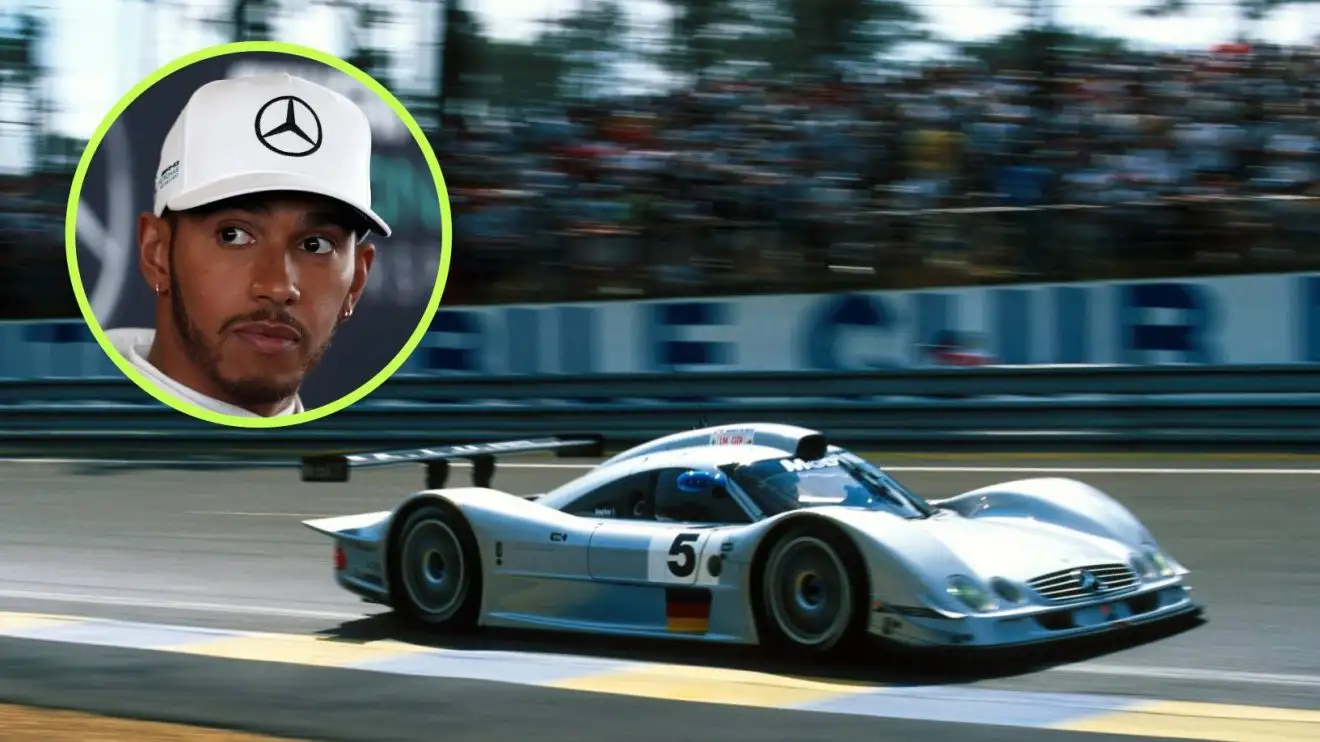
Mercedes' disastrous 1999 attempt at the Le Mans 24 Hours could have changed the course of Lewis Hamilton's future.
Lewis Hamilton’s F1 career and the participation of Mercedes might have been very different had the marque not withdrawn from the 1999 Le Mans 24 Hours.
Mercedes withdrew from the 1999 Le Mans 24 Hours, during the race, following a third incident in which one of its CLR cars flipped due to aerodynamic forces.
Bernd Schneider recounts the dramatic events of the 1999 Le Mans 24 Hours
Mercedes, together with partners AMG and HWA, developed the CLR for the LMGTP regulations in 1999, succeeding the CLK GTR.
Three such CLRs were entered into the 1999 Le Mans 24 Hours, but a design problem in the cars wasn’t discovered before the race, with Mercedes having carried out some 35 thousand kilometres of testing at the California Speedway, Miami-Homestead, Magny-Cours, and Hockenheim.
With a short wheelbase and a large bodywork overhang at both ends, the CLR had a major flaw in that, in certain aerodynamic conditions, the front of the car could generate a significant amount of lift. This lift could be greater than the downforce generated, raising the front of the car off the ground. This would result in the car taking off at high speed and flipping.
But this issue hadn’t yet been diagnosed by the time Mercedes showed up at the Circuit de la Sarthe for the world’s most famous 24-hour endurance race.
Driving chassis number four, Mark Webber, later a successful F1 Grand Prix driver, crashed on Thursday when he flipped his CLR at high speed. The incident was not captured by television cameras, with only photos of the aftermath to showcase what had gone wrong.
The Australian returned to the pits, but alarm bells weren’t yet ringing at Mercedes, as Schneider told the Beyond the Grid podcast. Schneider, a DTM legend and former F1 driver himself, was one of the drivers assigned to chassis number six.
“We didn’t know the problems of flipping the cars, because a lot of cars from other manufacturers had already flipped, and our CLK GTR was always a little bit in the air. This was why we didn’t run it at Le Mans in 1997,” he said.
“But the 1998 car was already not a big issue. We never had any problems with flipping, that the front went light. I was in pole position in 1998, and the car was really good. We just had a technical issue on the engine, after two hours.
“In 1999, we made another big step forward. Mark and myself, we had been at Hockenheim at the old track, running there without the chicanes.
“We did more than 330 kilometres an hour, over the bumps and everything, very close and in slipstreaming to simulate what’s going to happen.
“I’m very happy that nothing happened, because, at that old track, we had the trees right and left, and if something happened there at 300km/h, then I don’t want to be in the car. But we never had any issues there.
“Then we came to Le Mans, and we had a little issue with the power. We had to turn the power down, as the reliability was not there anymore.”
But this reliability change did have a profound effect on how the car behaved.
“So we had to drive with less power, and so we had to take off the downforce we were normally running, we took off to compensate and still get the top speed,” he said.
“We didn’t imagine that this would affect the lifting of the car that much.
“The worst accident was not on TV. Mark had that one on Thursday. The car was already prepared for the race, and he was driving to do a few consistency laps to see how the car would perform over the race distance.
“He followed Frank Biela in the Audi [R8R]. The Audi was pretty slow at that time, and Biela told me that he could see Mark coming. After the kink, he stayed to the left and said, ‘Okay, he will pass me now,’ but there was no more Mark.
Want more PlanetF1.com coverage? Add us as a preferred source on Google to your favourites list for news you can trust.
“[Biela] was so scared, because he said, ‘Where is he? Where is he going?’ Because he watched all the mirrors he had in the car, and he said there was no Mark.
“Mark told me that, when he took off there, he could see the tree from the top. I mean, these trees are really, really high. He did a complete flip and landed on all four tyres on the road.
“I passed the car, and I said, ‘Oh, technical issue’ I didn’t even see any damage. We didn’t have any cameras in the car, so we couldn’t see what happened.
“But I guess this was the worst, the highest flying ever, and it was not on TV. But we didn’t imagine it because we didn’t see it. Mark said, ‘Hey, I flipped the car, and this happened, and I did nothing wrong.’
“Yes, he flipped the car, but of course, we thought it must be something [else]. I remember when he came back, he was pretty white in the face, and he was really scared, but in that moment, we all did not really recognise what happened.”
Despite the uncertainty over what had occurred in the practice session, Mercedes rebuilt chassis number four, but upon returning to the track on Saturday, Webber flipped again. Like the first time, he escaped injury.
More on F1 nostalgia
How ‘overpaid’ F1 driver lost his motivation in ‘burnout’ Sauber season
Mercedes opted to withdraw this chassis from the race, but Schneider was eager to ensure the German manufacturer didn’t pull the plug on the race entirely, saying that he had had no qualms about climbing behind the wheel of the CLR as motorsport boss Norbert Haug expressed concerns.
“I was 100 per cent convinced the car was good. I had no issue,” he said.
“I drove so close to all the others. I never had anything, and then also the whole team said, ‘Okay, there must be a problem in the car with the setup, that we were too low and the front was too high. When you’re in the slipstream, we will prepare the car as we did in the simulation tests, it shouldn’t be an issue’.
“Then they built a new car for Mark, and he flipped it again in the warmup. This was on TV, and everybody said, ‘Oh, what’s wrong there? Did they find some footage from the old one?’
“But it wasn’t, it was another flip. Then Norbert Haug said, ‘We stop. Don’t drive at Le Mans if the cars are flipping’, because, with the history he had… this would have killed the whole motorsport programme of Mercedes-Benz, if somebody was really injured.
“I said to him, ‘Norbert, no, I want to drive. The car is good’.
“Then Gerhard Ungar, our engineer and the guy who built the car, said they’d put the rain setup on it. I mean, downforce, so much more downforce, front and rear. Then the car is safe.
“We really convinced him to let us drive, and that was the reason we drove the car.
“Then Peter flipped into the forest…”
With Mercedes starting the race with its #5 and #6 machines, Peter Dumbreck was behind the wheel of the #5 on Lap 75. Pursuing a Toyota, TV cameras perfectly captured the moment the front of his car lifted off the ground at high speed and left the Scottish driver a passenger as his car sailed over the barriers, tumbling end over end, before landing in a patch of land that had only recently been cleared of trees.
Unlike Webber’s two crashes, which saw him land within circuit confines, Dumbreck’s widely televised crash, and the staggering nature of it, meant there were no more questions to be asked. A lap later, Nick Heidfeld, Schneider’s teammate in the sole remaining CLR, the #6, was ordered to return to the pits and withdraw, with Mercedes promptly pulling the plug on the CLR project and its sportscar programme.
“I’d just got out of the car and changed. Franck Lagorce was my teammate, and he came in and said, ‘He flipped! He flipped into the forest, he flew into the forest!’
“I said, ‘Who the f**k flew into the forest?’
“I was so happy that he told me that Peter was okay, because I had no idea what had happened. But then I went immediately down to the box, and I saw the pictures.
“I mean, this was really shocking. Really, thank God that he survived that and nobody was injured there, because otherwise this would be part of my responsibility, because I was pushing hard that we are driving that race.”
It was the second time Mercedes had withdrawn from the top level of sportscar racing, an absence which ended in 2025 with a collaboration with the Iron Lynx project.
During that absence, Mercedes focused on Formula 1, where it was a works engine supplier to McLaren. Having partnered up with Ron Dennis’ team in 1995, Lewis Hamilton joined the McLaren-Mercedes driver programme in 1998, enjoying the support of both until he arrived in F1 with McLaren in 2007.
He would win his maiden title a year later. Mercedes entered F1 as a factory team in 2010, with Hamilton jumping across from McLaren at the end of 2012. He would go on to win six more titles with Mercedes, becoming the sport’s most successful driver along the way; all of his championship victories and Grand Prix wins, to this day, have been with Mercedes power, although he finally said goodbye with a switch to Ferrari in 2025.
None of this, Schneider believes, would have happened had that fateful weekend at Le Mans resulted in worse consequences for anyone behind the wheel of one of the CLRs.
“This, I always say, to people with Mercedes, this was one of the luckiest days of Mercedes motorsports,” he said.
“Because, if something bad had happened, we wouldn’t have had Lewis Hamilton in the Mercedes car, 100 per cent.”
As for the CLR, it never raced again. Haug defended his decision to press on after the first flips of the weekend, stating that the data from Webber’s practice crash had been adequately analysed and that, together with the drivers’ feeling there were no problems with the cars in traffic, meant there wasn’t conclusive evidence the issue was the car itself.
Shortly after Le Mans, Mercedes carried out a private test with the sole remaining CLR at an airfield, verifying wind tunnel data. No conclusions were ever published, but shortly afterwards, Mercedes cancelled the rest of its programme.
The two crashed CLR monocoques have not been seen in public since, although the remaining CLR has cropped up, courtesy of a private owner. It is currently on display in a German car museum.