

VIDEO: Are AI cars the future of motorsport?


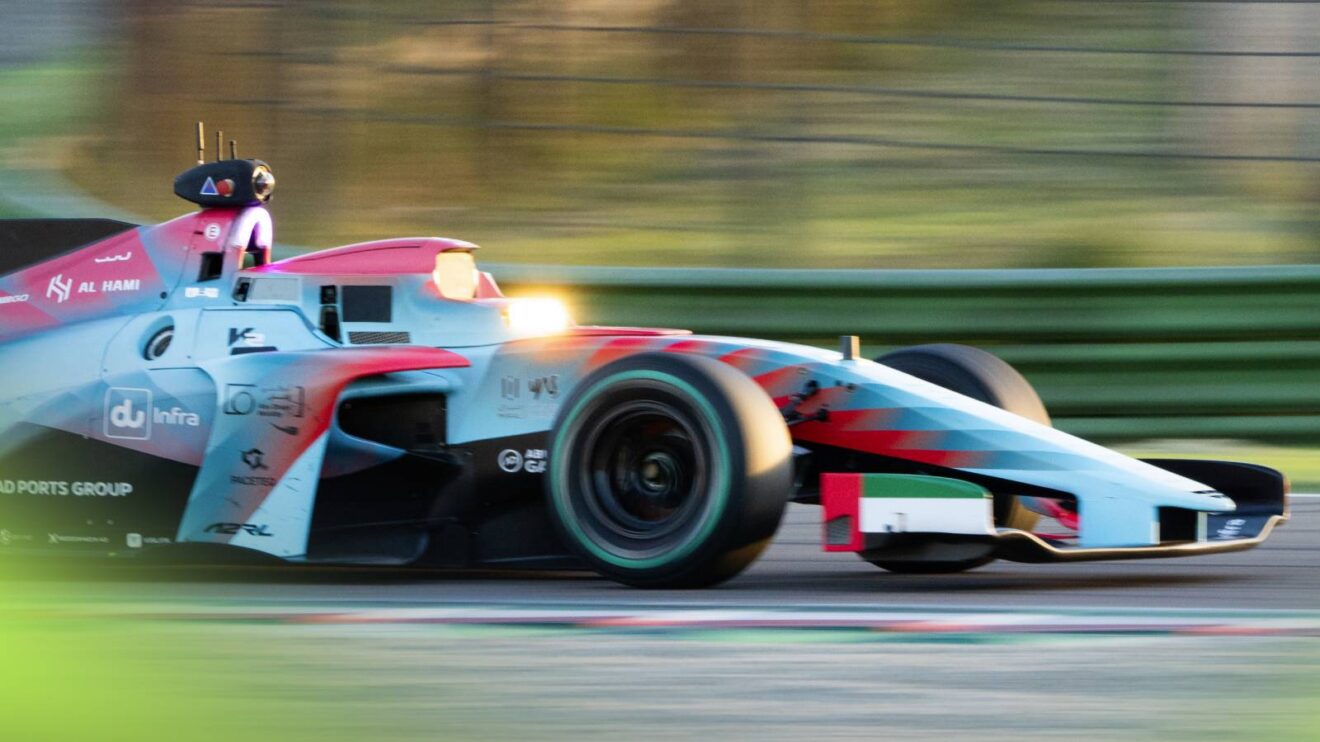
Is AI racing the future of motorsport?
Motorsport has long pitted man in machine against another, but will the future of racing see it shift towards man, AI, and machine?
Since the birth of the automobile, man has wanted to use the machines to race – a sport that captures many facets of brilliance, ranging from dexterity and reactions all the way to psychological factors such as nerves and instincts, as well as the intelligence factor, whether that be from driver, engineer, or designer.
How AI racing is approaching Formula 1 pace
Recently, Imola played host to the season opener of the third hosting of the Abu Dhabi Autonomous Racing League (A2RL), with the first two championships won over single-race events in Abu Dhabi by German constructor TUM.
This year, the championship has increased to two rounds, with the Italian venue hosting the series’ first international event before the season finale later this year at Yas Marina.
PlanetF1.com was on the ground at Imola for a tour of the technology and to meet some of the key personnel behind the race, which pits teams against each other in the arena of artificial intelligence as its driver, rather than a human behind the wheel.
How does A2RL race?
Created and organised by Abu Dhabi-based research facility ASPIRE, A2RL supplies each team with a spec Super Formula car and all the mechanical maintenance required to keep the machines in tip-top shape.
Where the series competes is in the coding of the artificial intelligence control systems: not only have the impact structures all been stripped out (after all, a computer can’t get hurt), but the cockpit itself is uninhabitable.
Instead, where a driver would usually sit has been fitted with state-of-the-art monitoring systems such as radar, LiDAR, and advanced camera technologies that interact with the intelligence ‘stack’ created by the individual team.
It’s in this coding that the teams, made up of PhD students, engineers, and AI experts, go to war by designing their own ‘driver’ by weighing up the balance of aggression, control, and speed around a lap, adjusting this as necessary to find the personality and approach that best suit them.
These algorithms and AI models are responsible for real-time perception of the track, localisation of position, planning its trajectory, and dynamic vehicle control.
Two years ago, the first race in Abu Dhabi proved unintentionally hilarious as the cars tootled around Yas Marina, performing bizarrely by stopping behind each other or losing control in unusual ways.
But the ticking off of factors affecting performance has seen a rapid rise in ability: watching trackside as the cars power around Imola, the improvement is staggering.
So much so that the cars are now capable of lapping with a handful (somewhere between one and five) of seconds of a human’s ability in the Super Formula machine: the current reference points in similar machinery have been ex-F1 driver Daniil Kvyat and F4 racer Juju Noda.
Granted, for now, there is little to stir the soul: motorsport is a very human story, and F1 has built its mystique off the back of legendary rivalries, bravery, and wheel-to-wheel battles. Comparatively slow and calculated racing lines, controlled entirely by computer, lack this romance.
But where A2RL is succeeding is in proof of concept of technology: the rate of improvement is rapid and, within a few short years, it’s feasible that an AI driver is capable of being faster around a circuit than any F1 World Champion.
Therefore, it’s possible that A2RL can become a sporting arena in its own right: pitting the humans behind the algorithms against each other in what could be seen as a racing equivalent to that old fan favourite, Robot Wars.
Is AI racing the future of motorsport? Probably not, in a traditional sense, but the seemingly inevitable moment at which an AI driver is capable of maximising a lap and being faster than a Max Verstappen or a Lando Norris is closer than you might think…
As software models improve and multi-car, wheel-to-wheel algorithmic battles become more fluid, autonomous racing will forge its own niche: less of a threat to human drivers, and more of a high-speed showcase of human engineering at its absolute limit.