

Audi makes revealing 2030 title prediction despite current struggles


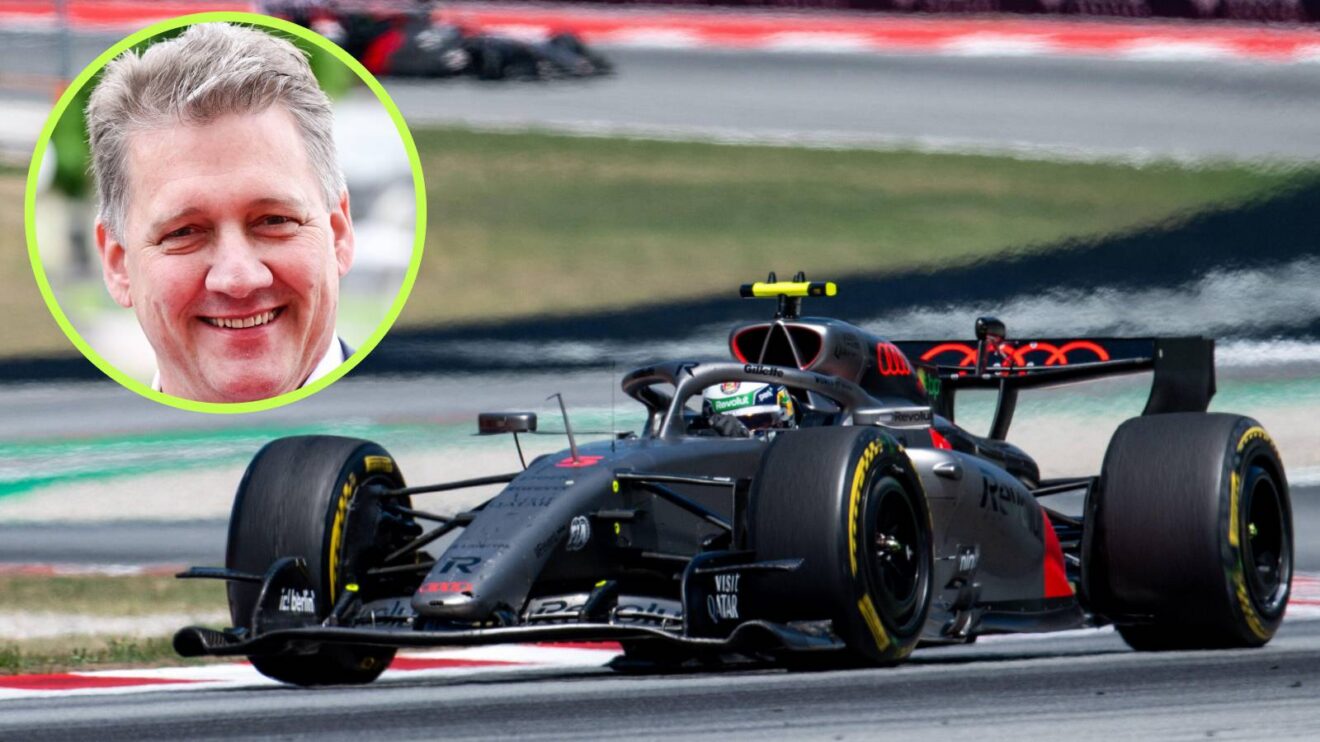
Audi's Gernot Dollner has reflected on his team's start to life in Formula 1.
Now established as a constructor in Formula 1, Audi is “absolutely on the path” to becoming a championship challenger, believes CEO Gernot Dollner.
The German manufacturer completed its takeover of the former Sauber team in Switzerland over the last winter, and is now racing as a fully autonomous constructor and power unit manufacturer.
Gernot Dollner confident Audi remains on track for 2030 target
Want more PlanetF1.com coverage? Add us as a preferred source on Google for news you can trust.
- Audi still targeting Formula 1 titles by 2030
- Gernot Dollner says the team is meeting expectations
- Engine deficit identified as Audi’s biggest weakness
The Audi team currently occupies ninth place in the Constructors’ Championship, but this is perhaps not fully indicative of just how competitive the team has been since arriving on the grid in Australia.
Qualifying in the upper midfield hasn’t been an unusual sight to see, but struggles to get the R26 off the line on a consistently strong basis have been a bugbear for the team, while misfortunes during the races have also resulted in Audi only scoring two points, despite keeping up with Alpine and Racing Bulls in terms of pace.
As an example of just how unlucky Audi has been, Nico Hulkenberg retired from the Barcelona Grand Prix due to a stone hitting his engine shutdown switch while he battled with Liam Lawson; a one-in-a-million incident that had the German driver musing that the “racing gods don’t want us to score more points”.
But, while on-track execution and misfortunes have played their parts in ensuring Audi remains on an unrepresentative two points, the competitiveness of the R26 is enough to have convinced Audi CEO Gernot Dollner that its plan to become a championship challenger by the end of the decade remains on course.
“We are absolutely on that path; to be, for two years, the challenger, then the competitor, and then the fight for the championship target year 2030; that plan is still in place, and we are following it,” Dollner told select media, including PlanetF1.com, during the Monaco Grand Prix weekend.
“This season is where we wanted to be, around where we are right now. Of course, we would love to have had more points in the last races, but the overall performance of the car, and where the team is, is where we have seen ourselves in our strategy.”
Asked to assess where Audi is after the first quarter of the season, Dollner said it’s clear there’s plenty to learn, but the overall trend trajectory of the team is on course to meet all initial expectations.
“We are very happy with the position we are in right now. After five races, the overall performance of the car is in the midfield when it comes to speed,” he said.
“Of course, we had an excellent start for the first two points in Melbourne, and after that, a lot to learn, I would say – a lot to learn where we are on the performance side, especially on the drivetrain.
“A lot to learn, also on operations, I mean, it’s the first time Audi has developed power units, first time we had to operate both sides, not only on the chassis side, but also the engine side, with the two teams interacting.
“The team has done an outstanding job in optimising the processes, and we learn step by step, and overall, we are very happy.”
Audi’s Mattia Binotto, whose background is in F1 engines, has been open about the power unit, with its larger turbo, being the main weakness of the team. Not only is it more difficult to get off the line, but it is also somewhat down on power compared to rivals.
The FIA’s ADUO findings are yet to be formally communicated to the public, but Audi is set to receive two homologation upgrades, indicating that it is more than 4% off the baseline combustion engine power of the standard-setting Red Bull Powertrains DM01.
But the comparative weakness of the power unit, Dollner explained, is not something the team is dwelling on, as he was asked about the aspects of Formula 1 that have surprised Audi as it finds its feet in the sport.
“Maybe the amount of learning points has surprised me, personally, so there were some just operational stuff that we did not expect in that amount, but, overall, it was crystal clear that it’s our first power unit – we are not in the lead when it comes to overall power of the engine,” he said.
“But, on the other side, I think very positively regarding the chassis, the aerodynamics, the high-speed corner performance, so that’s a positive.”
With more hiring of personnel to be done to reach the budget cap limitations, Dollner explained that this is likely to happen over the course of the next year, as Audi zeroes in on its technical abilities.
“It’s the overall development team that’s in focus, and we have many programmes in place in Hinwil, especially young talent programmes to bring in talent and brains from universities, and so that’s underway, especially for the whole technical development team,” he said.
One hurdle that Audi quickly had to overcome was the decision by Jonathan Wheatley to walk away from his post as team principal, following the reveal that Aston Martin’s Adrian Newey had identified him as a primary target to succeed him in the role.
While Wheatley is yet to be confirmed in the role, it is expected that he will be once his exit from Audi is fully formalised.
“Yeah, first of all, of course, we were surprised regarding that development, but we were absolutely fast in adapting to the new situation,” Dollner said, when asked by PlanetF1.com about his surprise regarding Wheatley’s decision to leave after one year. With Audi rejigging its management structure, Allan McNish has been brought in to support Binotto in leadership.
“I learned something over the past three years working close to Formula 1: the most important aspect is to be flexible and to be reactive in a positive way if something happens, and we are so, so glad to have Allan in the team.
“We have found initially very fast a setup that works really, really well. We are able to react in that direction, but we are absolutely happy with the actual setup.”
As for Audi’s financial position, Qatar’s sovereign wealth fund, QIA, is a significant minority shareholder in the team, but Dollner ruled out needing to chase any more partners any time soon.
“We are stable from the financial situation, so that’s all set up for the next few years,” he said.
“It could be an option, but, to be honest, it would be too early, and wouldn’t make sense from a business perspective.
“First of all, we have to develop the team to the next level, and then maybe it’s the right moment, but no decision, not even a plan in that direction. The setup, as it is, is the right one for us.”
How F1 has led to the creation of the Nuvolari
The Monaco GP weekend also saw Audi, as an automotive manufacturer, roll out its first and only existing iteration of the brand-new Nuvolari super sports car – the first of 499 planned units – which features a hybrid V8 drivetrain with a bi-turbo, that boasts 1001 brake horsepower.
The car was driven for two laps of the Circuit Monte Carlo, with Hulkenberg and Bortoleto each getting a lap, as they parked the car in front of Dollner and assembled Audi dignitaries at Antony Noghes to conclude the shakedown.
As the fastest and most powerful production car ever built by Audi, it was presented as an initial idea by three members of staff in Dollner’s office in March 2025. The concept has turned from a proposal into a real-world car in just 440 days, and Dollner revealed that, without Formula 1, the car would not have come into existence.
“I would say that the Nuvolari project would not be there without our Formula 1 entrance, because, being here in Formula 1 raised the question and made it feel absolutely natural that we need a proof point where we are heading in the performance segments with our brand, so F1 triggered that project,” he said.
Rouven Mohr, Audi’s chief technical officer, said Formula 1 has become an integral part of the marque’s branding ethos and mentality.
“From the development point of view, the boost of the motivation of the team related to Formula 1, this is also sometimes perhaps a little bit underestimated,” he said.
“Formula 1 is a kind of identification, also within the Audi company’s corporate side. It was really fantastic to see this spirit, also for this project, because we developed the project within 18 months, something like this.
“Usually, that’s impossible, but it was really a super focused team, clear decisions, fast decisions, and this is a little bit also inspired by Formula 1, on top of all the things that we did, because we did, for instance, aero – let me say, we did also some aero discussions with the colleagues of Audi Formula 1, and also we did also the driving simulator regarding the energy management of the car.
“You can learn a lot also for the street car, even if it’s not a one-to-one carry over, because it’s clear it’s a street car, and the other one is a Formula 1 car, but you can learn a lot, and the motivation has for sure helped a lot.”
Want to be the first to know exclusive information from the F1 paddock? Join our broadcast channel on WhatsApp to get the scoop on the latest developments from our team of accredited journalists.
You can also subscribe to the PlanetF1 YouTube channel for exclusive features, hear from our paddock journalists with stories from the heart of Formula 1 and much more!
Read Next: Max Verstappen calls for FIA action in untelevised Barcelona GP team radio