

Ford break 22-year F1 drought as Mark Rushbrook hints at Red Bull strength


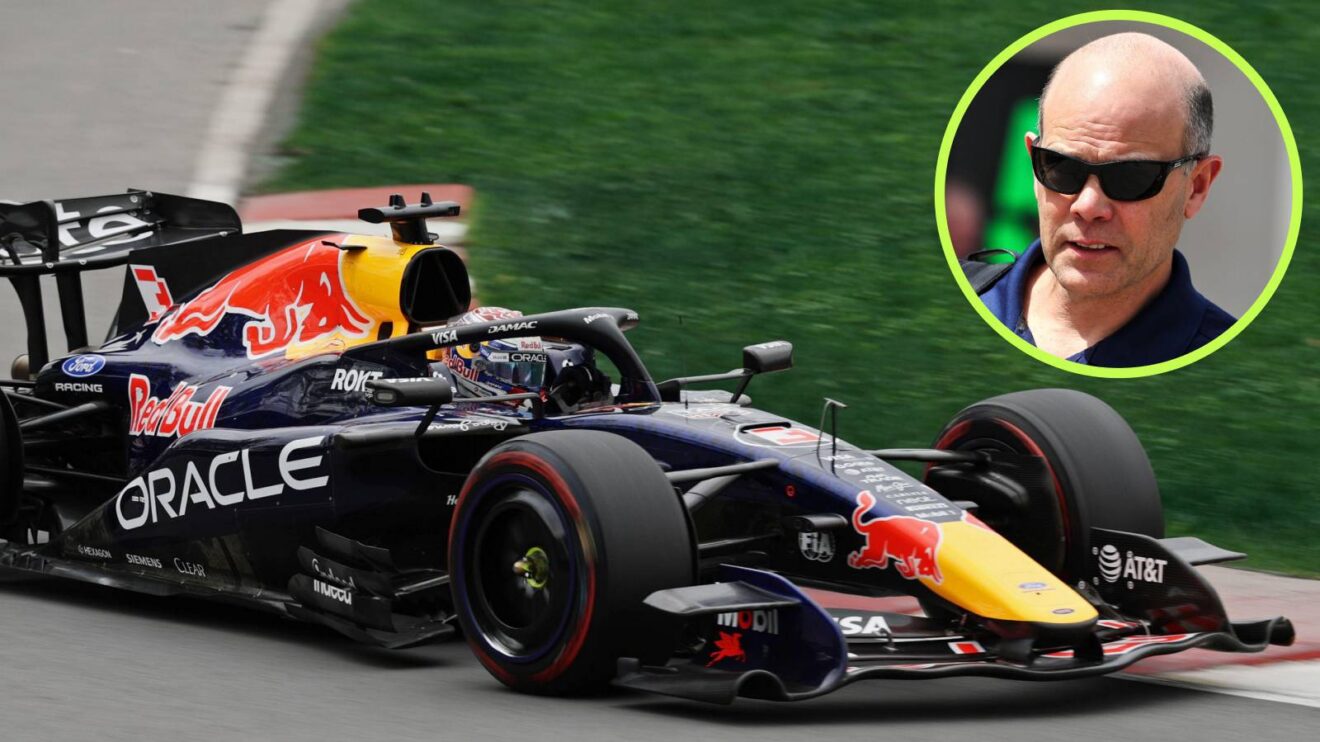
Ford's Mark Rushbrook has opened up on the relationship with Red Bull.
Ford’s Mark Rushbrook has opened up on how the relationship with Red Bull is progressing, with Sunday’s Canadian Grand Prix marking the partnership’s first podium finish together.
Max Verstappen’s third-place finish in Montreal was the first podium to feature the Ford blue oval since Giancarlo Fisichella won the 2003 Brazilian Grand Prix for Jordan-Ford.
Mark Rushbrook reacts to Red Bull Ford podium breakthrough
Want more PlanetF1.com coverage? Add us as a preferred source on Google to your favourites list for news you can trust.
- Mark Rushbrook explains why Ford is encouraged by Red Bull Powertrains’ early F1 progress
- Ford reacts after securing its first Formula 1 podium finish since 2003
- Rushbrook addresses growing intrigue around Red Bull’s 2026 power unit strength
With the all-new Red Bull Powertrains [RBPT] project proving one of the positive surprises of the F1 2026 season so far, its technical partnership with automotive giant Ford marked the return of the manufacturer to the grid for the first time since its ownership of Jaguar was relinquished at the end of 2004.
It’s been over two decades since Ford’s direct involvement in Formula 1, but the return was confirmed over three years ago when RBPT announced a technical partnership to bolster the strength of its capabilities as the Milton Keynes-based squad has evolved into a fully autonomous manufacturer, just like Ferrari, Mercedes, and Audi.
While the competitiveness of the Red Bull RB22 has been somewhat inconsistent across the five Grands Prix held so far, the power unit has been earmarked by rivals in the paddock as being particularly strong; the consensus being that it’s one of the top two power units, along with Mercedes, and perhaps even being the unit to beat.
In Canada, Verstappen put on a typically fighty drive to emerge with third place after a spirited battle with Lewis Hamilton over the podium positions behind race winner Kimi Antonelli, with the position ending a two-decade drought without Ford involvement.
It’s a fact that sounds almost unimaginable nowadays, given the extent of Ford’s past successes in Formula 1; Ford-badged engines have won 176 Grands Prix and powered 10 Constructors’ Championships, making it the third most successful manufacturer in the sport’s history.
“Seeing Max secure a first podium of the Red Bull Ford Powertrains era is a landmark moment for our partnership,” Ford’s global director, Mark Rushbrook, said after the result.
“It has been fantastic to witness the remarkable effort that has gone into the preparation for the 2026 season, and this result is a well-earned marker of the efforts of both Oracle Red Bull Racing and Ford Racing.”
While off-track considerations such as regulations are dominating the headlines at this early stage of the cycle, the on-track performance of the power unit is a testament to the strength of the personnel assembled at RBPT over the last half-decade, as well as the wealth of knowledge Ford has been able to imbue.
There has been significant evolution of the project over the course of the past year, too, as Red Bull opted to part ways with former CEO Christian Horner, who had been the catalyst for the RBPT project under the late Dietrich Mateschitz.
With Horner removed, Red Bull installed Laurent Mekies to oversee all of Red Bull’s racing activities, including RBPT.
For Rushbrook, the partnership with Red Bull continues to flourish as he assessed the strength of the collaboration following the realisation of its on-track position.
“We’re very happy with where we are right now,” he said.
“Red Bull Racing and Red Bull Powertrains – they’re great partners, and that’s what we knew three-and-a-half years ago when we struck the deal.
“The partnership with them has been incredible to develop an all-new power train together with them, based in Milton Keynes, and I’m incredibly proud to have that power unit on track in the Red Bull Racing cars and the Racing Bulls cars as well.
“So it’s a very proud moment for Ford Motor Company, Ford Racing, and all of our employees. We’re very happy with the partnership with Ben Hodgkinson as he leads the power trains part of the business, and with Laurent, with what he’s been doing overall with the racing team, very happy with everything that we’re doing there.
“Obviously, we want to compete to win races and win championships. We would love to be further up the grid but, at this point, we’re happy that we’re in the part of the grid where we are, the top half, and knowing the capability that exists within Milton Keynes.
“They showed in 2025, the comeback to get Max within two points of the championship. Everybody on campus and off campus is working very hard to continue to improve performance, and that’s all we want in a partner: the commitment to do whatever it takes to keep working towards the top of the grid.
“Absolutely, we have had issues, without question, but we’re committed to solving those issues and continuing to improve performance.”
More on Ford in Formula 1
Ford delivers verdict on Formula 1 V8 engine return push
Ford ‘would love’ Max Verstappen switch after surprise Mercedes GT deal
Rushbrook laughed and opted against a guess when asked about the paddock chatter regarding the FIA’s ADUO [Additional Development and Upgrade Opportunities] checkpoint after the Canadian Grand Prix.
But, assuming paddock chatter is correct, RBPT may be one of the two manufacturers not given the chance to introduce an extra homologation upgrade, assuming its power unit is within two per cent of the top-performing engine (or perhaps is even the benchmark itself!).
Regardless of whether or not RBPT is given that opportunity, Rushbrook said he feels the fairness of the catch-up mechanism has been well thought-out and refined with the help of Mekies and technical director Ben Hodgkinson representing its interests.
“There needs to be something like that in place, because everybody’s here for a reason, for the innovation, the learning, but also the marketing; everybody’s brand is on the line, so to give an opportunity, I think it’s appropriate,” he said.
“We leave it to Laurent and Ben to lead those discussions directly with the FIA and with F1, and we talk about it offline with them, and we trust how they’re representing everything in those meetings, and they’ve done a great job.”
Earlier this year, Hodgkinson told PlanetF1.com that he would like to see a development war on the power unit front, a war that is not possible under the current homologation rules and the constraints of the ADUO.
“I would personally love just to get rid of homologation and have a gloves-off fight. That’s what I’d really like. But we are where we are,” he said, pointing to the existence of a power unit manufacturer budget cap.
“We have a cost cap, and we have dyno hours limits. So I think there are enough limits in place without this.”
This budget cap, Rushbrook said, makes sense for the PUMs, but competitors will always want the chance to further innovate.
“I think it is important to maintain costs and a cost cap, because, if it goes out of control, then it could hurt the sport, or could cause people to leave the sport,” he said.
“But we’re also competitors, so to have that opportunity to make changes, it’s racing.
“I think that [relaxing the homologation rules] is something to be debated and a decision made, ultimately.”
It’s certainly not been a hugely relaxing return to Formula 1 for Ford, with regulation chatter dominating the background while navigating through Red Bull’s huge leadership reset.
With years to go on the current regulation cycle, Rushbrook said he can only see Ford’s commitment and partnership with Red Bull deepening as the bonds grow.
“From the very beginning, three-and-a-half years ago, we had our list of where we felt we could contribute, where Red Bull thought we could contribute, and that list has grown in these three and a half years, because Red Bull, they’re racers, we’re racers, we want to win, so we’ve made available whatever can contribute to that endeavour,” he said.
“We’re committed to continuing to do that through the current regulation period. Ford wants to be in Formula 1 long-term; we were gone from the grid for 22 years.
“We’re very happy to be back, and we want to continue that long-term, and we’re very happy with that Red Bull relationship. It’s a partnership, it’s a strategic technical partnership where we feel like we’re able to talk and listen to each other and move forward.”
Want to be the first to know exclusive information from the F1 paddock? Join our broadcast channel on WhatsApp to get the scoop on the latest developments from our team of accredited journalists.
You can also subscribe to the PlanetF1 YouTube channel for exclusive features, hear from our paddock journalists with stories from the heart of Formula 1 and much more!
Read Next: Ford delivers verdict on Formula 1 V8 engine return push