

Pirelli to stage Bahrain wet tyre test amid F1 2026 changes
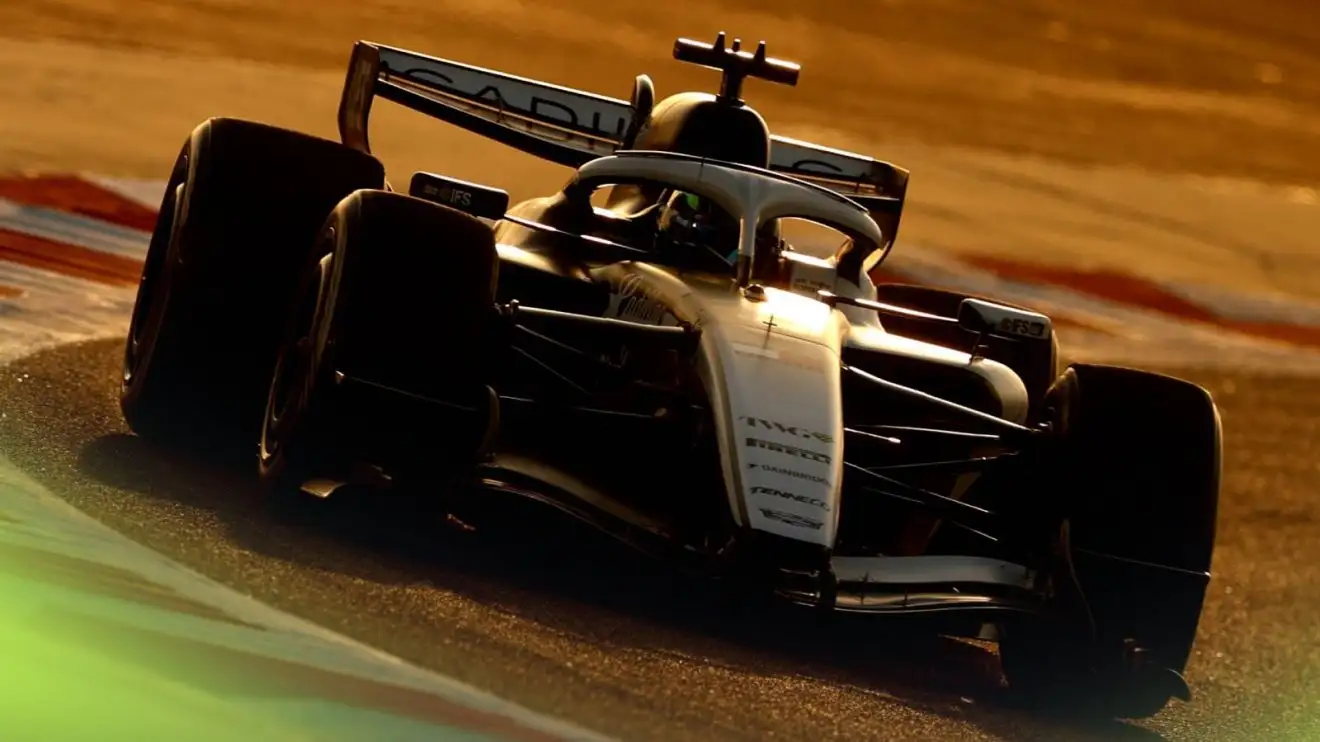
Pirelli is set to host a we-weather tyre test in Bahrain.
Pirelli’s future in Formula 1 may be under scrutiny — but its next wet-weather tyre test is heading to the desert.
The desert venue isn’t an obvious choice to carry out such a test, but Mario Isola has revealed how an unusual plan is being put together to allow for wet-weather running at the Bahrain International Circuit.
Why is Pirelli aiming for an F1 2026 wet-weather tyre test?
With the changes to the F1 cars for 2026, Pirelli has had to come up with new tyres to suit the revised 18-inch wheels as both the front and rear tyres are narrower than in ’25.
While the constructions and compounds are largely the same as last year, some consideration has had to be made to handle the increased forces under acceleration, as well as handling the forces encountered when the straight-line mode deactivates and results in high vertical load through the car as the downforce returns in an instant.
Pirelli does have its own testing programme throughout the year, in which every team is given the opportunity to supply a car and driver to help the tyre manufacturer carry out its requirements.
Such tests are usually scattered throughout the season, with Pirelli permitted to run a maximum of 40 days in order to accumulate the data it requires to refine its range of tyres.
This includes the development of its wet-weather tyre products, with more significant change expected in that regard once Pirelli is able to get a clearer picture of how the new cars – which have moved away from ground-effect aerodynamics – interact with the intermediates and full wets.
“We should consider that the cars are different – without the diffuser that was putting a lot of spray in the air, probably the visibility is slightly better,” Mario Isola told media, including PlanetF1.com, at the conclusion of the first Bahrain pre-season test.
“Also, the tyres are a little bit narrower, so putting less water in the air. If it is enough for the race director to let them run or not, this is something I don’t know.
“What we tried to achieve is to reduce the crossover time between the wet and intermediate in order to have the wet tyre more usable.
“The point is that, if you are in a race condition and the expectation is for the track to dry, they will put on intermediates because they want to minimise the number of pit stops.
“Any information is important for us, because we don’t have a lot of opportunities for testing.”
To get this information, Pirelli is set to host three separate tests throughout the year and, unusually, one of those tests will take place at a venue that is usually baking hot and sunny – the Bahrain International Circuit.
This is planned as a two-day event, taking place on February 28th and March 1st, with McLaren and Mercedes supplying mule cars to emulate the performance levels of the current cars, following Pirelli offering the test to all the teams.
“At the moment, we are planning three sessions. It’s a miracle, I tell you, because, if you look at testing in dry conditions, we can use Tuesday and Wednesday after a race,” Isola said of the usual approach to pulling together a test.
“Teams are already at a track. If there’s not a back-to-back, or a street circuit, we can ask them to stay at the track and test the tyres.
“So we had the opportunity, for example, to organise a test in Japan or at other circuits where we can stay a couple of days more. We are thankful to the teams, because also they are running 24 races, and the guys and drivers have to stay more for our test, so it’s not easy.
“But, for wet conditions, you need a specific track. We can go to Paul Ricard or to Magny-Cours [both in France]. But we are trying to organise a wet test here in Bahrain, and I am very confident, because the track has an idea on how to wet all the circuit, so the full circuit.”
The reason for pursuing a test in Bahrain is due to the more abrasive surface of the track, with Isola saying the information gleaned would be useful for Pirelli in understanding how its wet-weather products interact with a higher-severity circuit.
“This is something that doesn’t happen very often, so we have this opportunity we want to use in the best possible way,” he said.
“We have another couple of tests planned at Fiorano [in Italy], and one of either Paul Ricard or Magny-Cours, but that’s all.
“More than that is almost impossible. So we have to maximise any opportunity for wet development.
“I’m not saying I hope it’s raining in one of the first races, but it could be interesting for us to get information from a wet race, to understand a bit more on that, and then to direct our development in the right direction.”
More on F1 2026 Bahrain pre-season testing
Is Adrian Newey hiding true Aston Martin AMR26 until Melbourne?
F1 2026 race starts: Ferrari in spotlight as Stella makes ‘responsibility’ point
Given the baking hot and dry desert conditions that are very much the norm at the Bahrain International Circuit, Isola confirmed the intent is to run the test in the afternoon and evening, and that the cumbersome water tanker system that is used at other venues isn’t the intention.
“They have a fantastic idea with sprinklers and some other devices,” he said.
“I have to say that Bahrain people are always very cooperative when we ask for strange requests.
“I gave a call to the guys and I said, ‘What if we plan a wet test in Bahrain?’
“They said ‘Yes, of course we can’.
“I asked ‘Are you sure?
“[They said], ‘Let us think about it!’
“But we need consistency in the water level because, clearly, the risk is that inconsistency in water level is more important than the difference in prototypes’.
“But they were clear, ‘‘Yeah, understood, we will consider to prepare the track and everything’.”
Is Pirelli aiming to extend F1 contract?
During the Bahrain pre-season test, paddock sources indicated to PlanetF1.com that the tyre manufacturer is already considering taking up its supply option for F1 2028, with the sport continuing to provide value by way of being a useful test bench for development and innovation that trickles down into road car tyre technology, separate to the beneficial commercial aspects of the supply deal.
Currently, Pirelli’s contract as F1’s sole tyre supplier runs until the end of next year, with an option for ’28.
In the short-term, it’s understood that Pirelli’s goal is to extend the contract with F1 for 2028.
What is known is that Pirelli is also set to move into MotoGP in 2027 and, alongside that, there have been speculation rumours that rival tyre manufacturers such as Bridgestone and Hankook are thought to be interested in the F1 tyre tender.
Should that be the case, competition for the sole tyre tender – whether that be for 2028 or ’29 onwards – could be fiercer than previous cycles, but neither Bridgestone nor Hankook has yet expressed interest in the F1 supply deal.
Read Next: Red Bull chief designer Craig Skinner to leave team
