
Toto Wolff points to Miami ‘facilitated’ pass in F1 ownership debate


Liam Lawson v Max Verstappen raises A/B questions for Wolff
Toto Wolff has urged Formula 1 against pulling the “full handbrake” on dual ownership and customer teams despite what he called a “facilitated” pass at the Miami Grand Prix that favoured Max Verstappen.
Instead, the Mercedes team principal says Formula 1 needs to tighten the regulations about what is permitted and what is not.
Toto Wolff on F1 A/B teams and Miami controversy
Want more PlanetF1.com coverage? Add us as a preferred source on Google to your favourites list for news you can trust
The topic of A/B teams made headlines again after the Miami Grand Prix when McLaren CEO Zak Brown penned a letter to the FIA President, Mohammed Ben Sulayem, urging the governing body to introduce rules banning dual team ownership and legislating to dissolve existing structures.
Today, there is just one dual ownership situation on the grid with Red Bull owning both the Red Bull Racing team and Racing Bulls.
And that, according to Brown, crossed the line at the Miami Grand Prix.
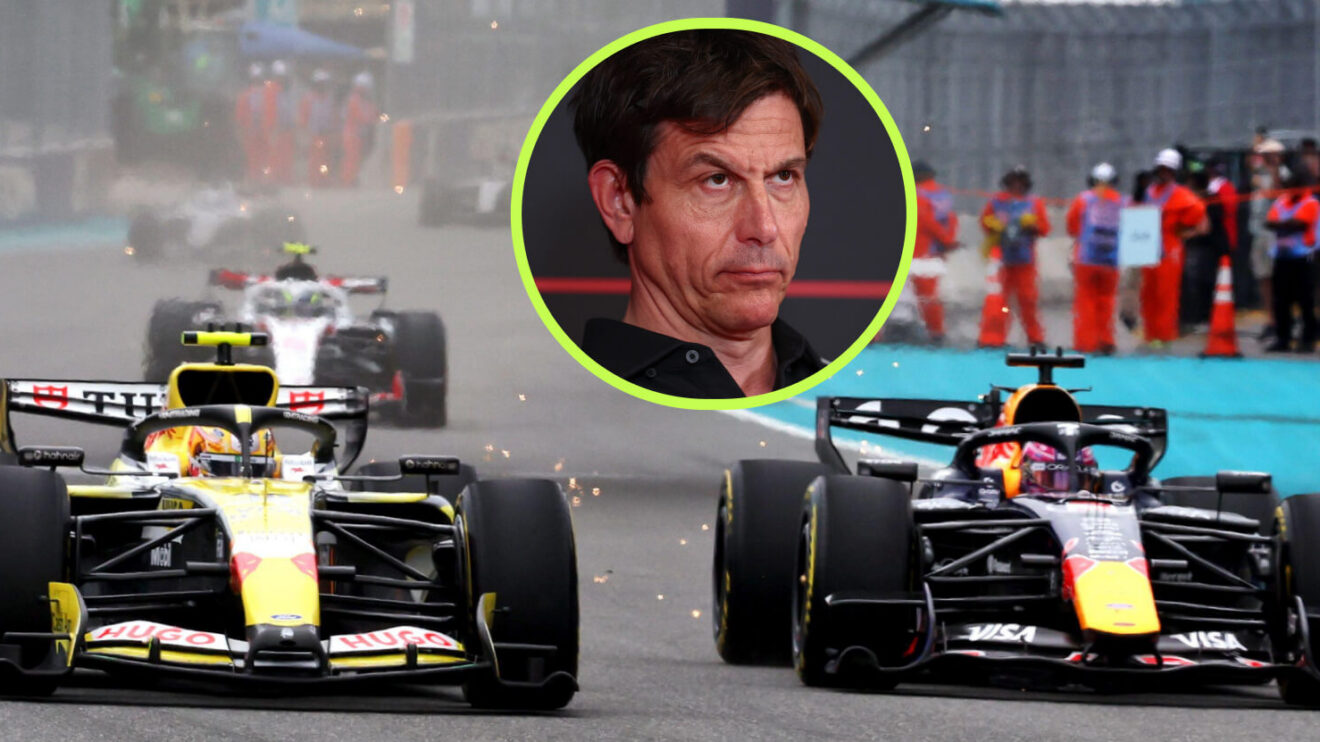
Liam Lawson was left surprised when Racing Bulls told him to let Max Verstappen through after both drivers went off the circuit while fighting for position, with Lawson emerging ahead.
The New Zealander was told to yield the position to the Red Bull driver, and incredulously replied: “Drove into the side of me. I don’t understand.”
He, however, followed the instruction and later admitted it was a “mistake” from his pit wall as it was Verstappen who was in the wrong, but in a split-second review, Racing Bulls wanted to avoid a penalty for Lawson.
Brown, though, used that as an example of why the A/B teams are “not healthy for the sport”.
Wolff, asked for his thoughts on the A/B team ownership, agrees with Brown that it was “facilitated”.
However, the Mercedes team principal cautioned that A/B team ownership isn’t that much different to customer teams such as Haas’s relationship with Ferrari.
“I think every position, philosophical position concerning that question is understandable,” Wolff said in Barcelona.
“Gene Haas wouldn’t have been able to enter Formula 1 if they wouldn’t have had a deal with Ferrari, because as a smaller team you simply can’t manufacture your engine, your gearbox, your hydraulics, your cooling, etcetera.
“So, in a day and age where it was really difficult to find teams that would compete in Formula 1 because it was so expensive pre-cost cap, that was an optimum way to do it, number one.
“Number two, there will be always the position of Zak, I guess, is to say how are these teams collaborating with each other? Is there an advantage in terms of development, using the same wind tunnel?
“I think the rules are strict enough that nobody would actually breach them, but it’s a fair argument for another team to say, ‘Is there an advantage when you shuffle people back and forth’, which you can still do.
“And that brings [me to] the third position, and I think this is mainly where Zak is coming from. If you have dual ownership of teams and dual control ownership, there will be automatically benefits in many areas, and some, I would say most of it, within the rules.
“We had a race in Miami where there was an overtake that was facilitated. Would that have happened between teams that weren’t under the same control? Maybe yes, maybe not.”
Rather than ban A/B ownership or, to the extreme, customer teams, Wolff wants the regulations regarding what is permitted and what isn’t tightened.
More on F1 team ownership
F1 team valuations surge as Ferrari tops billion-dollar boom
“So, from where I stand, I think we need to have rules where collaborations on the development side and on the sporting side need to be strictly defined.
“And if that is the case, it doesn’t matter actually what the shareholding or what the ownership structure is, whether you are a customer team and you’re buying certain parts or whether you’re a customer that’s buying just an engine. Because where do you stop?
“If we say, ‘OK, full handbrake, the sport is in good shape, we want to have 11 constructors’, that means everybody brings his own engine, everybody brings their own gearboxes, rear ends, etcetera.
“That would be obviously nirvana, but how should a relatively small team like Haas do that today? And it’s not possible.
“So, I think we need to allow space for all of the positions in that.
“And for me, the only right outcome and objective needs to be rules that make it even clearer what’s on and what is not on.”
Mercedes, of which Wolff is a co-owner, recently bid for Otro Capital’s 24 per cent stake in the Alpine F1 team, which would’ve been Mercedes, and Wolff, a co-owner of two teams.
Mercedes withdrew from the negotiations as the sale price from Otro was reportedly in excess of what it is willing to pay.
The BBC suggested that Otro, which purchased its stake for around $230 million in 2023, is seeking around $720 million for the stake. This values the team at around $3 billion – a figure in excess of what Mercedes believes it is worth.
Mercedes elected to pull out of discussions rather than return to the table with an increased bid.
Want to be the first to know exclusive information from the F1 paddock? Join our broadcast channel on WhatsApp to get the scoop on the latest developments from our team of accredited journalists.
You can also subscribe to the PlanetF1 YouTube channel for exclusive features, hear from our paddock journalists with stories from the heart of Formula 1 and much more!
Read next: Is Lewis Hamilton a title contender now? Not so fast