

The ultimate F1 2026 guide: Everything you need to know about the 2026 season
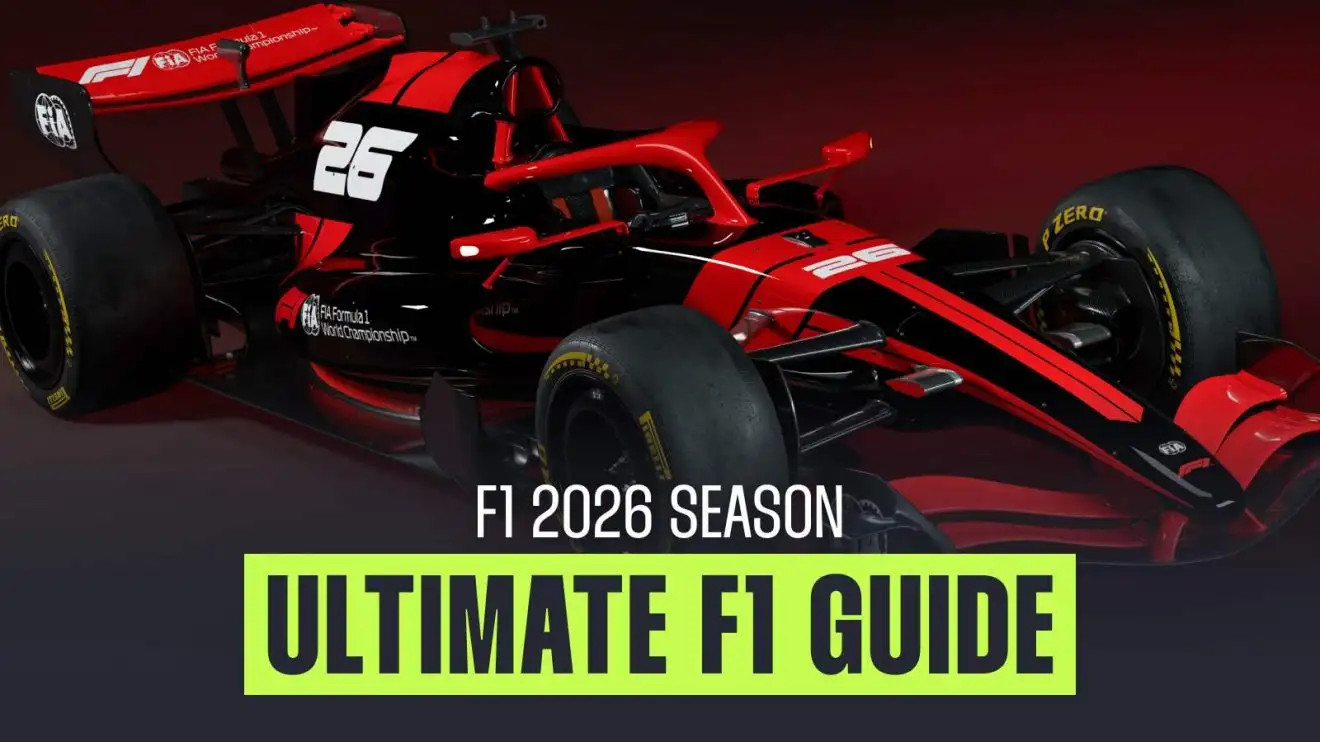
Need to know any key info from the F1 2026 season? It's right here.
F1 2026 is a season of huge change, so here is everything you need to know as Formula 1 moves into a new era.
Sweeping regulation changes are combined with relative driver continuity from season to season, but the changes begin even in pre-season testing.
When is F1 2026 pre-season testing?
With all-new cars to contend with, pre-season testing has been expanded from its usual three days to 11 days ahead of the F1 2026 season.
A five-day behind closed doors shakedown in Barcelona will kick off the teams’ testing schedule, before two three-day tests in Bahrain.
Shakedown: 26-30 January, Circuit de Barcelona-Catalunya
Test one: 11-13 February, Bahrain International Circuit
Test two: 18-20 February, Bahrain International Circuit
When does the F1 2026 season start?
Racing gets underway in Melbourne for the Australian Grand Prix from March 6-8 at Albert Park.
Australia hosts the opening round as part of an Asian-swing to start the year before heading to the Middle East, United States, and finally Europe.
F1 2026 calendar: Where are the races being held and when?
*Denotes F1 Sprint event
March 6-8: Australian Grand Prix, Melbourne
March 13-15: Chinese Grand Prix, Shanghai*
March 27-29: Japanese Grand Prix, Suzuka
April 10-12: Bahrain Grand Prix, Sakhir
April 17-19: Saudi Arabian Grand Prix, Jeddah
May 1-3: Miami Grand Prix, Miami*
May 22-24: Canadian Grand Prix, Montreal*
June 5-7: Monaco Grand Prix, Monte Carlo
June 12-14: Barcelona-Catalunya Grand Prix, Barcelona
June 26-28: Austrian Grand Prix, Spielberg
July 3-5: British Grand Prix, Silverstone*
July 17-19: Belgian Grand Prix, Spa-Francorchamps
July 24-26: Hungarian Grand Prix, Budapest
August 21-23: Dutch Grand Prix, Zandvoort*
September 4-6: Italian Grand Prix, Monza
September 11-13: Spanish Grand Prix, Madrid
September 25-27: Azerbaijan Grand Prix, Baku
October 9-11: Singapore Grand Prix, Marina Bay*
October 23-25: United States Grand Prix, Austin
October 30 – November 1: Mexico City Grand Prix, Mexico City
November 6-8: Sao Paulo Grand Prix, Interlagos
November 19-21: Las Vegas Grand Prix, Las Vegas
November 27-29: Qatar Grand Prix, Lusail
December 4-6: Abu Dhabi Grand Prix, Yas Marina
Where are the F1 2026 Sprint races being held?
As has been the case for the past few years, there will be six F1 Sprint events, as follows:
March 14 Chinese Grand Prix – Shanghai
May 2 Miami Grand Prix – Miami
May 23 Canadian Grand Prix – Montreal
July 4 British Grand Prix – Silverstone
August 22 Dutch Grand Prix – Zandvoort
October 10 Singapore Grand Prix – Marina Bay
What driver changes were made ahead of the F1 2026 season?
After five rookies took to the grid in 2025, just the one will be doing so in 2026, with British teenager Arvid Lindblad stepping onto the grid with Racing Bulls.
Yuki Tsunoda will drop into a test and reserve role with Red Bull, as Isack Hadjar partners Max Verstappen after an impressive rookie season in Formula 1.
With Cadillac arriving on the grid as the sport’s 11th team, Valtteri Bottas and Sergio Perez will both return to Formula 1 after a year on the sidelines.
Who are the F1 drivers on the 2026 grid?
Alpine – Pierre Gasly and Franco Colapinto
Aston Martin – Fernando Alonso and Lance Stroll
Audi F1 – Nico Hulkenberg and Gabriel Bortoleto
Cadillac – Valtteri Bottas and Sergio Perez
Ferrari – Charles Leclerc and Lewis Hamilton
Haas – Oliver Bearman and Esteban Ocon
McLaren – Oscar Piastri and Lando Norris
Mercedes – George Russell and Kimi Antonelli
Racing Bulls – Liam Lawson and Arvid Lindblad
Red Bull – Max Verstappen and Isack Hadjar
Williams – Alex Albon and Carlos Sainz
More about the class of the F1 2026 season
F1 drivers by age: From the oldest to the youngest
MOM is out and Boost Mode in as key F1 2026 terms defined
What is each F1 driver’s race number in 2026?
Rookie numbers in italics.
1 – Lando Norris
3 – Max Verstappen
5 – Gabriel Bortoleto
6 – Isack Hadjar
10 – Pierre Gasly
11 – Sergio Perez
12 – Kimi Antonelli
14 – Fernando Alonso
16 – Charles Leclerc
18 – Lance Stroll
23 – Alex Albon
27– Nico Hulkenberg
30 – Liam Lawson
31 – Esteban Ocon
41 – Arvid Lindblad
43 – Franco Colapinto
44 – Lewis Hamilton
55 – Carlos Sainz
63 – George Russell
77 – Valtteri Bottas
81 – Oscar Piastri
87 – Oliver Bearman
Which teams are on the grid for F1 2026?
In 2025 Championship order and how they will appear in the pit lane:
McLaren
Mercedes
Red Bull
Ferrari
Williams
Racing Bulls
Aston Martin
Haas
Audi F1 [formerly Sauber]
Alpine
Cadillac [new]
What are the names of each F1 2026 car?
We know the names of some F1 2026 cars at time of writing, but here are ones we know of at this moment and what we’re still waiting to know:
McLaren – MCL40 [expected]
Ferrari – Unknown
Red Bull – RB22
Mercedes – F1 W17 [expected]
Aston Martin – AMR26
Alpine – A526
Haas – VF-26
Racing Bulls – VCARB 03
Williams – FW48
Audi – Unknown
Cadillac – Unknown
What are the key rule changes for the F1 2026 season?
Where to even begin?
Both the chassis and power unit regulations in Formula 1 have changed at the same time, meaning completely new cars from front to back in Formula 1.
The minimum weight of the cars has been lowered, tyres will be slimmer and the cars will be slightly shorter and thinner, in order to try and create a ‘light, nimble’ racing experience compared to before.
Ground effect aerodynamics have been replaced, as teams focus on drag reduction through active aero – meaning movable front and rear wing elements – which also brings to an end the 15-season stay of DRS in the sport.
More powerful electric motors (around treble the previous output) partner a 1.6-litre V6 combustion engine in the cars, producing similar levels of power to the previous cars, though generated in a different way – and run on fully sustainable fuels.
The fuel capacity limit is dropping from around 105kg to about 70kg, meaning the drivers will have to rely on their increased electrical power and battery deployment to help maximise lap times.
Cars are predicted to have higher top speeds than the previous generation of car, but an overall 30 per cent reduction in downforce has been predicted ahead of the new season, meaning we may see slower lap times than before as a result of lower cornering speeds.
The engine development freeze has also been lifted, meaning every power unit manufacturer will be able to develop its products and potentially leading to a PU ‘development war’ in the years to come. However, a cost cap is in place to keep somewhat of a lid on things.
Heading into some smaller rule changes, the drivers have been allowed to modify their permanent driver number in Formula 1, which Max Verstappen opted to do. He has switched from number 33 when a non-title holder, to number 3, as he said it was always his preference.
When a ‘heat hazard’ is declared for a race weekend, drivers will also be mandated to wear cooling vests to help their temperature while inside the cockpit.
Off track, the stewards will be able to initiate a new review themselves on any incident when based on new evidence, while the fee for appealing a verdict for the teams has reportedly been increased significantly heading into 2026.
Read next: F1 schedule: When is the next F1 race and where is it being held?


