

Why Formula 2 refuses to follow Formula 1 with hybrid engines


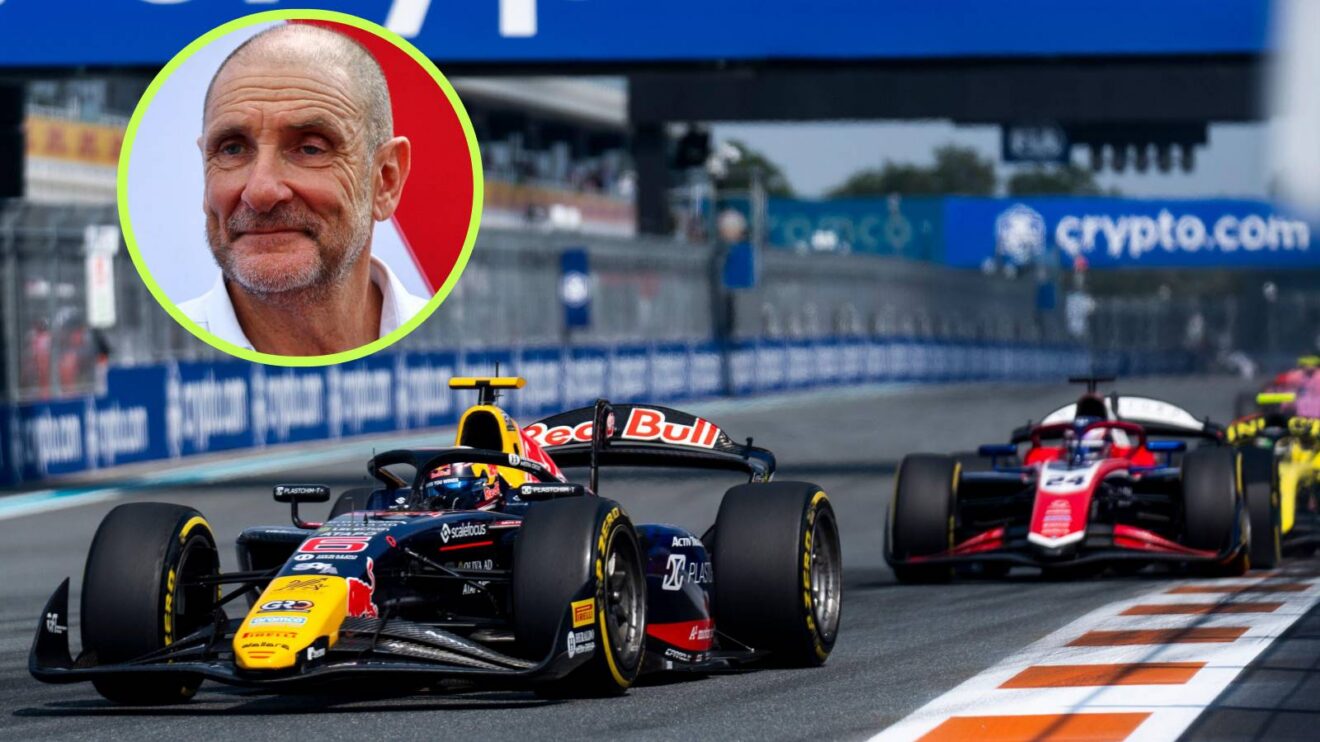
Bruno Michel has ruled out Formula 2 copying F1 by going hybrid.
Formula 1’s regulation sweep for 2026 means that leading junior category, Formula 2, now races with very different machinery – will that change for next year’s overhaul?
Formula 2 is set to roll out with a new car in 2027, having raced with the current generation machine for three seasons after its introduction in 2024.
Formula 2’s 2027 car will adopt styling cues from Formula 1
Want more PlanetF1.com coverage? Add us as a preferred source on Google to your favourites list for news you can trust.
As a spec series, all the cars in Formula 2 are purchased, rather than the teams being constructors in the way they are in Formula 1.
Italian manufacturer Dallara manufactures the current design, created by F2 technical director Pierre-Alain Michot for introduction at the start of 2024.
Now approaching the end of the planned three-year cycle, Formula 2 now represents a very different racing experience from what Formula 1 has recently moved to, with F1’s regulation overhaul for this cycle turning to active aerodynamics and ditching the long-standing DRS overtaking aid.
But F2 continues to utilise the drag reduction system, with the cars themselves looking quite different to the direction F1 has moved in for its latest generation.
Several months out from the reveal of the new F2 car for 2027, series CEO Bruno Michel has confirmed the next car will closely match the aesthetic of the new F1 machines, given the importance of F2 continuing to be an ideal training ground for drivers on the cusp of earning a step up to the peak of single-seater racing.
“We are going to change and to improve the aerodynamics of the car, that’s for sure,” he said in a select media session, including PlanetF1.com, in Miami.
“Actually, what we’re going to do for next year’s car is an update. I don’t want to make a brand new car because I want to try to limit the cost.
“Every time you make a brand new car, the problem is that not only do the teams have to buy the cars, but they also have to constitute a stock of spare parts, and it makes a big difference.
“So what we’re going to do, we’re going to change the aerodynamics of the car to try to give it a familiar look with the F1 car.”
With the DRS being a simple mechanism that offers clear benefits as an overtaking aid, ditching the drag reduction system isn’t guaranteed, and Michel suggested Formula 2 won’t move away from this philosophy on the new car, although exploration of different ideas is underway.
“We have different possibilities,” he said.
“At the moment we are doing it for this season, we have the possibility to continue, or we can have some other systems, like Formula 1 have… that’s something we’re discussing, having some kind of Push-to-Pass, having some kind of different possibilities, but with the same power unit, which means that, if you want to put a Push-to-Pass, but then you need to detune the engine a little bit to make it efficient.
“So there are a lot of questions that we’re asking ourselves at the moment, but we’re not going to make a massive change and go hybrid, for sure.”
More on Formula 2
McLaren hidden gem driver tipped for long-awaited F1 chance
Formula 2 rules out Formula 1-style hybrid engines for 2027 car
While the chassis can be more closely aligned with F1, it’s not possible to do this with the power unit. Formula 2 uses an ‘old-school’ 600-horsepower Mecachrome V634, a 3.4-litre turbocharged V6 designed to last the whole season.
At the start of 2024, F2 beat F1 to the introduction of sustainable fuels as it swapped to the use of a 55 per cent bio-sourced fuel mixture, developed by Aramco, before becoming 100 per cent sustainable through bio-fuel in 2025.
But following in F1’s footsteps of moving to a complex V6 hybrid with electrical energy recovery is not a direction Formula 2 can move in, due to the massive cost increase this would represent for the teams.
Sticking with a simpler engine, therefore, will be the path forward for F2, Michel explained.
“We have absolutely no resources to go in that direction. There’s no doubt about that,” he said.
“So we will continue. There are a few things that will continue to improve. Our strategy in terms of sustainability has always been, and we’ve been the first one to do it with Aramco, to go with sustainable fuel, and we’re working at the moment with 100 per cent sustainable fuel, and we did it before Formula 1.
“We’re going to continue in that direction. We are going to continue the development with Aramco to go with synthetic fuel as soon as we can, which is going to make a massive difference as well.
“But I would say that’s more our strategy than going into a 50/50 engine as they have in Formula 1, because, in terms of Formula 2 costs, it will make absolutely no sense.”
But the inability to follow in F1’s power unit direction does have some drawbacks: as a training ground for the top level of single-seater racing, there is now quite a disparity in approach between the two categories in terms of how to extract laptime and go racing.
With F2 being a straightforward racing category, requiring drivers to hustle for laptime and get past through outbraking rivals, Formula 1’s new regulations have seen drivers having to adjust, fundamentally, their approach to racing.
For optimal laptime, as has been extensively documented through the first months of the new ruleset, drivers are required to ‘drive slower to drive faster’, due to more laptime being generated through optimal energy use around a lap than considerations such as tyre-limited apex speeds.
F1’s power units reward drivers who brake earlier, due to the energy harvesting benefits that pay off down the straights through deployment, although the regulations are being tweaked in order to reduce this unnatural driving dynamic.
Asked by PlanetF1.com whether Formula 2’s relevance in training F1 drivers has been reduced by the changes made at the top level, Michel admitted it’s a “good question, and that’s something we’ve been thinking of.”
“I think we’ve been showing, over the last two seasons, that we were delivering drivers that were immediately ready for Formula 1,” he said.
“With F1 being different now, for sure, they will probably need a little bit more training with the Formula 1 teams than they had in the past. Because, in the past, it’s true, they were arriving, and they were immediately… you look at last year, we put five drivers in Formula 1 and they all did extremely well immediately.
“They will probably need a bit more training. But what you also need to realise now is that most of the drivers coming to Formula 1 are part of team academies, and they have been working on a simulator, and they’ve been working during the race weekends, and they understand how things are working.
“As long as they do not really have the car in their hands, of course, it’s going to make a difference, but those guys are very, very strong drivers.
“Maybe it will take a little bit more time, but a little bit more time for a driver is what? A few laps. When you come to a new track, and the drivers tell you, ‘I don’t know the track’… after five laps, they know the track.
“So I’m exaggerating a little bit when I say that, but I’m not worried, because we are going to deliver the best drivers that can arrive in Formula 1 after that. Yes, they will need some kind of training. Definitely.”
Want to be the first to know exclusive information from the F1 paddock? Join our broadcast channel on WhatsApp to get the scoop on the latest developments from our team of accredited journalists.
You can also subscribe to the PlanetF1 YouTube channel for exclusive features, hear from our paddock journalists with stories from the heart of Formula 1 and much more!
Read Next: Why F1’s agreed 60/40 engine split could still unravel