
Audi turn pitstop weakness into strength after key Red Bull signing


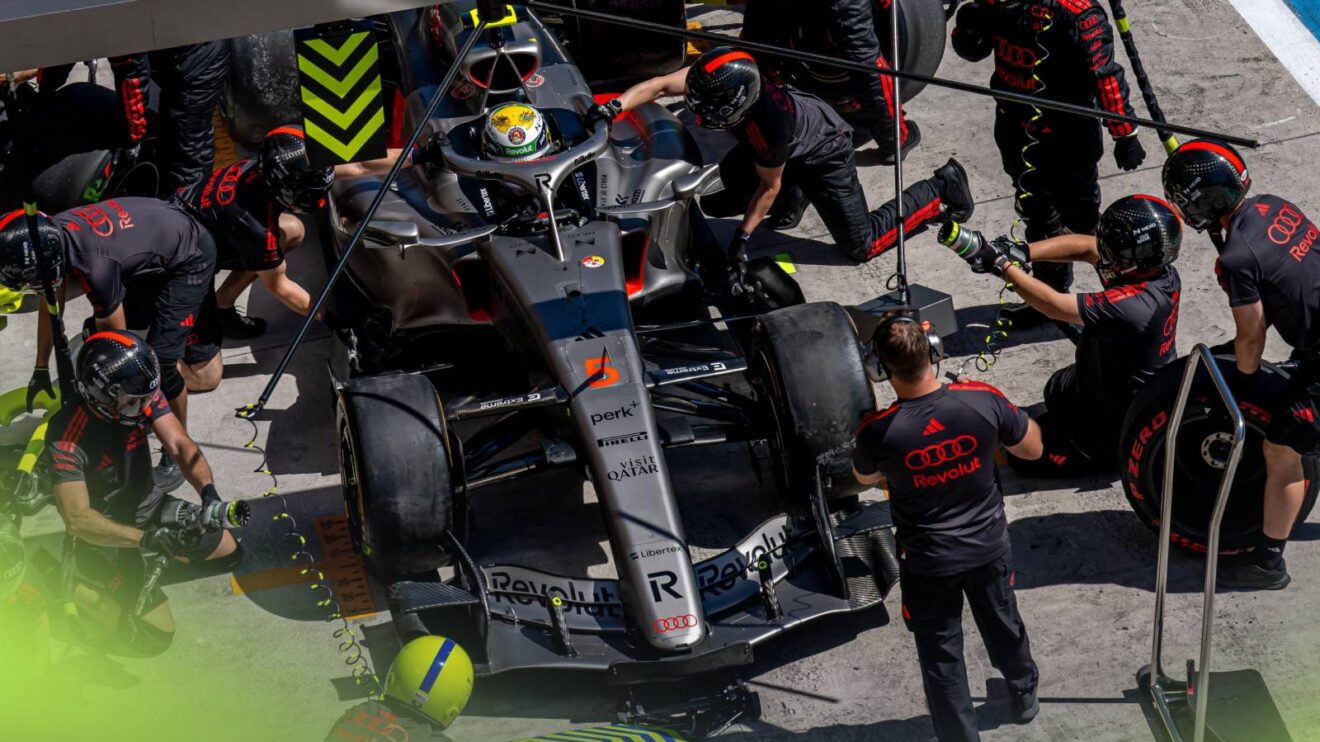
Audi's pitstops have seen it become one of the best performing teams in the pitlane.
A key signing from Red Bull in 2024 has seen Audi build up a key strength in its team, having had a major operational weakness that needed addressing.
Audi, under its Sauber guise, had a horrible time with pitstops in 2024, but has now emerged as one of the consistently quickest crews in the pitlane this year.
Lee Stevenson helps Audi transform its pitstop performance
Through the middle part of this season, Audi has started to feature more regularly in the fastest pitstops tables, and, in recent races, has even started to emerge as a benchmark operation.
At any given Grand Prix, there could be anywhere from 25-50 pitstops during the race, depending on the longevity of the tyres, and ensuring a quick turnaround can make or break a driver’s race.
Being the fastest and most consistent pitcrew can yield significant rewards for a team, such as Red Bull consistently proving itself the quickest with the fastest season averages every year between 2020 and ’24.
In 2025, Ferrari toppled Red Bull to take over as the sport’s fastest crew, and it’s no surprise that, usually, the top teams in terms of car performance also dominate the charts for their pitstops.
Last year, only Mercedes didn’t make it into the usual top four, with Racing Bulls the usurper to keep the Brackley-based squad down in fifth.
This year, Mercedes has improved significantly to lead the season average, ahead of Racing Bulls, although it is Alan Permane’s squad that has the fastest time of the year so far, with a 1.99-second stop for Arvid Lindblad in Hungary.
Red Bull and Ferrari average out in third and fourth place for the season so far, but a big gainer in recent races has been Audi.
This is thanks to some very rapid stops, with the Hinwil-based squad proving fastest of all in Zandvoort as Nico Hulkenberg was turned around in 2.3 seconds on Lap 19 – Gabriel Bortoleto’s stop on Lap 34 was rated 10th-quickest on 2.62 seconds.
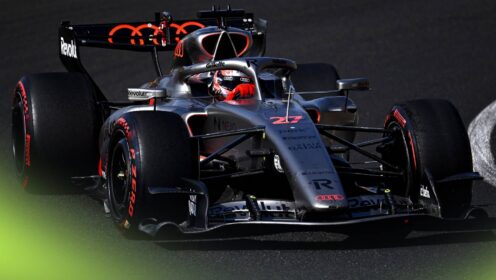
But, at Monza, Audi was untouchable: Hulkenberg’s stop on Lap 27, appropriately enough, saw him stationary for just 2.44 seconds, a full two-tenths of a second quicker than what Red Bull managed with Max Verstappen in the next-quickest stop of the race.
While Mercedes and Red Bull snatched back the pitstop crown in Madrid, Audi was still there as a consideration: Hulkenberg and Bortoleto’s stops were 2.34 and 2.38 seconds, respectively, to finish as third and fourth-fastest stops of the race.
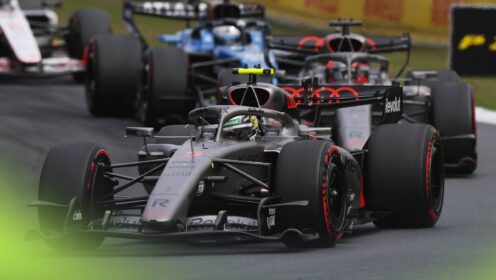
The clear improvement from Audi comes at a time when the German manufacturer is easing its way into Formula 1 competitiveness, during a year in which it has emerged as a genuine midfield contender alongside Racing Bulls and Alpine to vie for best-of-the-rest behind the top four.
The pitstop performances have come a long way from the team’s struggles in 2024, in which the then-Sauber squad started the year unable to keep pace in the pits as a consequence of its materials choices for the wheelnuts, resulting in easy cross-threading.
This led to some disastrous pitstops and, while countermeasures introduced at the Australian Grand Prix improved the situation, Sauber was consistently amongst the slowest teams in the pits that season, although the situation stabilised to average out in seventh place by year end.
A key factor in the improvement is down to the expertise of Lee Stevenson, team manager at Audi, who joined Hinwil in mid-2024 as chief mechanic. He was signed from a 20-year career at Red Bull, in which he had climbed to become Max Verstappen’s chief mechanic, during the Milton Keynes-based squad’s period of pitlane superiority.
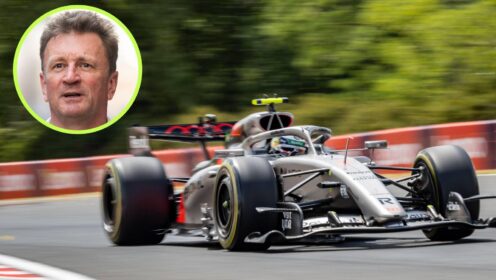
Audi’s racing director, Allan McNish, singled out Stevenson’s leadership when PlanetF1.com asked about the pitstop improvements following the Italian Grand Prix.
“This has been an area that’s been worked on really through the end of last year and the beginning of this year,” the Scot said, when it was pointed out that the team has turned things around considerably from the travails of early 2024.
“It’s a valid point, and in that respect, in terms of the team, Lee, who came to us last year, in the middle of 2024, has a good feel for what we needed to do.
“At the end of the day, the team there is pretty much the same people, and they’re delivering it very, very well and consistently now.”
More than just the speed, it’s about consistency as well, and McNish said it’s clear Audi is now capable of raising its average.
“Because, in Zandvoort, it was the quickest as well, and also, the other thing from my point of view, it’s not just necessarily one stop, but when we have multiple stops, all the stops are good, and so the team there is working very well, and that’s important for us as well because we’ve got to take every advantage out of the race that we can,” he said.
“It’s not as if there’s much of a delta in this midfield, and so they’ve definitely delivered the opportunity for the drivers to take more out of the race than what they had going into the pit stop.”
Latest F1 2026 talking points on PlanetF1.com
When can Kimi Antonelli win the F1 2026 World Championship?
Russell’s Mercedes future was settled long before Verstappen’s Red Bull decision
Asked whether Audi has therefore inherited a key strength of Red Bull in successfully coaxing Stevenson away to lead its garage operations, McNish smiled.
“I wouldn’t say we’ve inherited; I think we have developed it!” he said.
“But no, at the end of the day, that was one of the reasons that Lee came on board: to build the team within the garage, and I think he and the wider side that’s in there have done a very good job.
“You just see them now, the way that they conduct, not just the pit stops, but also all of the work on the cars. It’s very good to see.”
With Audi having concentrated significantly on operational factors to boost its results with a solid, if distinctly midfield, car, McNish addressed the tangibilities of what that means in response to a question from PlanetF1.com.
“It’s a little bit of everything, to be honest with you,” he said.
“It’s making sure that you are prepared for the eventualities that come up. There’s also a little bit of a point where, and this is the same for a driver, the same for a team or anybody, when you break the duck, when you get the first points, then there’s an element of confidence in the delivery, and we saw that with the mechanics and the pit stops.
“So I think it’s an element of confidence of everybody being able to execute it, and we know that we’re going in the right direction.
“But fundamentally, people are starting to work together as well, because there are new people in the team, myself included, and so, from that perspective, I wouldn’t say it’s one thing.
“I think it’s a lot of things, but it’s also the knowledge of what we’ve got and how to get the best out of it, including drivers, including engineers, including strategy, tyres, and you build up an element of understanding.
“But also, we’re quite fresh, and there’s a big part of the whole team, being power unit, that is completely fresh, without previous experience, and so there’s an element there as well.”
Want to be the first to know exclusive information from the F1 paddock? Join our broadcast channel on WhatsApp to get the scoop on the latest developments from our team of accredited journalists.
You can also subscribe to the PlanetF1 YouTube channel for exclusive features, hear from our paddock journalists with stories from the heart of Formula 1 and much more!
Read Next: Ferrari make 2027 development stance clear with ’80 per cent’ carry-over