

Ferrari half-season review: F1 title challenge has shifted


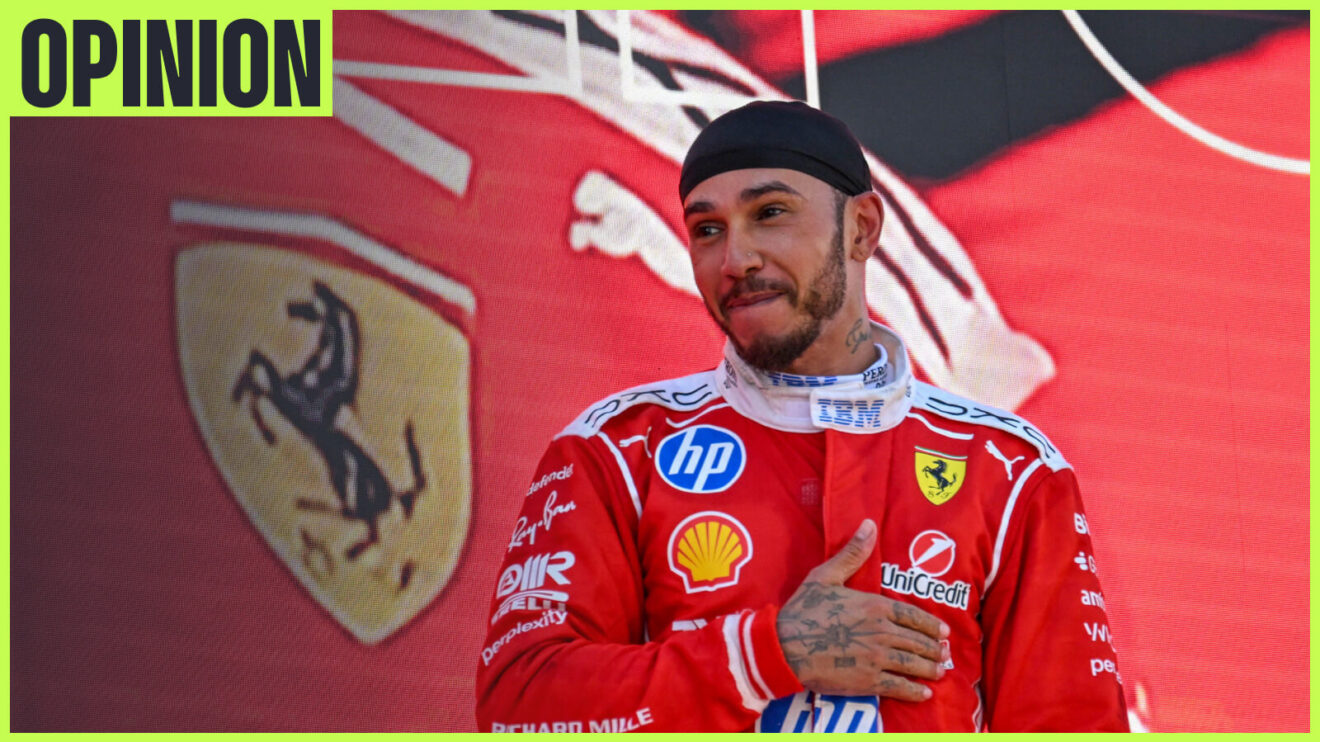
An 8/10th for Ferrari's first half
Ferrari’s rapid starts and increasingly competitive chassis have not been enough to consistently overcome Mercedes in the first half of the 2026 season.
But better reliability has kept Ferrari in the hunt, with the team 72 points behind Mercedes in the Constructors’ Championship, while Lewis Hamilton trails Kimi Antonelli by 50 points in the Drivers’ standings.
Ferrari’s F1 title challenge now depends on execution
Want more PlanetF1.com coverage? Add us as a preferred source on Google to your favourites list for news you can trust.
Unlike last year’s fantastical proclamations that Ferrari was half a second faster and talk of a championship fight, made largely by the Italian media who had ‘heard’ it from someone, this year’s predictions were somewhat cautious.
Instead, it was Mercedes which was officially placed in the number one spot, with its incredibly well-balanced chassis and dominant power unit (no matter what the ADUO process might say).
That took the pressure off Ferrari such that, even when Charles Leclerc set the outright fastest lap of the entire Bahrain test in the final hour, all eyes were still on Mercedes.
But Ferrari, it was noted, had one huge advantage – a smaller turbo in its power unit.
By removing the MGU-H from the new power unit formula, Formula 1 removed a key tool that the turbocharged engines needed for launches. But by building an engine with a smaller turbo, Ferrari’s power unit could get into the start configuration earlier than rival power unit manufacturers.
Then the FIA negated that by introducing a blue light system that let the drivers know the start was five seconds away.
Despite that, Ferrari still managed to shoot into the lead in three of the opening five Grands Prix. Alas, the chassis and power unit was no match for Mercedes’ W17, and they were overtaken time and again. It made for a thrilling (if somewhat artificial) back-and-forth opening stint in the Grands Prix.
The story began to shift in Barcelona where Ferrari introduced a substantial upgrade that featured a total of eight parts, including a new front wing design and significant changes to the floor, as well as diffuser and sidepod revisions. It was the team’s second big upgrade on the back of its Miami revisions, with rivals suggesting Ferrari now had the highest-performing chassis on the grid.
Although Mercedes started the Barcelona Grand Prix on pole position and led ahead of Hamilton, an inspired three-stop strategy from Ferrari, in which Hamilton was always the first of the frontrunners to pit, meant he was leading when the VSC came out for Fernando Alonso’s stricken Aston Martin. He would go on to build up a lead over 20 seconds to secure his first Grand Prix win as a Ferrari driver.
Charles Leclerc added his name to the winners’ board at the British Grand Prix, as he also converted a front row grid spot into a race win. Again, Ferrari stopped earlier than its Mercedes rivals and later took advantage of a late Safety Car with Leclerc up in P1 as the race finished behind the Safety Car.
But in true Ferrari fashion; what Ferrari giveth, Ferrari taketh away.
Ferrari gifted Mercedes a dominant one-two at the season-opening Australian Grand Prix where the Scuderia opted not to pit behind a VSC early in the race. Mercedes reacted instantly, double stacking its drivers, while Hamilton and Leclerc stayed out. It meant that even though Ferrari ran 1-2, they had no answer to Mercedes’ pace and once Russell and Antonelli had broken free of overtaking mode, it was game over.
Ironically, the team’s decision later in the season to pit Hamilton behind the VSC at Silverstone cost Ferrari its first 1-2 of the campaign.
Team principal Fred Vasseur conceded: “Where we have to improve is that, if I draw a conclusion based on [Hungary], I would say execution, but execution so far was probably a good one for us from the beginning of the season.”
It has, by all accounts, been an interesting first half of the season for the Italian stable, especially as momentum has recently shifted away from Mercedes, but by no means entirely towards Ferrari.
The team has thrown everything and the kitchen sink into improving its SF-26, bringing more new parts to the track than any other team. That, though, begs the question; can Ferrari continue with its development pace?
Toto Wolff says no. However, Vasseur is adamant the team will continue with the upgrade plan and will also improve its power unit along the way.
“We know that we have to improve on the engine side. We will do it, even if the inertia on the engine is much higher than the chassis,” declared the Frenchman. “The most important thing would be to be able to keep the pace into the development.”
With 316 points still in play in the Drivers’ standings and 546 points available in the Constructors’ Championship, Ferrari is by no means out of either title fight.
But it’s not yet time to dream. Execution and engine are still wanting.
Ferrari’s rating: 8/10
Want to be the first to know exclusive information from the F1 paddock? Join our broadcast channel on WhatsApp to get the scoop on the latest developments from our team of accredited journalists.
You can also subscribe to the PlanetF1 YouTube channel for exclusive features, hear from our paddock journalists with stories from the heart of Formula 1 and much more!
Read Next: Best team radio of 2026: Verstappen ‘morons’ rant, Wolff stages intervention, Stroll duty