

Andrea Stella insists F1 2026 remains the ultimate driver challenge
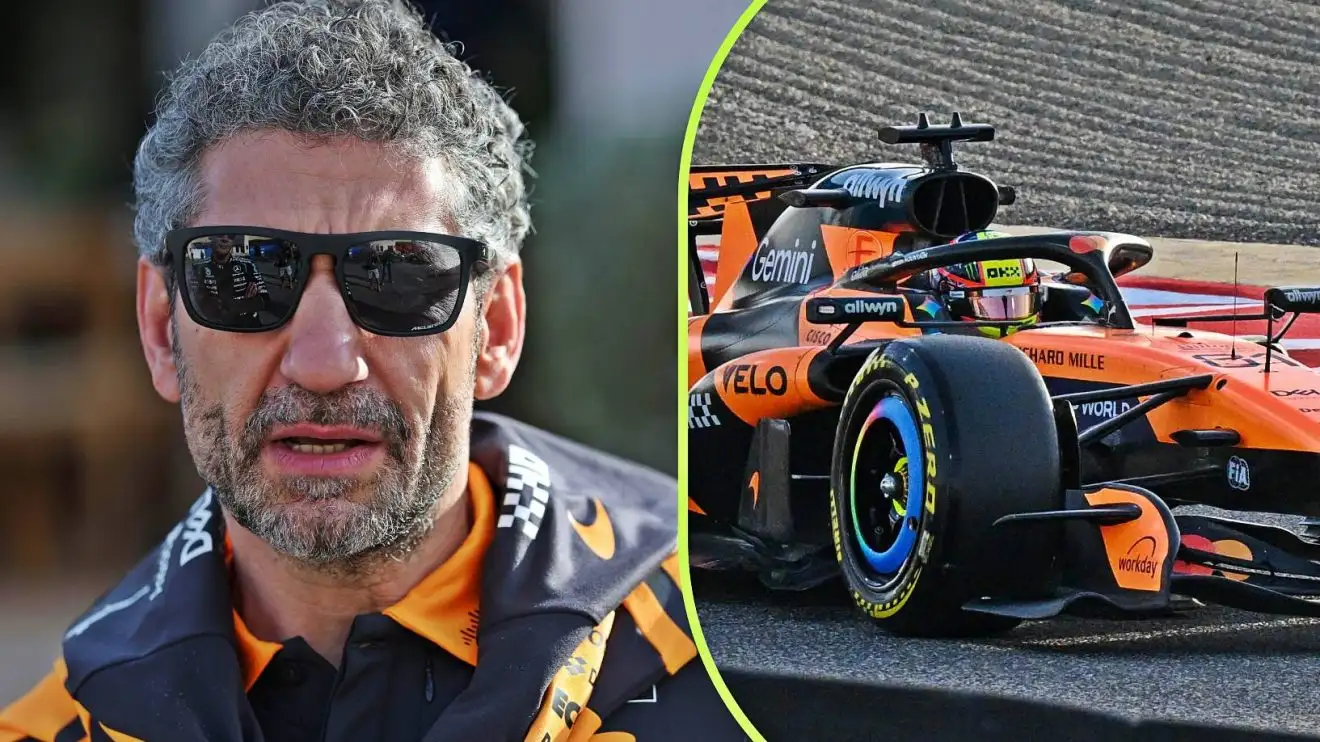
Andrea Stella insists F1 remains the ultimate driver challenge, despite the changes in driving dynamics introduced by the new regulations.
Andrea Stella believes F1 remains the “ultimate challenge” for drivers, despite the requirements for unusual techniques to unlock ultimate laptime.
The revised power units introduced for F1 2026 have seen drivers having to learn new and unusual techniques for maximising energy harvesting and deployment.
Andrea Stella: Drivers are ‘more involved’ in F1 2026 cars
Want more PlanetF1.com coverage? Add us as a preferred source on Google for news you can trust.
In order to maximise lap time with the quickest way around a circuit, the drivers have to compromise on attacking every straight and corner with maximum speed, even on qualifying laps.
This is due to the need to harvest energy, which is achieved with techniques such as lift-and-coast, downshifting down the straights, and braking, all contributing to conserving energy to allow for more efficient deployment.
It’s led to some consternation from the drivers, with Max Verstappen and Lewis Hamilton expressing sentiment that energy conservation is not in the spirit of racing, as they are no longer quite on the ragged edge of physics through every corner.
Bahrain testing proved the cars themselves are only a few seconds off the pace of last year’s, with Charles Leclerc’s best time – tyre delta adjusted – being just over three seconds off the best time set by Carlos Sainz last year.
But any concerns that F1 is no longer the ultimate challenge for drivers have been assuaged, with McLaren‘s Andrea Stella pointing to how the reduced sure-footedness of the cars is challenging them more than the ground-effect stability of recent years.
“I think what we have seen here in Bahrain definitely confirms that it is the ultimate challenge,” Stella told media, including PlanetF1.com, at the end of Bahrain testing.
“Probably this is because Bahrain is a harvest-rich circuit, so you drive in a very normal way.
“I have to say, with these regulations, the cars slide quite a lot more, and the role of the driver, if anything, is even more involved in extracting the most out of the car.”
But, with other circuits not being quite so straightforward in terms of energy harvesting, Stella said the drivers will have to get used to using techniques that feel the antithesis of what’s usually expected of them.
“Barcelona was a slightly different situation because, being a relatively harvest-poor circuit, there were some special manoeuvres that needed to be made,” he said.
“Like not being flat out at high speed in order to balance the level of harvesting and produce the fastest lap time, which, not necessarily in Barcelona, meant that you could be at the fastest speed in high speed.
“We will have to see a few more circuits. I think, from this point of view, these two circuits do not necessarily give the full picture.
“Definitely, there could still be cases in which the driver needs to approach driving in a way that is not the common way of driving a ca,r which is just drive as flat as possible, brake as late as possible, and go as fast as possible on every corner.
“But, like I say, we will have to monitor the situation a bit.”
One idea that is being looked at is a change in energy deployment known as ‘super-clipping’.
This is where a car switches back into an energy harvesting mode while the driver is still at full throttle, and is achieved by engine mapping changing the ratios of power output between the internal combustion engine and the electrical system.
The battery can recharge from the ICE, but this technique is currently capped at 250kW. McLaren experimented with increasing that limit to 350kW during the final day of testing, with the F1 Commission discussing the idea for a potential limit change once more data has been gathered during the first few races.
“I think, when it comes to improving the balance between the regulations, in a way, in the current format and some other driving challenges, there is time to fix this,” Stella said.
“There is a way of changing the way in which we deploy the electrical engine, such that this requirement to do these special manoeuvres is reduced.
“So there are things that can be done in the future, but I think we should monitor a little bit more in some of the circuits.”
More on the F1 2026 regulations
F1 2026 explained: why ‘super clipping’ could reshape racing
Explained: How F1’s new ‘overtaking mode’ will work in 2026
McLaren’s Oscar Piastri believes there is still plenty of scope for learning as a driver, due to the very different techniques needed to best exploit the machinery for performance, and that the extent of the driving requirement will vary from circuit to circuit.
“From the simulator running I’ve done, [Melbourne] is very different,” he said.
“I think, at certain tracks, we’re going to be much more harvest limited than we are [in Bahrain], depending on where you set your optimality, you don’t have to do much super-clip or much lift-and-coast, whereas, in Melbourne, I think if you didn’t want to do any, you’d be running out of energy very, very quickly.
“It just depends on the layout of the circuit. Jeddah is another one, you know, places where you have a few straights linked together by fast corners, where it’s very difficult to harvest, that’s where the most kinds of abnormality are going to come.
“So, yeah, there’s going to be some big differences. But, in saying that again, you can change things around a lot.
“At the moment, it’s kind of all set before you get in the car. We can change on the fly, but it’s a bit different because you’re not just managing on the throttle.
“Melbourne is going to look quite different, I think, and will be a challenge for us all, I’m sure.”
Want to be the first to know exclusive information from the F1 paddock? Join our broadcast channel on WhatsApp to get the scoop on the latest developments from our team of accredited journalists.
You can also subscribe to the PlanetF1 YouTube channel for exclusive features, hear from our paddock journalists with stories from the heart of Formula 1 and much more!
Read Next: Kimi Antonelli warns Mercedes battery faces ‘shock’ in Melbourne


