

Ferrari working on Mercedes-style trick with F1 2027 engine – report
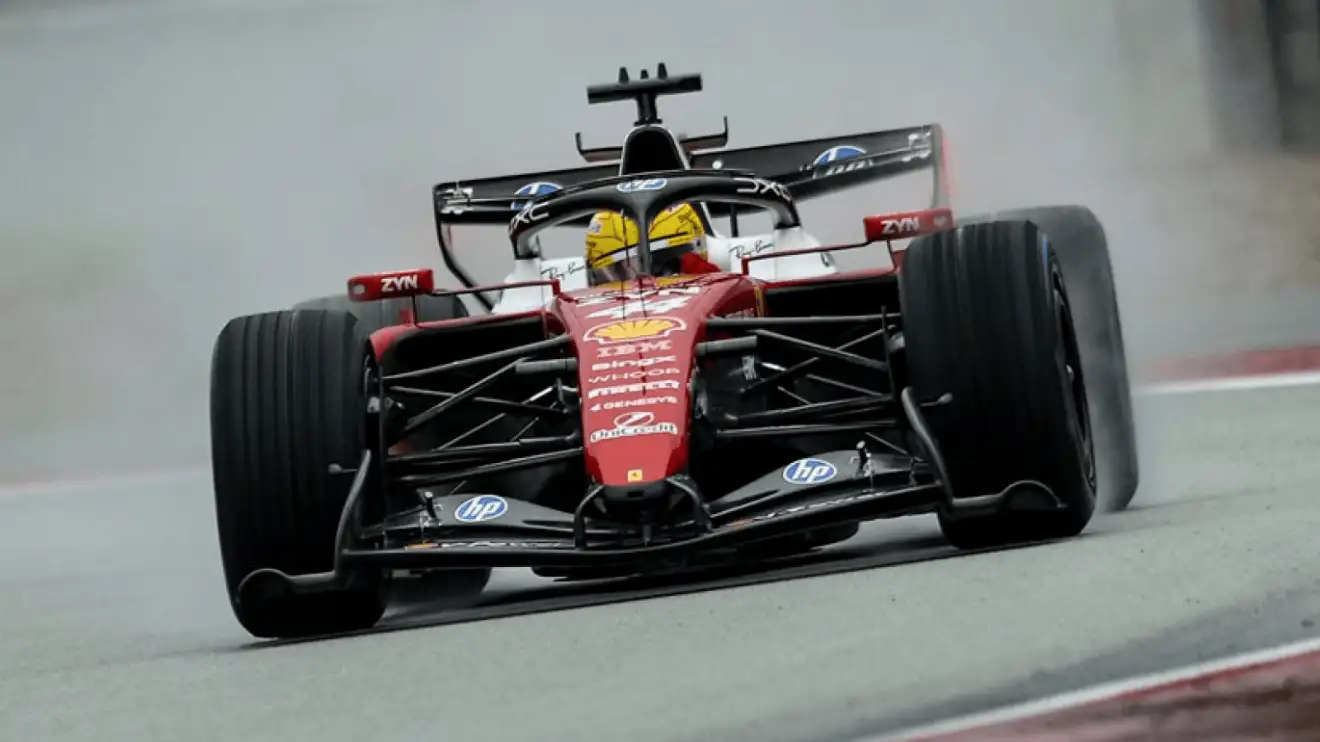
Image: Scuderia Ferrari HP (X)
Ferrari is planning to include a Mercedes-style compression ratio trick in the design of its new engine for the F1 2027 season, it has been claimed.
It comes after it emerged last week that Mercedes’ rivals are pushing for a change to how compression ratios are measured ahead of the Australian Grand Prix next month.
Rumour: Ferrari to follow Mercedes’ lead with F1 2027 engine trick
Want more PlanetF1.com coverage? Add us as a preferred source on Google to your favourites list for news you can trust
Persistent reports over the winter have claimed that two engine manufacturers – widely named as Mercedes and Red Bull Powertrains – have identified a gap in the new engine regulations related to compression ratio.
F1’s rules state that the compression ratio can be no higher than 16.0 under the new regulations for 2026, a drop from 18.0 under the previous rules.
With compression ratios only measured when the engine is not running at peak temperature, however, it is said that the manufacturers at the centre of the claims have found a way to increase the compression ratio to 18.0 when out on track.
This could bring a significant advantage – potentially worth as much as 0.3s per lap – in F1 2026 by increasing engine performance and fuel efficiency.
Lewis Hamilton and Charles Leclerc to race for Ferrari in F1 2026 season
F1 driver contracts: What is the contract status of every driver on the F1 2026 grid?
Think Lewis Hamilton regrets his move to Ferrari? Just wait until 2026
With rival manufacturers voicing concerns over the exploitation of the loophole, the FIA has held several meetings with “technical experts” over recent weeks with the Power Unit Advisory Committee (PUAC) also meeting last Thursday.
It emerged on Friday that Mercedes’ rivals are pushing for a change to the way compression ratios are measured in time for the opening race of the new season in Australia on March 8.
This could be achieved by either using sensors when the cars are out on track or taking measurements in the garage when the engines reach operating temperature.
Despite the unhappiness of rival manufacturers with the situation, it has been rumoured that Ferrari is planning to incorporate the compression ratio trick into its engine design for 2027.
A report by Italian journalist Leo Turrini has claimed that Enrico Gualtieri, Ferrari’s power unit technical director, has already started work on the team’s 2027 engine.
This work reportedly involves ‘some substantial modifications aimed precisely at creating a dynamic compression ratio’ in the style of that used by Mercedes.
The plan is rumoured to have been approved by the heads of Ferrari’s engine department with the team operating under the expectation that the Mercedes solution will ultimately be declared legal ‘in all respects’ by the FIA.
It is said that Gualtieri and his team are aiming to achieve a similar result to Mercedes by producing a new connecting rod ‘with a sufficiently high thermal expansion coefficient to ensure that it can lengthen and thus reverse the loss of compression due to thermal expansion.’
Turrini adds that the 2027-spec engine will not be tested on the dyno before this summer due to what he describes as ‘production timing issues.’
Speaking to PlanetF1.com and other media outlets following the launch of Ferrari’s 2026 car on January 23, Gualtieri expressed his confidence that the FIA will address the loophole saga “in the proper way.”
He said: “We are approaching the topic together with the FIA. We are still discussing with them.
“We had a meeting, a technical meeting, a technical workshop yesterday, actually, and we are going to have additional one in the next days, up to the PUAC meeting.
“So we are approaching the topic together with them.
“We are certainly trusting them for managing the topic in the proper way, going through the procedures and the governance that is in place by regulation, and we completely trust that the process could come to an end in the next days and weeks.”
Ferrari’s current engine is also believed to be innovative in its own right following rumours over the winter that the team has opted for steel cylinder heads for 2026.
Despite being heavier than the previous aluminium version, the steel cylinder heads are thought to be producing more efficient combustion with reports of unprecedented temperatures and pressures during the ignition process.
Ferrari reportedly committed to the steel cylinder heads for 2026 after working hard on improving the reliability of the new version over the winter break.
The Scuderia completed the second-highest number of laps at last month’s shakedown test in Barcelona with 442 on the board, 58 fewer than Mercedes.
The Ferrari power unit – also used by the Haas and Cadillac teams – was also second on the engine lap count in Barcelona with 992 laps completed compared to Mercedes’ 1,136.
It was claimed last week that Red Bull’s stance could prove key to the hopes of a change to the way compression ratios are measured before the Australian Grand Prix.
Although Red Bull Powertrains is believed to have exploited the same loophole as Mercedes, it has been speculated that the Milton Keynes outfit has not enjoyed the same results.
As such, it could suit RBPT to join those pushing for a rule change to shut down the loophole.
According to the governance procedures of the PUAC, a significant and immediate change to the power unit rules requires the backing of four of the five engine manufacturers, along with the FIA and FOM.
If its rival manufacturers – Red Bull, Ferrari, Audi and Honda – are aligned on the issue, Mercedes could be left relying on the FIA and FOM to prevent a change to the rules.
Toto Wolff, the Mercedes team boss, confirmed last week that the Silver Arrows had “very positive” dialogue with the FIA throughout the development of its 2026 engine.
Wolff also accused rival manufacturers of looking for excuses before the start of the new season and called for them to “get your s**t together.”
It is common for teams and manufacturers to consult the FIA during the development of a new technical innovation.
Mercedes memorably took this approach with the famous Dual Axis Steering (DAS) system – allowing the drivers to adjust the alignment of the front wheels on track by pushing or pulling the steering wheel – in 2020.
DAS, which helped the drivers manage tyre temperature and improved straight-line speed by reducing drag, was eventually banned for the following season.
Additional reporting by Mat Coch
Want to be the first to know exclusive information from the F1 paddock? Join our broadcast channel on WhatsApp to get the scoop on the latest developments from our team of accredited journalists.
You can also subscribe to the PlanetF1 YouTube channel for exclusive features, hear from our paddock journalists with stories from the heart of Formula 1 and much more!
Read next: Aston Martin AMR26: What we’re hearing about Adrian Newey’s first Aston Martin


