

From laboratory to track: How Ferrari combines chemistry and engineering
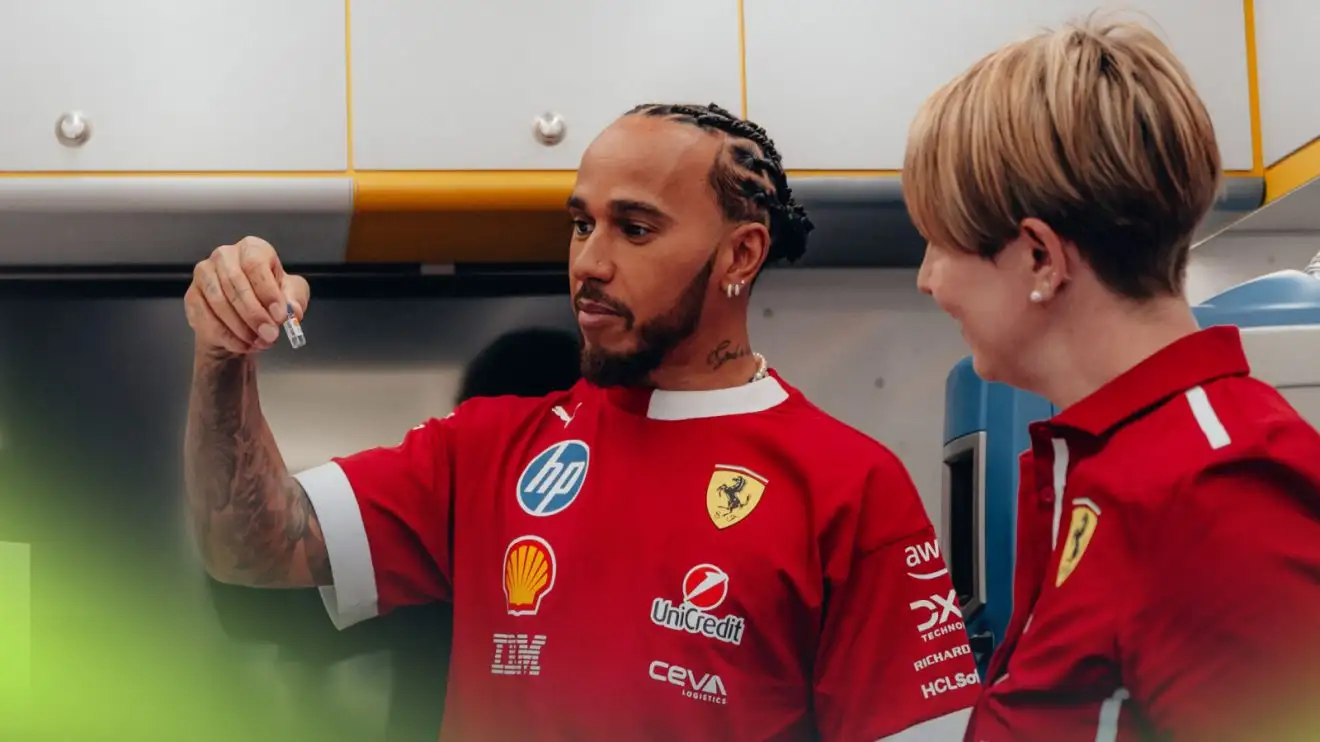
Lewis Hamilton inside Shell's trackside laboratory.
Hidden away inside Ferrari’s garage is a small, well-equipped laboratory designed to support the team’s on-track activity, staffed with chemists from Shell who are tasked with overseeing critical elements of the car each and every weekend.
Located within the Ferrari garage, Shell’s travelling trackside laboratory houses a mobile chemistry suite packed with high-precision instruments, humming software, and, on any given day, a pair of analysts testing hundreds of fuel and lubricant samples.
Inside Shell’s trackside laboratory
To step inside the lab, as I did at the Circuit of The Americas, is to walk into a world where chemistry, engineering, and adrenaline collide.
“This laboratory goes around the world,” explained Shell trackside analyst Lauren Singer, who has spent her three Shell traveling with Scuderia Ferrari HP. “The lab itself doesn’t change, but the minute you step outside these doors, everything is different. The cities, the countries you go to, are so different.”
For Singer, landing here was as much destiny as it was design. She grew up with a love of chemistry, eventually specializing in energy-related chemical research at university.
“As a child and then moving into studying, I always liked to understand the reasons why,” she said. “Chemistry answers those questions, or it leads you to the right place. So when someone says to you, ‘why is the sky blue?’, it’s chemistry that can tell you the answer — or it can lead you to physics or mathematics.”
And that same about why things are the way they are is easily satisfied in the dynamic world of Formula 1.
“In motorsport and especially in this role, you naturally have an element of problem solving, right? And in this role it’s about finding why has the problem happened and then what is the solution we can find here on track,” Singer explained. And all of it is taking place “in this kind of high-pressure environment.”
For trackside analysts like Singer, the job begins early in the week. During a race weekend, she’ll arrive on site on Tuesday, then begin setting up the lab in the Ferrari garage. The container itself travels separately, and the analysts themselves bring the ultra-sensitive testing equipment to flesh out that empty box into a full-fledged laboratory that will become a hotbed of action almost immediately.
Before Ferrari ever fires up a power unit, Shell is already testing. Fuel drums shipped months in advance, from Hamburg to race circuits like Singapore or Austin, are sampled, catalogued, and compared to their original chemical fingerprints.
“We test the fuel every time it changes location,” Singer explained, gesturing toward two tiny vials feeding into a chrome instrument that separates hydrocarbons with surgical precision. “The idea behind these machines is [that] they take a small amount of the fuel, they evaporate it, and they basically separate individual components. So it then tells you we have X amount of component one, Y amount of component two.
“It’s a little bit like the fingerprint on your hand, and what we’re looking for is that we have that overlap with the fuel which came from Hamburg. That’s really important, because the fuel which left Germany is compliant with the FIA regulations.” Once that fuel arrives at the track, it’s critical to ensure that it hasn’t been contaminated, and that it still complies with regulations.
But that’s not the only time those samples will enter the machine, Singer explained.
“We test the fuel samples every time it changes location. We do it in Hamburg, we do it here in Austin in the storage container and the drums. Then we do it when they go into the machines, and then we do them from the cars. At every single point the fuel is moving, we take samples just to check again that there’s nothing put in there — for example, a little bit of grease or a bit of dirt that’s in the hose.”
In the rare event that there has been some contamination, Shell’s rigorous testing means its analysts know exactly where the contaminant was introduced, allowing it — or one of the teams it oversees — to make the necessary changes.
But while fuel is monitored for legal compliance, lubricant testing is the true heart of the lab’s work. After every on-track session, Ferrari sends over fresh engine-oil samples so Shell can determine what’s happening inside sealed components the team isn’t allowed to open.
Singer pulled out two vials from her “magic drawer,” one a golden fresh sample, the other darkened after just 100 kilometres.
More on the huge upcoming changes in F1 2026
F1 2026 tech analysed: The future of overtaking and biggest car advantage identified
F1 2025 vs F1 2026: Nine key questions ahead of massive regulation changes
“We do about 150 of these tests each weekend,” she said. “We do a few different tests on the engine oil, but the main one is detecting metal content, so we’re really looking at what’s inside the oil which was not there before.”
Shell is able to detect the amount and kind of metal inside the samples with one rapid, two-minute test. It will then cross-reference its results from that oil sample with a massive database of every oil sample it’s taken over the past few years. If something is amiss, it will be able to point to the problem in question and provide that data to Ferrari.
To the engineers, this is closer to medicine than mechanics. “[The oil] is almost like a blood sample for the car,” she added. “Once the car is sealed, you can’t open it up to check if a small gear is working or not. But what you can do is check if there’s maybe the metal that the gear is made from inside the engine oil when it shouldn’t be. We refer to it as an early warning detection system.”
That early-warning capability becomes even more critical under time pressure. During a sprint weekend like Austin, for example, Ferrari might have less than an hour between sessions to decide whether to continue running a power unit or make a change.
“Our tests take two minutes,” Singer said. “We can get that data to Ferrari really quickly so their telemetry and our chemistry work together.”
The job, however, is far from sterile lab work. When the fate of not just Ferrari but every race team utilising Ferrari power unit rests in your hands, you have to be ready to think on your feet.
“You have to be positive. You have to love people. I think generally you have to be very resilient,” Singer said. “You have a lot of challenges thrown at you, and finding a solution, which maybe is not perfect but fits the bill. It gives you time to find out either a better solution or really come down to the crux of the problem.”
And for the analysts, they’re thinking of these challenges in blocks of weeks: weeks away and weeks at home, as Singer explained. It took some adjusting to get used to the daily frenetic pace of a race weekend, followed by the quieter weeks spent at home — both for Singer and for her friends and family, who have had to learn that her chaotic schedule doesn’t always allow them to easily find time together.
It’s not just the travel schedule, either. There are also logistical oddities to contend with, like Monaco, where the lab doesn’t fit inside the paddock.
“We’re situated two kilometers away along the harbor,” she laughed. It’s easy to imagine technicians sprinting back and forth with samples.
“Last year we did 30,000 steps a day.”
Despite the chaos, the sense of purpose is palpable. Shell’s work doesn’t just keep Ferrari compliant; it contributes to future fuels and lubricants, both for racing and road cars. The data from this tiny container reverberates far beyond the pit lane.
And for Singer, that connection — to science, to the team, to the legacy — is everything.
“It feels a little bit cringey to say,” she admitted, “but it really is an honour. I do actually feel a little bit to be part of this team and part of this partnership, especially as someone who loves chemistry. I was a fan of Scuderia Ferrari HP before I joined this team.” It’s special.
Her favourite moments aren’t solitary triumphs but shared ones. “In this team we spend so much time together — weeks and weeks and weeks. Sometimes I think I see some of the guys more than my family.
“Real highlights for me are when we have a good result; the joy and happiness of the team, the atmosphere and the buzz is one of the best experiences. Key core memories I think I’ll never forget.
Even on tough weekends, she reminds herself: “People say to me, ‘Lauren, you have a dream job.’ And for me, I come back to that. That’s my baseline. You take the rough with the smooth.”
Inside a paddock where every millisecond counts, you’re just as likely to find excellence on the track as you are to find it tucked into the back of a garage, inside a foyer-sized container full of vials, whirring machines, and a chemist chasing answers at 200 miles per hour.
Read next: Gallery: Formula 1 unveils all-new renders of F1 2026 machinery