

Is Barcelona testing blackout doing F1’s engineering excellence a disservice?
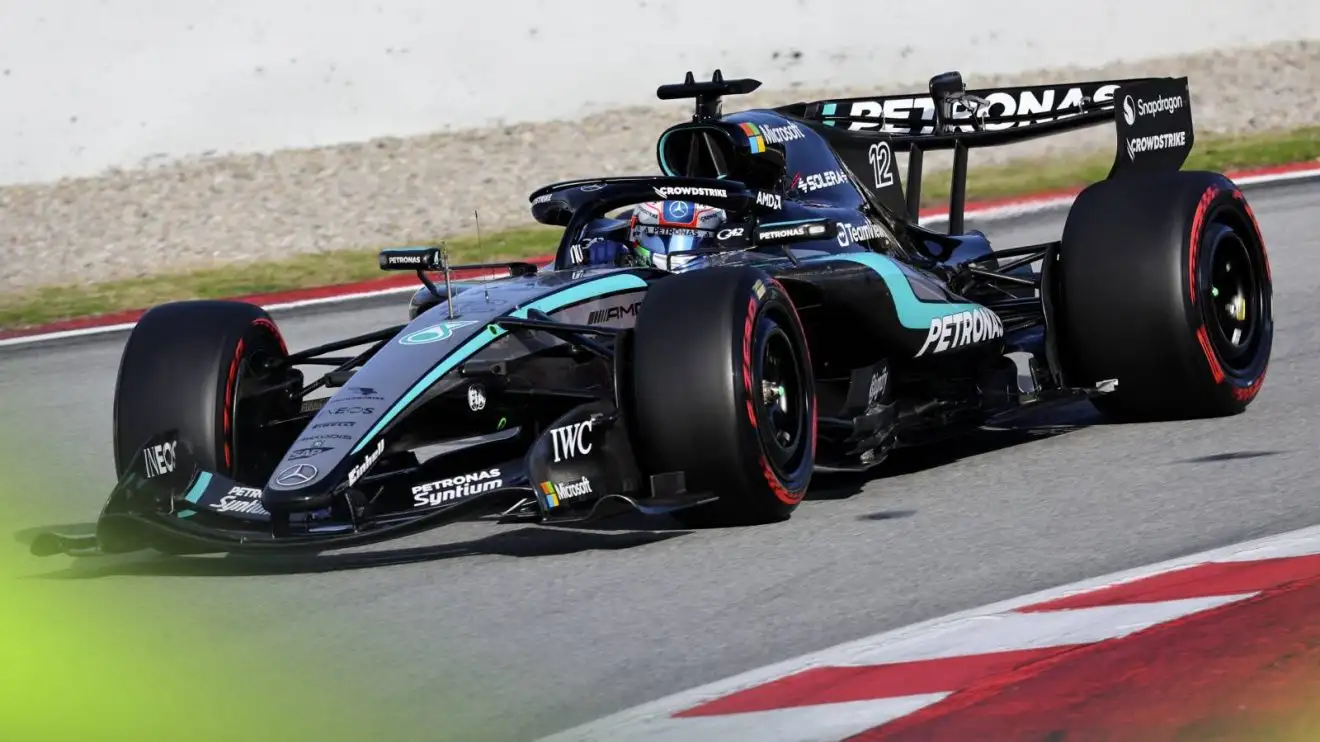
Has F1's engineering excellence been done a disservice by holding the first test behind closed doors?
With the first days of F1 testing proving remarkably nondescript, was there really a need for such intense secrecy about the Barcelona test?
Barcelona’s hosting of the first F1 ‘shakedown’ of the new era has been a hush-hush affair so far, but has an opportunity to show confidence in the new regulations been missed by maintaining such intense secrecy?
F1 teams entitled to privacy and secrecy, if desired…
After years of building up to the new regulation cycle, most of the new cars have taken to the track for the first time. But, aside from mostly carefully curated shots released by the teams and F1’s own social media channels, it’s been quite a subdued start to the new era.
The shortened off-season has put teams under tremendous pressure to get their cars on track before January ended, reducing the time they have to ready their new machinery ready. And while one or two teams have fallen short of making the first test (Aston Martin being uncertain at the time of writing), the five-day Barcelona test has started in unexpectedly routine fashion.
Against the backdrop of such far-reaching regulation changes for this year, the regulations included provisions to allow for extra testing beyond the usual three-day outing that has become de rigeur in recent years. Largely, that is on account of a vastly different power unit that boosts electrical output to a 50/50 split with the internal combustion engine.
In a move pushed for by the teams, this extra testing programme included a private collective test open to all, which is the event that is taking place in Barcelona this week.
The private test was initially set to be even more sealed off than it has turned out to be, with no photos or video, even curated, featuring in the original plans. But, realising that the task of fully securing the entirety of the perimeter of the circuit confines, as well as the airspace, might prove extremely difficult to the point of impossible, compromises between the teams and FOM were reached. Each team can issue up to six images per day of the car, with up to another six pictures of other aspects such as team personnel and the garage, as well as up to three-minute social media videos.
As those of you who have been following PlanetF1.com’s live coverage throughout the first two days of testing have probably realised, the information coming out of the circuit has been extremely limited. Not only was a wayward live timing server quickly spotted and shut down by the powers-that-be, but any fans or media attempting to loiter near enough to the circuit to take pictures or glean any information were quickly moved on by patrolling security forces.
It is a fully privately-operated test at a circuit hired out by the participating teams, outside of the framework of the usual competitive environment and entirely catered for by the provisions of the 2026 regulations, due to the unique situation of the entirely new technical regulations.
Given that this is not an FIA or FOM-operated test, with the two authorities on the ground merely to lend ground support and test out their own systems ahead of the season, there can be no expectation of either to release any information about the events of what is essentially a series of track days, booked out by particularly high-end clients.
Like any privately operated test, such as a Testing of Previous Cars (TPC) outing, there is simply no requirement for the teams to provide any information and, indeed, the fact that any imagery or information is released at all is more than what was originally planned.
But, while entitled to privacy and this being a provision of the regulations, has it been the right path to take?
More on F1 Testing
McLaren outlines Barcelona testing plans after sitting out first two days
What are those flashing mirror lights on F1 2026 cars? FIA explains
Have the teams missed a chance to boast about engineering excellence?
There is a reason for such guardedness. In 2014, the last engine regulation change, the first test with the 1.6-litre V6 engines proved a litany of breakdowns and red flags as the teams moved from straightforward naturally-aspirated V8s to the complicated new hybrids.
It took until the fourth day of the test for any driver to make it into triple-digit laps, with a huge disparity in lap time across the field remaining in place throughout the test.
The uncertainty over the new regulations and how the simulated performance levels of the cars, as well as the driving dynamics, translate to the real world has resulted in caution. In turn, that has lead to a desire for a closed-door test and a relatively peaceful five-day event in which the teams don’t have to worry about dramatic headlines or unnecessary pressure at a time when they are focused on just making sure these cars work correctly.
After all, F1 is in a very different place in 2026 than it was even as recently as 2014. While immensely popular, the sport had yet to hit the mainstream boom that it’s enjoyed ever since Drive to Survive’s Netflix debut. For big automotive manufacturers such as Cadillac, Honda, Mercedes, and Audi, trying to keep a lid on stories pertaining to one of their new power units causing a breakdown – no matter what the reason – is likely even more desirable than it was 12 years ago.
But, as is the nature of things in the modern world, enough information is still leaking out that the on-track events are still quite easy to keep tabs on. Perhaps surprisingly, the much-feared onslaught of breakdowns and embarrassing red flags hasn’t occurred during the first two days of the shakedown.
In fact, it’s quite the opposite: while there have been red flags and stoppages, this has been alongside some already quite impressive mileage counts racked up by brand-new power units. On the first day, for instance, Ferrari’s new power unit completed 198 laps between Haas and Cadillac’s running, while the fresh-off-the-press RBPT engine in the Red Bull and Racing Bulls cars did 195 laps – the equivalent of three race distances at the very first time of asking.
On day two, Ferrari completed over 500 kilometres between Charles Leclerc and Lewis Hamilton, while Red Bull completed another race distance – a distance that likely would have been greater had Max Verstappen not gone off into the gravel in the morning, and Isack Hadjar into the barrier in the afternoon.
These are no small feats. Granted, the scale of the technological leap is smaller than that of the change from the now downright primitive normally aspirated V8s to the first-generation hybrids, but these are power units running with vastly different fuels and a completely different philosophy, as electrification output has increased to a 50/50 split with the internal combustion engine.
However, having made the collective decision to keep the early running behind closed doors and behind a veil of almost complete silence, these achievements can’t be boasted about to the extent that they warrant. Of course, by the time the second Bahrain test rolls around, the first of the three tests to have full coverage in terms of media access and live timing, Barcelona will be long forgotten, and the scale of what most have achieved at this point will have been diluted, if not forgotten entirely.
In a sport that revolves so much around engineering excellence and the rewarding of brilliant minds, F1’s teams and manufacturers appear to have run scared of their own potential.
In hiding away in Barcelona, with information dribbling out unofficially rather than being shouted from the rooftops, F1 as a whole missed a trick. The much-vaunted new regulations could have hit the ground running in spectacular fashion, with the incredibly aesthetic new cars screaming around the Circuit de Catalunya in a bold declaration of the brilliance the sport has to offer: the bravery of the new technical rules, as well as the genius of the manufacturers and teams in rising to meet that engineering challenge and, seemingly, nailing it.
While the decision to run behind closed doors has undoubtedly succeeded in suppressing the pressure on the teams at this early point, this seeming lack of faith in their own abilities has also restricted their ability to announce and advertise to the world just how capable they’ve proven themselves to be.
Read Next: McLaren outlines Barcelona testing plans after sitting out first two days


