

Why Norris considers battery management the ‘biggest challenge’ of F1 2026 rules
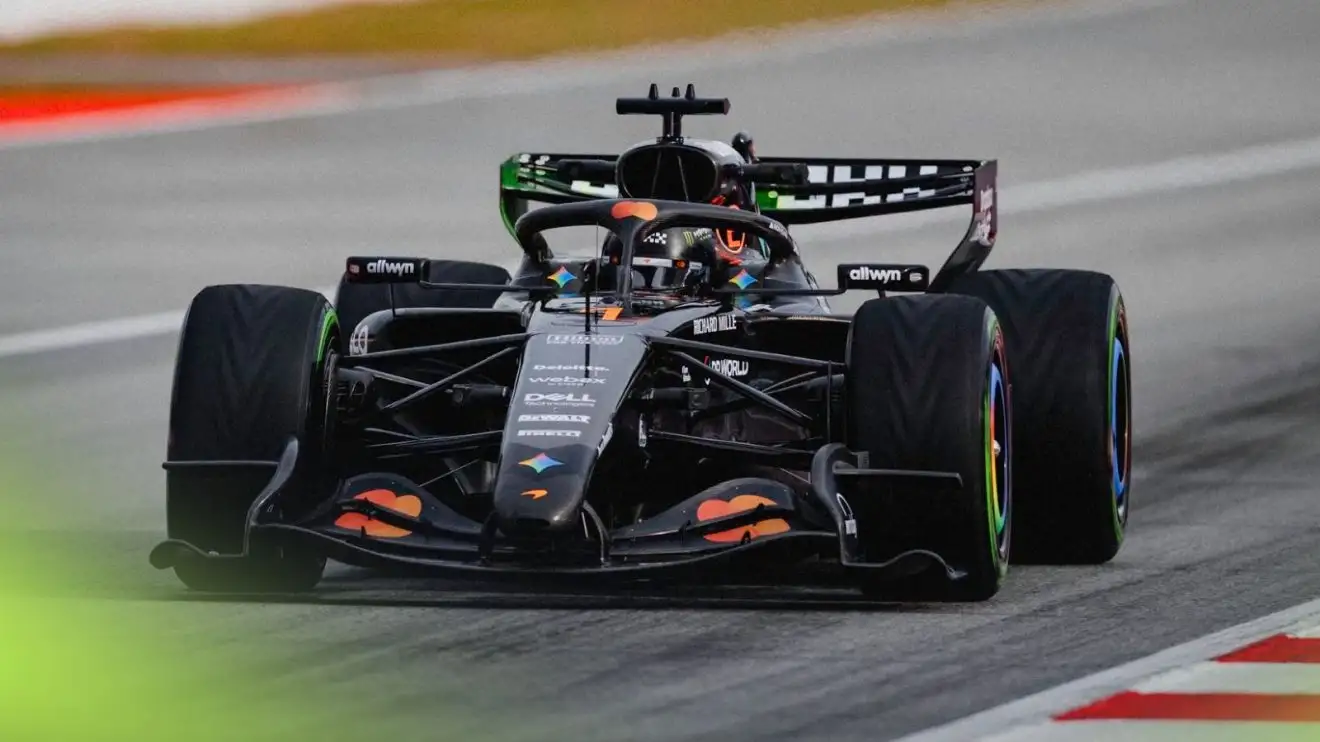
Lando Norris driving the McLaren MCL40 in the Barcelona shakedown
On the eve of official F1 2026 pre-season testing, Lando Norris says establishing best practices for using the increased battery power is number one on the list of challenges.
Norris explained the implications that this will have throughout Formula 1 competition, from qualifying laps, to overtaking, to strategy and more. Norris suspects that come the season-opener in Australia, variants such as weather and traffic could put the cat among the pigeons.
Lando Norris opens up on F1 2026 cars and battery management
Want more PlanetF1.com coverage? Add us as a preferred source on Google to your favourites list for news you can trust.
The teams and drivers – all bar Williams duo Carlos Sainz and Alex Albon – got a first feel for the new look F1 2026 cars in Barcelona, as part of a five-day test which was closed to the media.
With smaller, lighter cars, active aerodynamics and 50/50 electric and biofuel engines all coming into play, this is a very different formula to the one which the sport left behind.
The electrical power output has tripled with the new engines, peaking at 350kW, and it is a boost which Norris, the reigning World Champion, can feel after getting behind the wheel of the McLaren MCL40.
“It certainly feels more powerful,” Norris said of his new car, when speaking with PlanetF1.com and a select group of other accredited media.
“I mean, you also have that little bit less grip. But even when you’re not grip limited, and you’re third, fourth, fifth gear… I mean, even when you’re just deploying all the battery, now, we get the MGU-K to shut down and you stop deploying halfway down the straight, but if you didn’t, and you just let it run to max, you’d easily be hitting probably 380 [kph] or something.
“So, the cars effectively could do a lot more. And if you, say, unleashed a Formula 1 car, you could almost achieve even more, but you’d probably get to the end of the straight, and the battery will be completely finished.
“So it does feel quicker, and certainly for the neck and everything, it’s not so much a worry of cornering as much this year, because it’s a good amount slower, for now. That will get a lot better. But certainly slower in the corners.
“But yeah, just the first day with your neck, the acceleration, and just the G going forwards, was a little bit of a surprise, a little bit of a shock to the system.
“But you do feel the acceleration, and I think for the last few years, you just kind of get used to it quite easily and quite well. So this certainly felt like a step up in terms of acceleration and force in the body. But after five laps you get used to it.”
As Norris alludes to, one of the concerns raised about this new Formula 1, with bigger batteries, was that there may be instances where drivers have to downshift, and/or lift and coast down the straights to manage and re-charge.
Norris was asked whether downshifting was happening, after hitting the track for the first time in Barcelona.
“At times it can, yeah,” he confirmed. “The biggest challenge at the minute is battery management and knowing how to utilise that in the best way.
“It’s not simple. I think you can explain it in quite simple terms. It’s just you have a very powerful battery that doesn’t last very long, so knowing how to use it in the right times, how much energy, how much of that power you use, how you split that up around the lap, and also now, the biggest challenge is how you can recover the batteries as well as possible.
“And that’s when it comes down to the gears, hitting the right revs. Obviously, you’ve got some turbo lag now, which we’ve never really had before. So all of these little things have kind of crept back in.
“But I don’t think that changes too much. In a perfect world, I probably wouldn’t have that in a race car, but that’s Formula 1. Sometimes you have these different challenges. Sometimes it suits one person more than another.
“But yeah, our challenge as a team, as drivers, as people, but also as an engine manufacturer, is all of these things, and that’s our job, is to try and be on top of that as much as possible.”
More on F1 2026 from PlanetF1.com
Mercedes rivals pushing for Australian GP rule change over F1 2026 engine loophole – report
Oscar Piastri confirms McLaren has tweaked papaya rules ahead of 2026 season
The Drag Reduction System [DRS] bowed out after 2025, though drivers will have a replacement overtaking aid to work with in F1 2026.
When within one second of a car ahead, as was the case with DRS, drivers can now activate ‘Overtake Mode’ for a battery power, and therefore performance, boost.
What this does, though, is create another variable in what Norris already describes as a complex situation in regards to energy management.
Norris was asked whether he had any experience of being close to, or overtaking other cars, in Barcelona.
“I did some bits,” he said. “Also just to kind of get the feel what it’s like when you use the boost button.
“Then you realise, once you use the boost button, how much that can hurt you on the next straight and how you have to get the battery back up quickly.
“So yeah, a lot of the testing is just trying things, even pressing it when you would never normally press it, just to see what happens. What are the consequences. How do you have to then drive the next lap or next few corners to recover all of those things.
“I would say I don’t have the best feeling at the minute for close following. It didn’t feel that bad, honestly. Hard to say if it was much better or worse than last year.”
Norris teased that this area of the new formula may be explored a little further during Bahrain pre-season testing.
He added: “I think what you’re going to see is, generally, you can have almost more chaotic racing, depending on when people use the boost button, at what times, because there’s a lot of straights and places, even in Barcelona, where you don’t really deploy the battery that much.
“Say, between Turn 5 to Turn 7, it’s a little straight, but if you use boost out of it, you gain a good amount of horsepower, and you can overtake someone into 7, which you’d never normally see before. The only thing is, then you’re screwed down to Turn 10.
“But you’ll be able to force people more in different positions, kind of create racing potentially in better ways than you have been able to in the past.”
Put to him that we are set to see some yo-yoing of driver positions in F1 2026 then, Norris confirmed: “Yeah, I think you’re going to see more of that.
“You’re going to see, potentially, someone overtake, maybe not even because they’re much quicker, but just be able to overtake, but then have a consequence of a lap or two trying to recover the battery in the correct way.
“And obviously then when you’re behind, what was DRS, the one-second gap advantage that you now have is you can have a bit more battery. So you want to have that to your advantage as soon as you get overtaken and you’re behind that car, and that’s crucial, because you’ll be able to get 5/10 kph more on a straight, which is almost like what DRS was in some ways.
“So yeah, you’ll see more yo-yoing, more, like, moves with extra speed, but then that person might have to defend more than what you’ve seen in the past, and that will create more chaos, which is great for you guys.”
Asked how a driver is to control energy deployment, whether that be solely through the throttle, and/or via a button, Norris confirmed: “I mean, it can be a bit of both.
“There are certain places where you don’t deploy the full amount of battery, which is just an automatic system and something the FIA regulate.
“Of course, the main one is when you use the boost button. You get everything, and that can be very powerful in certain places that are limited and you use the boost button. Can make and have big effects.
“I mean, obviously, that’s the main part of it. The boost button is the biggest factor in all of this. When you want to see big differences in speeds, a lot of it’s going to be solely based on someone pressing the boost button and taking advantage of maybe having more energy if they’re within one second.
“But at the same time, the more energy you use, the more you try and make up.
“There’s more limits than in the past, especially at the minute, more limited with what you can actually do yourself, as a driver, on the steering wheel to help a lot of these functions. The main one is press overtake. The rest you have to drive in a manner where you use the throttle pedal less to try and recover a bit more.”
How drivers will go about passing backmarkers, with potentially different deployments going on, is “another challenge” which Norris says the stars of F1 2026 must figure out.
With all of that going on, he was asked whether the new cars fundamentally are fun to drive.
“I mean, it was fun to drive,” he said. “It’s different, of course.
“When you’re on a quali lap and you have to lift off a little bit, it’s certainly not what you’ve grown up doing, you know, it’s not what you do in karting, it’s not what you ever have done. So, there’s some different challenges.
“When you’re starting a lap, and mentally you’re like, ‘Okay, here we go,’ and you don’t go flat out at the last corner because you’re saving the battery, and then you go over the line, and then you lift again… That’s certainly not how you normally think you start a qualifying lap. But that’s just the challenge that we have. And this will also get better over time.
“I’m sure, over time, try and make adjustments to these things to make it better for racing and better for everyone watching.
“But yeah, they were good fun, because it’s more power and less grip, to a certain extent, which means you’re hustling. You’re having to control the car a bit more and fight the car at times more.
“Turn 9 in Barcelona, Turn 3, the last corner, were pretty much flat last year, which is quick, especially the last corner. To do it almost flat is quite an achievement in a Formula 1 car. This year is like you’re almost having to brake a little bit. A lot more corners that were easy in previous years, or the last few years, are going to become much bigger corners again.
“So that’s a good thing in some ways, and therefore you can see more racing. We all might have different strategies, because what was then flat last year, and not really your grip-limited section, now, when you put a new set of tyres on, you’ll be able to gain in a lot more parts of the track.
“So I think, yeah, there are a lot of things that we still have to figure out and learn, and strategies, pit-stops, all of these things, the tyres.”
The drivers have two, official pre-season tests in Bahrain to come – held from 11-13 and 18-20 February – to further acclimatise to the new cars before the season-opening Australian Grand Prix on 8 March.
Norris was asked by PlanetF1.com’s Thomas Maher whether he believes the changes made in Formula 1 will play to his strengths, how far along he feels in the adaptation process, and whether he believes he will be at 100 per cent for Melbourne.
The reigning World Champion replied: “I think behind the scenes there’s going to be a continuous process, because I think it’s one of the biggest focuses for any PU manufacturer at the minute, is understanding how to harvest in the best way and how to deploy in the most efficient way.
“You can gain a lot of lap time at the minute, if you can do a little bit better, one per cent, two per cent better than another manufacturer. So that’s important.
“As drivers, I would say we should be there or thereabouts with understanding quite a few things. But there’s always going to be something that comes up in the race that you’re not prepared for, and it’s just going to be the randomness. It’s going to be when you get yellow flags, or traffic or something, or weather.
“Especially because with the weather, I don’t even know if it’s official or known, if you’re going to have straight mode active or not active in wet weather conditions, which then can change how quick you are on the straight, obviously changes how much you’re bottoming.
“So all these things that then have to be pre-calculated, and then you spend a lot longer in the straight, you use a lot more battery, then lap times will go slower… Yeah, there’s a lot of other things to manage.
“So I don’t know. I think we’ll be there or thereabouts on perfect condition running. But in abnormal conditions, whether that’s rain or traffic or flags, whatever it may be, I don’t think everyone will be completely prepared, which is an opportunity for any team to try and be on top of.”
Additional reporting by Thomas Maher
Want to be the first to know exclusive information from the F1 paddock? Join our broadcast channel on WhatsApp to get the scoop on the latest developments from our team of accredited journalists.
You can also subscribe to the PlanetF1 YouTube channel for exclusive features, hear from our paddock journalists with stories from the heart of Formula 1 and much more!
Read next – Andrea Stella: Mercedes ‘definitely raised the bar’ for McLaren


