
Why isn’t Mercedes’ new F1 upgrade package working?


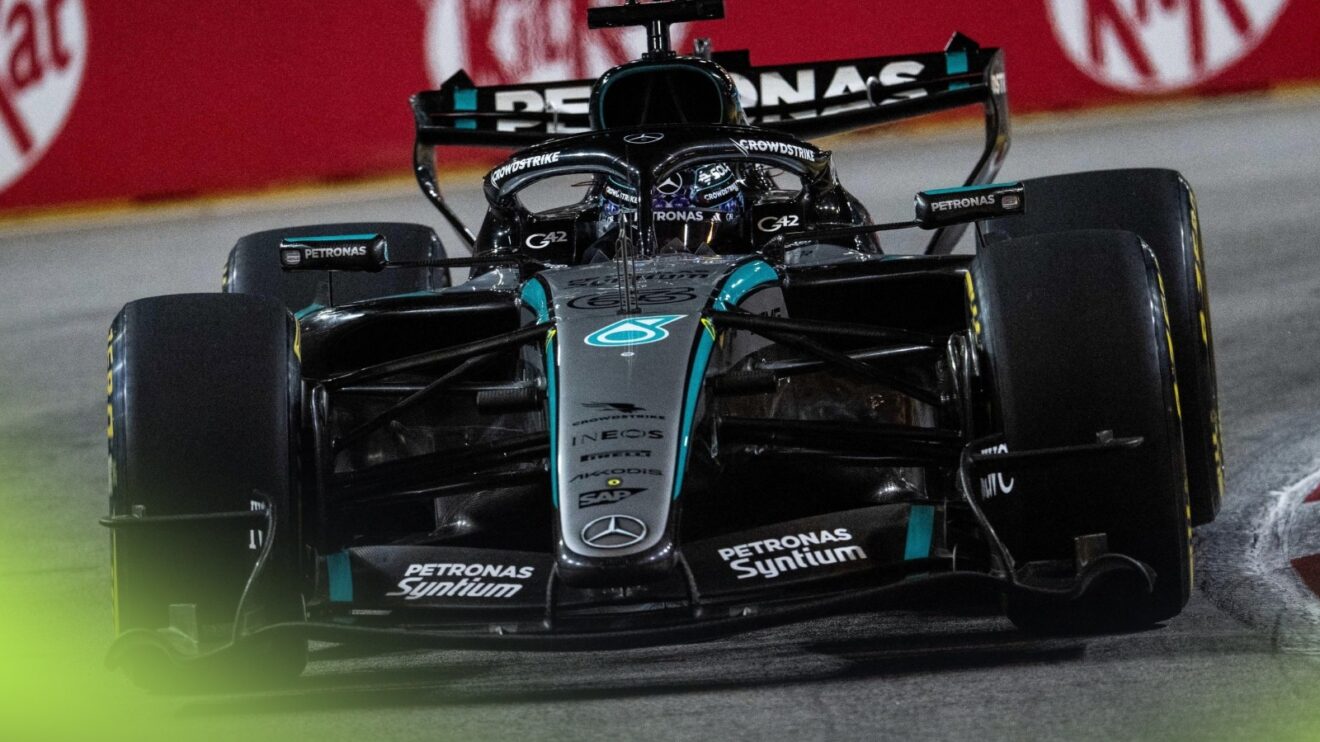
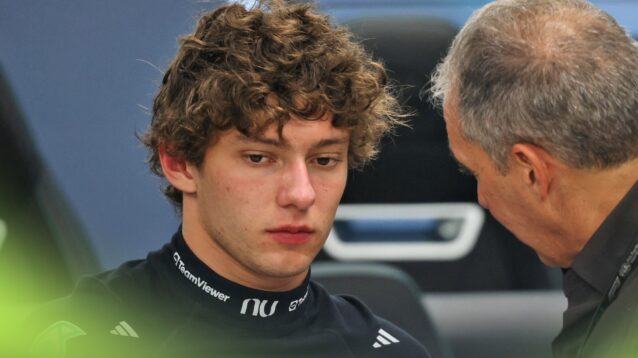
Antonelli at the Singapore Grand Prix
It is no coincidence that following the introduction of their major new upgrade package, Mercedes is no longer the benchmark for outright track pace, with Max Verstappen taking that role.
The central question is why this new package is failing to deliver, and we turn to telemetry data to uncover the answers.
Is Mercedes on the wrong development path?
That all was not well with the revised Mercedes W17 was evident back in Malaysia. However, that was somewhat expected at the time, given that finding a car’s setup sweet spot invariably takes time when aerodynamic revisions are this extensive. We have seen this scenario unfold repeatedly, and not just with Mercedes.
What is concerning, however, is that the issues look no better now in Singapore. During the first and only free practice session, Mercedes (at least Kimi’s side of the garage) appeared less focused on fine-tuning car setup and more preoccupied with gathering data and testing a new front wing – a highly unusual approach during a Sprint weekend format.
Kimi Antonelli completed multiple runs during practice with the new specification before the team ultimately abandoned it, opting to revert to the older specification for sprint qualifying.
The revisions on the new front wing are substantial. First and foremost, the nose support pylons are now attached directly to the mainplane (first element), allowing the remaining two flap elements to move along straight-line sections of the track.
In the earlier design, as seen in the image below, the supports mounted to the second element, leaving only the uppermost flap – which was previously significantly larger – to move. While such a modification might seem subtle at first glance, it profoundly alters airflow structures feeding downstream aerodynamic elements, particularly during transitions between high- and low-downforce modes.
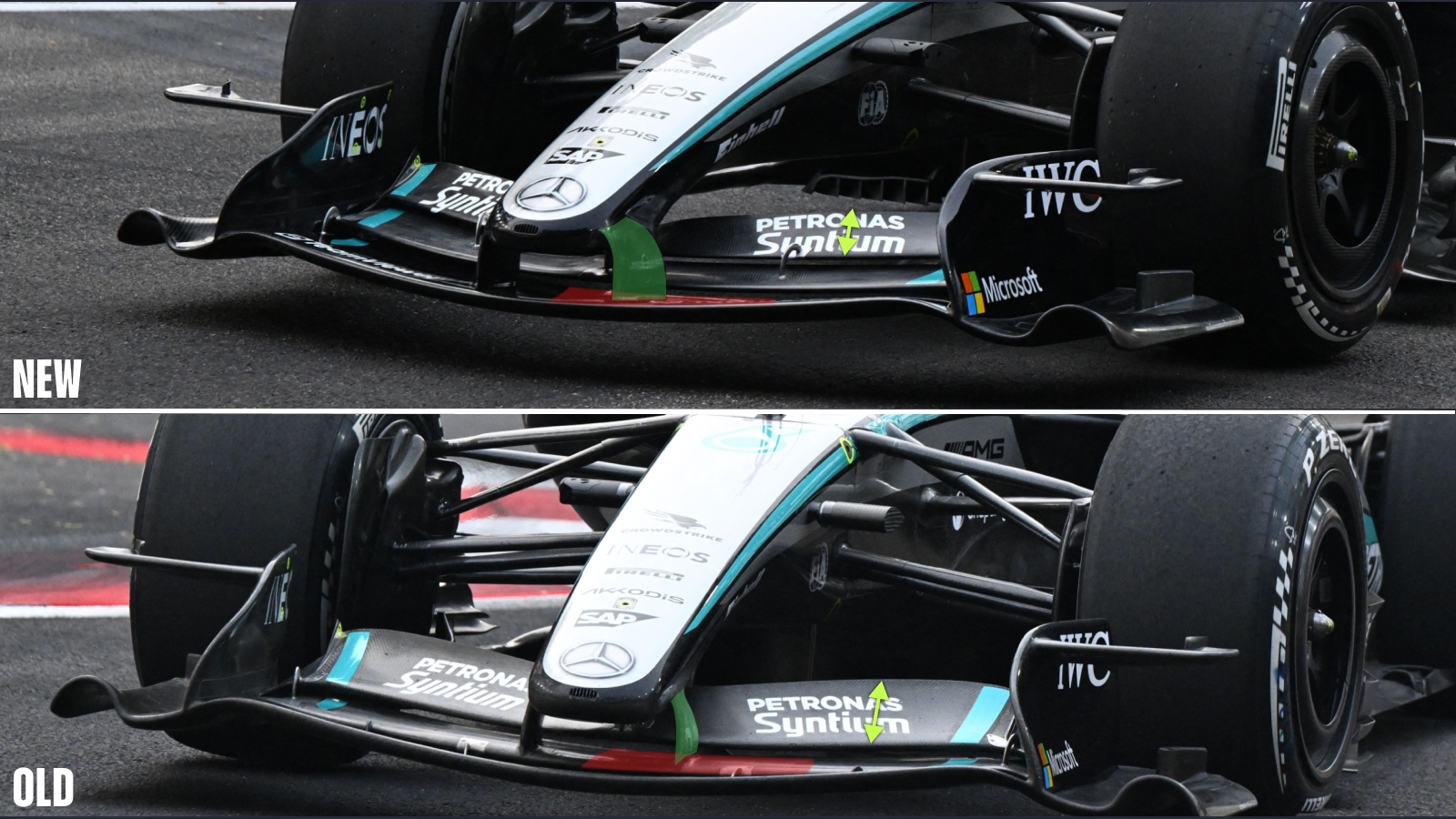
The conclusion drawn following free practice was that the new front wing failed to deliver its intended performance, leaving the Italian lacking front-end confidence around the street circuit in Singapore. Antonelli finished FP1 a full 1.2 seconds adrift of session-leader Russell, but without logging a single lap on soft C5 tyres.
On the other side of the garage, George Russell chose to forgo the upgrade package introduced in Malaysia entirely, electing instead to run the old specification – a damning indictment in its own right.
Antonelli’s struggles continued on the soft compound, with his final SQ3 lap coming in nearly 0.6 seconds slower than Russell, who secured P2 on the grid.
A deep dive into the telemetry suggests that Kimi Antonelli lacks front-end confidence entirely. The car exhibits noticeably sluggish rotation, particularly through low-speed corners, while persistent understeer plagues medium-speed turns.
This characteristic is evidenced by lower apex speeds for the Italian through Turn 5, Turn 8, and Turn 14.
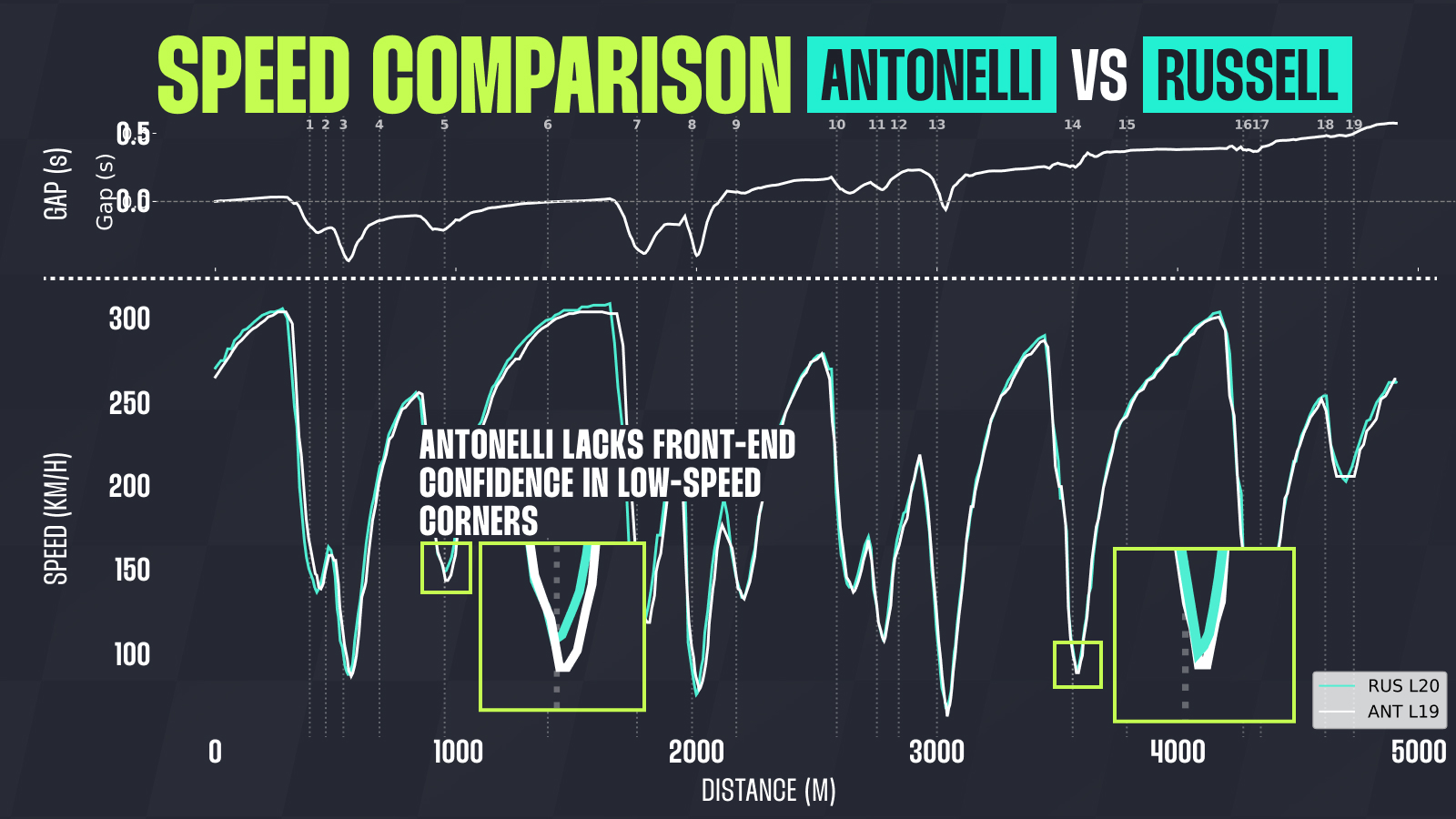
An unstable front end also severely compromises performance under heavy braking. When confidence in front-axle grip is absent, a driver is forced to brake earlier – especially in Singapore, where the slightest miscalculation carries a heavy penalty in the concrete barriers.
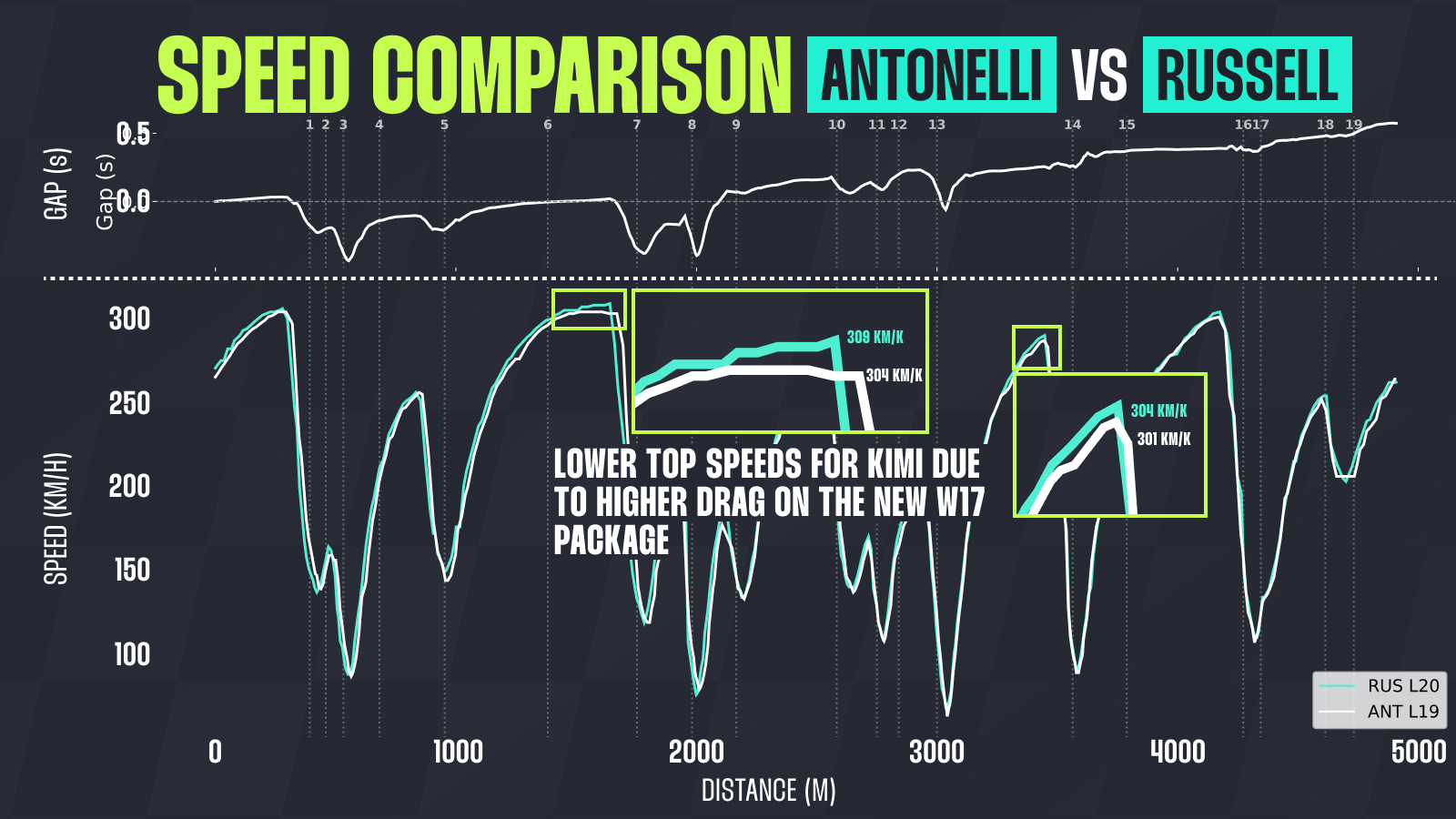
Furthermore, the data indicates that the new upgrade package generates higher aerodynamic drag compared to the older specification, disrupting electrical deployment strategies for the MGU-K. While these margins are tight, they are nonetheless tangible: entering Turn 7, Kimi suffers a 5 km/h top-speed deficit relative to George, and is 3 km/h slower on entry to Turn 16.
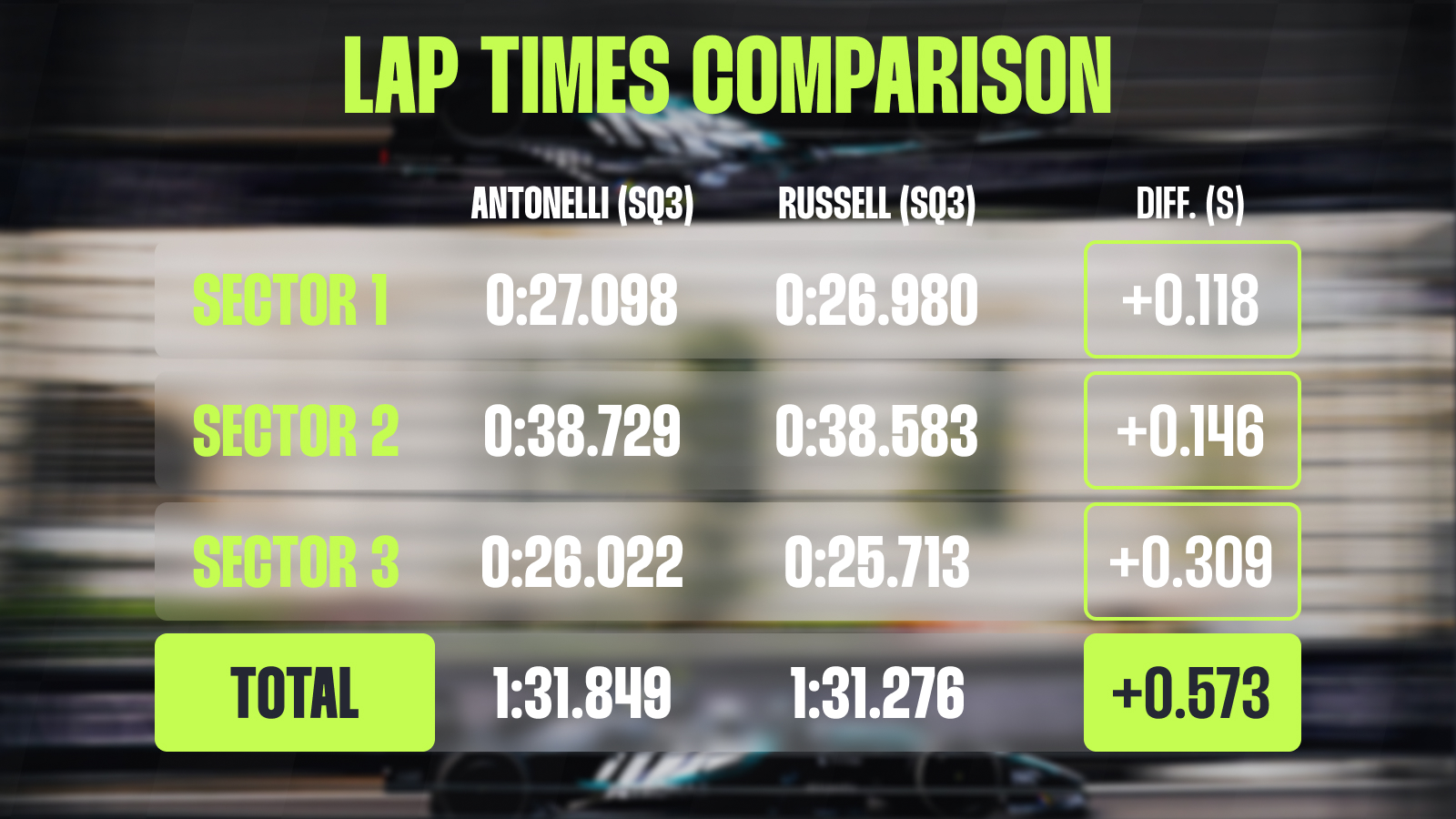
All of this prevents Antonelli from extracting his maximum potential. On a street venue like Singapore, driver commitment is paramount, and a lack of trust in the car will inevitably manifest in qualifying lap times.
It can also be deduced that the new upgrade package is harsher on its tyres. The expanding white delta trace across the second half of the lap suggests Kimi struggles to keep the soft compound within its optimal working window throughout a full flying lap – a trend corroborated by time bled in Sectors 2 and 3.
What Antonelli must now rely on is the work of his engineering crew, hoping they can unlock a balance better suited to this revised W17. As far as the championship picture is concerned, Kimi has already laid the groundwork, and his weekend is somewhat eased by the knowledge that Russell faces a grid penalty for the main Grand Prix.
Want to be the first to know exclusive information from the F1 paddock? Join our broadcast channel on WhatsApp to get the scoop on the latest developments from our team of accredited journalists.
You can also subscribe to the PlanetF1 YouTube channel for exclusive features, hear from our paddock journalists with stories from the heart of Formula 1 and much more!
Read next: Christian Horner Red Bull exit came with $150m price tag