
What new Max Verstappen and Lando Norris contracts tell us about modern F1



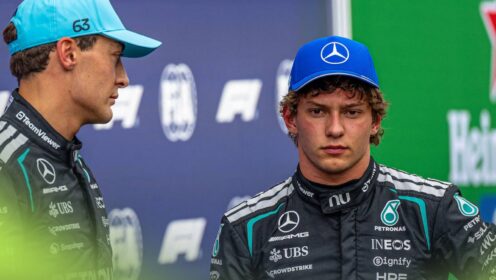
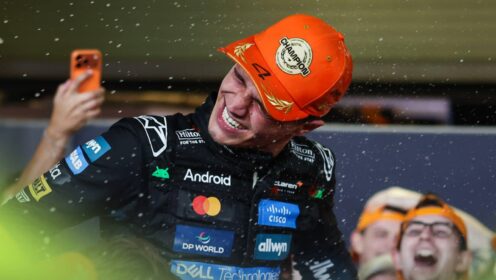
Lando Norris and Max Verstappen signed new long-term deals with McLaren and Red Bull respectively
The announcement of Lando Norris’ lengthy contract extension at McLaren is the latest in a growing list of drivers being put on lockdown.
This year’s ‘silly season’ has turned into ‘very sensible season’, as multiple long-term deals and extensions have been confirmed.
F1 driver programmes are creating unprecedented stability at the top teams
With Norris having already been under contract at McLaren until the end of 2028, a sudden announcement from the team on Saturday morning revealed that the 2025 F1 world champion had signed a deal to remain with the team until at least the end of 2030.
But that’s not a guaranteed exit either: there is a ‘multi-year’ option beyond that, meaning it could be 2032 before Norris and McLaren are no longer a combo.
It’s not the only recent long-term deal announced. Just a week earlier, Red Bull revealed that it had secured Max Verstappen’s signature on a new contract extension.
Like Norris, Verstappen had been under contract until the end of 2028, albeit with escape clauses in his contract that meant his immediate future was an annual storyline as the Dutch driver needed convincing about Red Bull’s longevity at the top.
But Verstappen is now under contract until the end of 2030. At Ferrari, having already signed previous lengthy contracts since arriving at the team in 2019, Charles Leclerc’s recent contract extension also sees him remain at Ferrari until at least the end of 2030.
It’s not just the established top teams either. At Audi, Gabriel Bortoleto revealed during the summer break that his contract details will see him race for the team for the next couple of years, and also hinted at 2030.
“As far as I can say, because it’s something confidential, let’s just say there are no clauses,” he told Motorsport Brazil.
“I have a long-term contract with Audi. I’ve already said it: I’ll be with Audi next year, and not only next year, but for the following years as well. Mattia [Binotto] is always talking about 2030. So let’s put it that way. It’s a project we really believe in. I believed in it when I joined them; they believe in my potential, and that’s what I can say. It’s something long-term.”
Such long-term deals becoming commonplace is in stark contrast to the truly ‘silly’ seasons of yesteryear, but what is driving this proliferation of stability? Has something changed in the coffee in the respective hospitality units that is making drivers and teams seek out safety, reducing risk exposure by gambling on young and unproven rookies, or swooping for a big-name driver from another team?
The simple answer, of course, is that teams no longer need to take these risks, and this is the end result of the maturation and success of driver programmes up and down the grid – team-operated initiatives designed to identify precocious talents, support and refine those talents, and, in return, reap the rewards of their success.
These long-term deals are being signed with drivers who are the products of their teams, underlining the growing success of these programmes.
For instance, Mercedes’ driver programme, established in 2014, has promoted four into Formula 1, with Pascal Wehrlein being the first more than a decade ago.
While Wehrlein’s F1 foray ultimately petered out, Esteban Ocon has carved out a lengthy career, while Mercedes’ driver line-up is now made up entirely of home-grown talent in George Russell and Kimi Antonelli, with the duo signed to the programme under Gwen Lagrue in 2017 and ’18 respectively.
Antonelli, the championship leader, boasted such potential that he made his debut at the Brackley-based team, not even needing to convince Toto Wolff by way of a year or two at a lower team; a decision that is now paying off in abundance, with a long future in silver seemingly assured for the Italian youngster.
At Red Bull, one of the most mature driver programmes on the grid having been conceived under Helmut Marko in 2001, Max Verstappen is a product of that programme (although he was a comparative late signing), while Isack Hadjar was signed up in 2022.
At Racing Bulls, the sister team, both drivers are also Red Bull programme talents, with Liam Lawson and Arvid Lindblad each with the team for over half a decade.
Ferrari’s driver programme, established in 2009, resulted in Jules Bianchi making it to F1 before his tragic death in 2015.
Of the current grid, Sergio Perez, Charles Leclerc, and Ollie Bearman are all Ferrari-honed talents, with Leclerc being the obvious success story after toppling Sebastian Vettel in his first season at the Scuderia in 2019.
At McLaren, Lando Norris is the latest in a long line of drivers to be picked up by the Woking-based team’s programme, which was set up in 1998, but is only the fourth to make it into F1 as a graduate – Lewis Hamilton being the first to succeed, after Nick Heidfeld had to find another route into Formula 1.
Driver programmes are certainly nothing new, but the approach to identifying talent and understanding how best to unlock a driver’s potential is something that the teams have invested heavily in. Data-driven insights mean it’s easier to spot the capabilities of a driver at an earlier stage, with the team’s job then being to help turn potential into tangible results.
Last year, Mercedes’ Gwen Lagrue explained the process in an exclusive interview with PlanetF1.com.
“What we like to do at Mercedes is to do it when they are 11 or 12 years old,” he said.
“I really like to watch them in Mini (karting’s Mini category, in which Antonelli won several championships in 2018 prior to his Mercedes signing), because you can see the raw talent.
“So you can see the DNA of the drivers – the way they are defending, preparing an overtake – it’s pure, and you can really read the pure talent of the driver. This is quite obvious on track.
“Then we’re equally focused on the behaviour, the work ethic, the character, etc.
“To us, it is as important because if you take the top five racers in Mini at the international level in terms of just talent – what you can see on track – they are very, very, very close.
“So what will make the difference is more the personality, the character, attitude, the capacity of questioning themselves all the time, etc.
“Of course, over the years, we’re developing the skills they have, and we’re correcting, let’s say, their faults, or what they are not doing well.
“We are building them to make sure they will be ready for the top level.
“Not necessarily F1; we know that they won’t all go to Formula 1, but if we can’t achieve F1, we are sure they will have a career in motorsport.”
With the best of these talents being picked up, honed, and growing with the teams they are stepping up into Formula 1 with, there’s already an established dynamic and working relationship by the time they make their debuts.
Personality-wise, there are no surprises for either side and, even better for the teams, there will always be a subconscious fealty from a driver who was picked up as a child by a team.
How can one resist an instruction, or rebel against scenarios they feel unfair, when they owe their entire careers to a team? Or to a figurehead that will always have an aura of authority over them, due to the unique dynamics created as teenagers become adults?
With F1 drivers’ careers becoming ever lengthier, thanks to ever-evolving athlete management and progress in sports science that means drivers aren’t hitting mental or physiological barriers until later in their lives, the success of these programmes does have the side effect of creating a bottleneck of talent, which is starting to become evident.
At the top teams, with several drivers now hoarding the top seats for years to come, there is little chance of any current midfield driver from another team getting the nod as an external hire, and this is only likely to be refined further in the years to come as drivers from a pre-programme age start to retire.
For example, if Lewis Hamilton were to retire at the end of this year, the obvious candidate to replace him would be Oliver Bearman, currently at Haas, as another member of the Ferrari Driver Academy.
But Bearman too is only at the start of his career and, assuming his form is as expected, who would bet against him also remaining at the team for a decade or so? What does Ferrari do with any drivers on the programme over those years?
With teams uncovering drivers they feel tick all the boxes, resulting in such long-term contracts, it appears as though the days of truly silly seasons might be fading away, with teams simply able to call upon the next bright talent in their pipelines – meaning upcoming talented drivers’ careers could be determined by nothing more than the vagaries of timing, withering away on the sidelines as F1’s talent pool is augmented by team-specific personalities.
It may give the teams and drivers incredible levels of stability and dependability, but, in doing so, the successes of the programmes have created a stagnant driver market.
Want to be the first to know exclusive information from the F1 paddock? Join our broadcast channel on WhatsApp to get the scoop on the latest developments from our team of accredited journalists.
You can also subscribe to the PlanetF1 YouTube channel for exclusive features, hear from our paddock journalists with stories from the heart of Formula 1 and much more!
Read Next: Lando Norris gets special McLaren bonus after new contract signed