
FIA president targets V8 engine rules decision within months



A FIA F1 World Championship flag on display in the paddock.
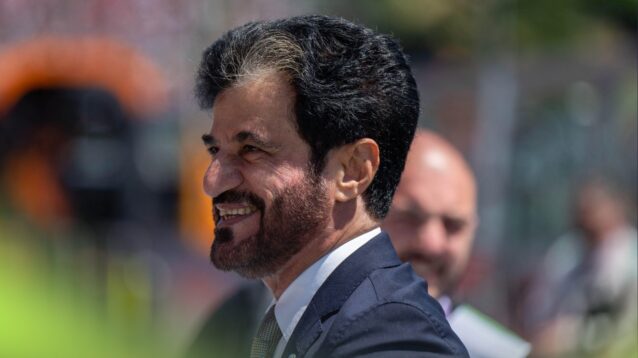
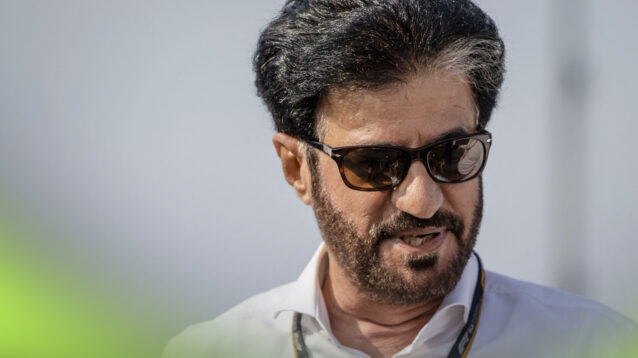
FIA president Mohammed Ben Sulayem believes the technical framework for V8 engines to make a comeback in 2030 will be set out within a few months.
He did, however, acknowledge that a return to V8 power units had yet to be agreed upon by Formula 1 teams and the sport’s power unit manufacturers.
Mohammed Ben Sulayem outlines timeline for F1 V8 engine regulations
Formula 1 introduced a new power unit formula this season, the sport switching to a near 50/50 split between combustion and electrical power.
It was criticised from the get-go, with drivers describing it as “Mario Kart” with a “mushroom boost” and “Formula E on steroids”. Overtakes, which are largely dependent on battery power at the time, have been labelled “artificial”.
But while changes have been announced to the F1 2027 power unit regulations, moving to a 58/42 split in favour of the ICE, followed by a 60/40 split in 2028, Ben Sulayem wants to see V8 engines back on the grid.
Formula 1 last used V8 engines in 2013, before switching to turbocharged V6 engines.
The FIA president announced his plan earlier this year, saying he was “committed to bringing V8s back to Formula 1”, and revealed that F1’s power unit manufacturers “want it to happen”.
He doubled down on that stance during a recent visit to Rwanda to confirm the African Grand Prix.
However, speaking to PlanetF1.com and other select media outlets during a recent roundtable, Ben Sulayem acknowledged that the teams and PUMs had yet to agree to a V8 comeback.
“No, no, no, not yet,” he said, “but it will be.”
“I hope it will be agreed,” he continued with a chuckle, “because you see, then there will not be a V8, maybe a V16 if they don’t take a V8, and they know that.”
Adopting a more serious tone, he said: “The consultation has been a lot. The papers are with the teams. Teams are reading them. Team principals, PUMs, power unit manufacturers. A driver has been consulted about it.
“When you make it simpler, and then you make it half the price, you know, the R&D doesn’t just go down by half, but then the simplicity that comes with it means production can take less time.
“So, you know, there are materials also… the block is only for reliability. You go up, and then it’s the power.
“That’s where you have to limit things, because limiting the power means you have to police it so that nobody can use certain materials. Certain materials can be very expensive if you’re trying to get those last few horsepower.
“And then the sound will be there. Then a very light car, but you have to be very careful about how light you can let it be.”
Quizzed on whether a V6 would mean an even lighter car, Ben Sulayem replied: “But lighter also means a problem for them because then some teams will have to pay more.
“You know, we have the cost cap being controlled, so it’s not just a case of going lighter and lighter. No. You need to go smaller, of course.
“I was at Retromobile this year in France, and there were two cars there. Then I was also at Le Mans, where I saw the old car and the current car, which is huge compared to the old one.
“I said, when you think about it, every year, or every three years of that cycle, it gets bigger. You don’t remember what was there 15 or 20 years ago. But when you put them together, you see how big the car is now.”
F1 2026: The season’s winners and losers
The results of the F1 2026 championship
The F1 2026 Drivers’ and Constructors’ Championship standings
As the F1 2026 season nears its conclusion, Ben Sulayem was asked whether time was of the essence in finalising the new formula ahead of the 2030 championship.
This year’s new power unit regulations were decided in 2022, giving the PUMs three years to design their power units.
“Yeah,” replied the 62-year-old, “but that engine is very complex. I’m sorry, you had the MGU-H, then it went to the MGU-K. You have a big battery, and it was the demand of the teams and the PUMs.
“Here, when I say simpler, it will definitely be simpler.
“You can go and ask an engine builder, and they will tell you how long it takes to build that type of engine.
“I mean, if they come back, they will not approve only the technical data. They will also approve the time required. They will know how much time it will take.
“And, you know, I am very proud of our team in single-seaters and the amount of work they have done. Believe me, it’s a lot of work. They will not give the teams something that is simply not doable. It is doable for them.”
Ben Sulayem believes the technical regulations for the next power unit cycle will be decided in the coming months.
“Yes, yes. In a few months, hopefully,” he said. “Of course, you push the teams and the PUMs to come back to you, and we will wait for them to come back to us.”
Additional reporting by Thomas Maher
Want to be the first to know exclusive information from the F1 paddock? Join our broadcast channel on WhatsApp to get the scoop on the latest developments from our team of accredited journalists.
You can also subscribe to the PlanetF1 YouTube channel for exclusive features, insights from our paddock journalists and stories from the heart of Formula 1, and much more!
Read Next: F1 legal battle erupts in Texas as former supplier takes rival to court