
In full: Pierre Gasly verdict by FIA International Court of Appeal


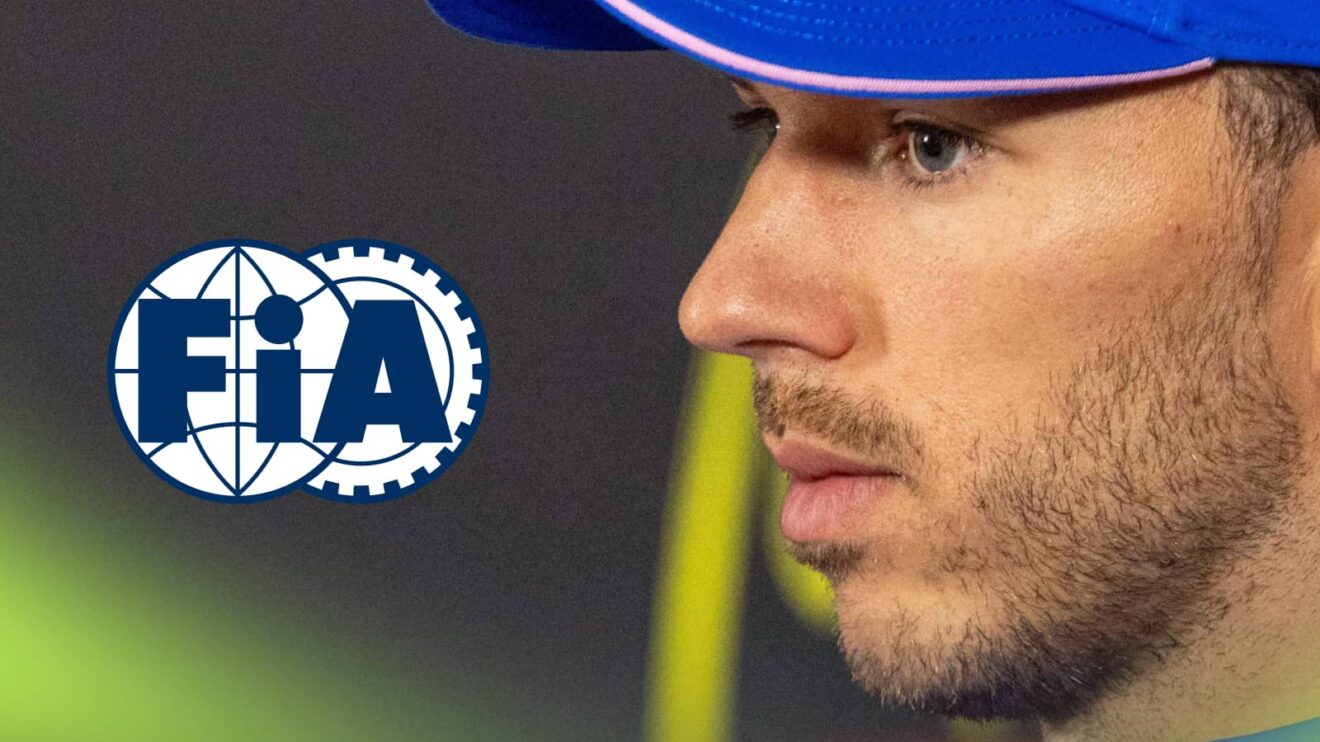
Pierre Gasly has been stripped of his third-place finish in Monaco
Alpine driver Pierre Gasly has been stripped of his podium finish at the 2026 Monaco Grand Prix following a successful appeal by the Red Bull and McLaren teams.
The decision sees Iscak Hadjar reinstated to third, with Gasly dropping to seventh in the final classification. Here is the full 26-page verdict from the FIA’s International Court of Appeal…
Pierre Gasly loses Monaco Grand Prix podium finish after Red Bull, McLaren appeals
FIA
INTERNATIONAL COURT OF APPEAL
COUR D’APPEL INTERNATIONALE
INTERNATIONAL COURT OF APPEAL (ICA)
of the
FEDERATION INTERNATIONALE DE L’AUTOMOBILE
Appeals brought by
McLaren Racing Limited and Red Bull Racing Limited
against
Decisions No. 1 and 2 dated 12 June 2026 contained in Document 99 of the Stewards of the 2026 Monaco Grand Prix counting towards the 2026 FIA Formula One World Championship
Case ICA-2026-06-07-08-09
Hearing of 25 August 2026
Decision of 3 September 2026
International Court of Appeal – Hearing of Tuesday 25 August 2026
Decision of 3 September 2026
1
INTERNATIONAL COURT OF APPEAL
COUR D’APPEL INTERNATIONALE
The INTERNATIONAL COURT OF APPEAL (“the Court”), which comprised Mr Michael Grech (Malta), who was designated President of the Hearing, Mr Tomas Borec (Slovakia), Mr Luigi Fumagalli (Italy) and Mr Filippo Marchino (Italy/USA) held a hearing at the Fédération Internationale de l’Automobile, 8 place de la Concorde, 75008 Paris, on Tuesday 25 August 2026.
Prior to the hearing, the Court received and considered submissions and attachments thereto made by McLaren Mastercard Formula 1 Team (“McLaren”) and Oracle Red Bull Racing (“RBR”) (the two of them collectively referred to herein as “the Appellants”), the FIA (“the Respondent”) and BWT Alpine Formula One Team (“Alpine”) as well as VISA Cash App Racing Bulls Formula One Team (“Racing Bulls”), (the latter two collectively referred to herein as “the Third Parties” and the five of them collectively referred to herein as “the Parties”).
The following persons attended the hearing:
On behalf of the Appellant, McLaren:
Mr Alessandro Alunni Bravi, Chief Business Affairs Officer
Mr Andrea Stella, Team Principal
Mr Nick Leech, Legal Director
Mr Ed Hadcock, Lead Legal Counsel
Mr Randeep Singh, Racing Senior Director
Mr Will Courtenay, Sporting Director
Mr Jon Mitchell, Lead Trackside Control Systems Engineer
On behalf of Motorsport UK (McLaren’s ASN):
Ms Sian Woolley, Head of Legal
Mr Nick Bamber, Legal Counsel
On behalf of the Appellant, RBR:
Mr James Segan, KC, Representing attorney, Blackstone Chambers
Mr Ben Gordon-Smith, General Counsel and Head of Business Affairs
Mr Jamie Ptaszynski, Head of Legal
Mr Stephen Knowles, Lead Engineer-Strategy and Sporting
On behalf of the Respondent, the FIA:
Mr Adam Lewis, KC, Representing attorney, Blackstone Chambers
Mr Tim Malyon, Sporting Director
Mr Paul O’Dowd, Chief Legal Officer
Ms Alejandra Salmerón García, Head of Regulatory
International Court of Appeal – Hearing of Tuesday 25 August 2026
Decision of 3 September 2026
2
INTERNATIONAL COURT OF APPEAL
COUR D’APPEL INTERNATIONALE
Ms Delphine Lavanchy, Senior Legal Counsel
Ms Lauren Pagé, Partner, Bird & Bird LLP
Mr Zac Randall, Senior Associate, Bird & Bird LLP
Mr Arbi Karapetian, Chief Engineer and Innovation Officer, FOM (Witness)
Mr James Boyd, Legal Director Risk and Disputes Formula One, FOM
On behalf of the Third Party, BWT Alpine Formula One Team:
Mr Andrew Ford, Principal, LK Law LLP
Mr Steven Nielsen, Managing Director
Mr Richard Lockwood, Sporting Director
Mr Dave Greenwood, Racing Director
Mr Simon Holdsworth, Head of Legal
Ms Teona Phatsatsia, Associate Solicitor, LK Law LLP
Ms Jessica Wakelin, Associate Solicitor, LK Law LLP
On behalf of the Third Party, VISA Cash App Racing Bulls Formula One Team:
Mr Alan Permane, Team Principal
Mr Marco Perrone, Sporting Director and Team Manager
Mr Riccardo Fecchio, Legal Director
On behalf of the Observers:
Mr Mark Lowe, Sporting Director, TGR Haas F1 Team
Ms Alison Wood, General Counsel, Atlassian Williams F1 Team
Ms Carrie Donaghy, General Counsel, Mercedes AMG Petronas Formula One Team
Ms Caroline Mc Grory, Chief Legal Officer, Cadillac Formula One Team
Mr Marco Gasparet, Sporting Specialist, Scuderia Ferrari S.p.A.
Mr Michael Moritz, General Counsel, Audi Motorsport AG
Mr Inaki Rueda, Sporting Director, Audi Motorsport AG
Mr Andy Stevenson, Sporting Director, Aston Martin Aramco Formula One Team
Mr Olivier Rumsey, Legal Director, Aston Martin Aramco Formula One Team
Also attending the hearing:
Mr Jean-Christophe Breillat (Secretary General of the FIA Courts)
Mr Nicolas Cottier (Clerk of the FIA Courts)
Ms Sandrine Gomez (Administrator of the FIA Courts)
International Court of Appeal – Hearing of Tuesday 25 August 2026
Decision of 3 September 2026
3
INTERNATIONAL COURT OF APPEAL
COUR D’APPEL INTERNATIONALE
The Parties filed written submissions and, at the hearing on 25 August 2026, set out oral arguments and addressed the questions asked by the Court. The hearing took place in accordance with the adversarial principle, with the aid of simultaneous interpretation in French and English. None of the Parties raised any objections, in relation either to the composition of the Court or to the manner in which the proceedings and the hearing were conducted, notably concerning the respect of the adversarial principle or the simultaneous interpretation.
1. REMINDER OF THE FACTS
1. The present appeals arise from the 2026 Monaco Grand Prix (“the Monaco GP”) counting towards the 2026 FIA Formula One World Championship and concern two alleged breaches of the pit lane speed limit by Car 10, driven by Mr Pierre Gasly. Article B1.6.3a of the FIA 2026 Formula One Regulations – Section B [Sporting] (“the F1 Sporting Regulations”) provides that a speed limit of 80 km/h is imposed in the pit lane during the whole Competition, while permitting the Race Director to amend that limit in order to ensure the safe and orderly conduct of the Competition. For the Monaco GP, having regard to the particular configuration of the circuit and pit lane, the Race Director reduced the applicable pit lane speed limit from 80 km/h to 60 km/h. The penalties, subsequent review proceedings and the present appeals all arise from the application of that 60 km/h limit.
2. The FIA’s designated Official Timekeeper, Formula One Management (“FOM”) operates the Official Timing System (“OTS”) to measure the average, and not the instantaneous, speed of cars in the pit lane. In other words, a car may temporarily exceed the pit lane speed limit, but if it takes a longer line or reduces speed then its average speed may still be within the speed limit.
3. In order to monitor each car’s pit lane speed, the pit lane is divided into a number of sectors, each beginning and ending with a timing loop consisting of two parallel wires embedded in the asphalt, allowing the Official Timekeeper to record the time taken by each car to travel through the sector.
4. Before a competition, FOM determines, measures and inputs the ‘minimum distance’ between the two loops into the OTS. The competitors’ average speed between two loops is calculated using the minimum distance input by FOM into the OTS and the time taken to travel between them.
5. A transponder fitted to the front axle centreline of each car transmits a constant signal that is detected by a decoder connected to each loop. The time, in seconds, that it takes for a car to travel between two loops is determined by the transponder sending a signal when it passes over the two parallel wires in a loop to a decoder. The signal produces two parabolic-shaped peaks corresponding to the signal strength received by the two parallel wires that form one loop, with the drop in signal strength between those peaks…
International Court of Appeal – Hearing of Tuesday 25 August 2026
Decision of 3 September 2026
4
INTERNATIONAL COURT OF APPEAL
COUR D’APPEL INTERNATIONALE
6. …enabling the decoder to calculate the precise moment when the transponder passes over the loop.
The minimum distance between each pair of loops is physically measured on-site by FOM officials prior to the Free Practice sessions. A Global Navigation Satellite System (“GNSS”) survey records each loop’s position for reference and sense-checking purposes, while the distance actually input into the OTS is measured by hand by FOM officials using a tape measure. FOM measures the minimum distance using one of three approaches depending on the geometry of the pit lane between consecutive loops, namely a Straight Pit Speed Sector, a Curved Pit Speed Sector with barrier, or a Curved Pit Speed Sector with no barrier. The minimum-distance convention is used to avoid over-reading speeds.
7. To be in line with the pit lane speed limit, and avoid incurring penalties for breach of the pit lane speed limit, each car has its own embedded speed ‘limiter’, which, when activated, is designed to set and hold the car’s speed at just below the pit lane speed limit. The teams use Free Practice Sessions in the days before a race to configure, calibrate and adjust their limiters to the speed limit based on the timings they receive from FOM, which in turn are based on the OTS. For example, teams may deliberately seek to ‘attack’ the shortest line during Free Practice Sessions, to obtain data from the OTS which will assist them in avoiding speeding penalties during the race. Breaching the speed limit in Free Practice Sessions only results in a low €100 fine for each km/h above the limit, up to a maximum of €1000.
8. The speed limit in the pit lane is enforced strictly, i.e. exceeding the speed limit by even 0.1 km/h will result in a breach of Article B1.6.3 of the F1 Sporting Regulations. While the FIA previously permitted a tolerance of up to 0.5 km/h, and only generally issued warnings if the limit was exceeded by 0.5 and 1.0 km/h, it was agreed at the FIA Sporting Advisory Committee (“SAC”) meeting on 20 September 2022 that the tolerance would be removed, as teams were simply calibrating their pit lane speed limiters to exceed the speed limit within the tolerance in order to gain an advantage. Therefore, since the 2022 SAC meeting, anything above the speed limit, even 0.1 km/h has been sanctioned. This strict enforcement requires that the OTS must be accurate to less than 0.1 km/h. As mentioned above, the minimum distance between loops is measured by tape measure within an accuracy of ±1cm and the OTS measures the drivers’ elapsed time through each loop sector within an accuracy of 0.1 ms. The combined effect of those tolerances is that, even when both margins of error are maximised, the system yields an error of less than 0.1 km/h.
9. As stated, the pit lane speed limit for the Monaco GP was reduced from the speed limit set out in Article B1.6.3 of the F1 Sporting Regulations, and set at 60 km/h by the Race Director due to the particular configuration of that circuit.
10. During the Free Practice Sessions at the Monaco GP on 5-6 June 2026, five cars were found to be in breach of Article B1.6.3 of the F1 Sporting Regulations, as a result of…
International Court of Appeal – Hearing of Tuesday 25 August 2026
Decision of 3 September 2026
5
INTERNATIONAL COURT OF APPEAL
COUR D’APPEL INTERNATIONALE
…speeding in the pit lane. Four of those breaches related to the Pit Entry Loop Sector. During Free Practice and other sessions over the race weekend, the teams received pit-lane timing data. Communications between team engineers and drivers concerning those data were also produced in evidence.
11. On 5 June 2026, an ‘electronics debrief meeting was held between the FIA and team representatives. FOM was not present at that meeting, nor was Alpine. Meeting notes taken by Olivier Kieffer, the FIA F1 Electronics Team Leader, circulated to every team, thus including Alpine, that evening, stated that there was a “[g]eneral discussion around discrepancies in pit lane speed measurements: Observed deviation between FOM and on-car measurements; Similar issue historically linked to loop problems; No confirmation from FOM representatives during the meeting”. Mercedes and Williams both raised the fact that the average speed measured by the OTS did not match their in-house team specific pit lane speed data.
12. After this meeting, due diligence was undertaken by FOM and the information received at the time was that the majority of teams did not perceive an issue. FOM received a request to look at the pit lane speed calculation measurement on 6 June 2026, at which point FOM proceeded to check both the physical distance measurements as well as the timing system, which measures the time between the loops as well as the applied procedures to see if they had done anything differently. FOM did not find any discrepancies with what FOM had done before on Thursday 4 June 2026. The FIA Race Control was informed that there was no known issue and that the data were therefore accurate for the purpose of measuring speed during the race which took place on 7 June 2026 (“the Race”).
13. During the Race, after the third penalty for speeding in the pit lane, the Stewards queried this issue with Race Control who in turn communicated with FOM, who in turn reconfirmed that all was in order.
14. During the Race, Car 10 driven by Pierre Gasly of Alpine received two 5-second time penalties for breaching the pit lane speed limit, and therefore Article B1.6.3 of the F1 Sporting Regulations. His calculated speeds were 60.4 km/h and 60.5 km/h respectively. Four other cars received time penalties for the same breaches, including the car driven by Franco Colapinto of Alpine. In total over the race weekend there were 423 pit lane passages out of which there were 11 infringements.
15. As permitted by Article B1.9.6 of the F1 Sporting Regulations, Alpine opted for its cars not to pit to serve the time penalties but for the respective time penalties to be added to their timing after the Race, subject to an admissible Right of Review, whereas the other cars served the time penalties during the Race, more precisely when the Safety Car was deployed. On application of the time penalties, Gasly dropped from third place to seventh in the “Race Final Classification”, while Colapinto, who had also been penalised, finished outside the points.
International Court of Appeal – Hearing of Tuesday 25 August 2026
Decision of 3 September 2026
6
INTERNATIONAL COURT OF APPEAL
COUR D’APPEL INTERNATIONALE
16. Notwithstanding the six penalties issued, neither FOM nor the FIA nor the Stewards were aware of any significant error or issue during the race, aside from the potential “statistical anomaly”.
II. THE REVIEW PROCEDURE
17. Shortly after the Race, Alpine filed two petitions for review pursuant to Article 14 of the International Sporting Code (“the Code”), requesting review of the two 5-second time penalties imposed on Car 10. Alpine argued, in essence, that the penalties were imposed erroneously as incorrect distance measurements had allegedly been used in the Pit Entry Loop Sector.
18. On 9 June 2026, the Stewards summoned representatives from Alpine, FOM and the FIA for a hearing on 11 June 2026.
19. In the first part of the hearing, the Stewards determined that Alpine’s petitions for review were admissible and met the threshold requirement of establishing, pursuant to Article 14.1.1 of the Code, that there was “a significant and relevant new element which was unavailable to the Stewards at the time of the decision[s]”. The Stewards indeed stated that “information concerning the inaccurate distance measurement was provided by FOM on Wednesday June 10, therefore was “new” and unavailable to the Stewards at the time of the two decisions referred to in Documents 73 and 75 (June 7).”
20. In the second part of the hearing, the Stewards considered the substance of Alpine’s petition for review, finding that Car 10 did not breach the 60 km/h pit lane speed limit and, therefore, the two penalties issued to Car 10 for such breaches must be rescinded. Based on the foregoing, the Stewards issued the Document 99, containing their Decisions No. 1 and 2, which reads as follows in its relevant parts:
“CONCLUSIONS
35. The calculations of distances done by Alpine post-race, whilst confirming the discrepancy referred to in the Official Timekeeper Report, have been largely disregarded by the Stewards due to the level of tolerance error present in a trundle wheel, as have the vCar and vSaS calculations. However, they do not in any way, even allowing for margins of error, contradict the evidence presented in the Official Timekeeper report.
36. Whilst Car 10 could not have been driven along the “theoretical shortest distance” between the two loops in question, there is still a significant delta in the distance used to calculate the speed and the distance which could be driven by Car 10, and which, from the evidence presented by Alpine, appears to have been driven.
International Court of Appeal – Hearing of Tuesday 25 August 2026
Decision of 3 September 2026
7
INTERNATIONAL COURT OF APPEAL
COUR D’APPEL INTERNATIONALE
37. The Stewards note in particular the Official Timekeeper’s calculation that in the recorded times of Car 10 between the two loops in question (1.604 seconds and 1.602 seconds respectively) if an assumption was made that Car 10 was averaging 60 km/h the distance travelled would have been 2673 cm and 2670 cm respectively. When these distances are compared to the applied distance of 2692 cm and the theoretical shortest distance of 2615 cm, we conclude that Car 10 was not exceeding the 60 km/h speed limit between those two loops. This conclusion is reached even taking into account the car width and the likelihood that the car was not driven on the theoretical shortest route.
38. Critical to the background of the Stewards’ conclusion is the wording of the formula referred to in the Official Timing Report, where reference is made (ref Point 21 above) to “the measured minimum distance between the loops”. In this case, there is merit in Alpine’s assertion that this should be the figure of 2615 cm as measured by the Official Timekeeper.
39. The Stewards also conclude that the revised barrier layout at the entry to the pit lane may have enabled drivers to take a different trajectory to that used in previous years.
40. The Stewards have sympathy for the argument that many other cars were not reported for exceeding the speed limit, however these two Right of Review petitions relate only to the two penalties that were imposed on the driver of Car 10 for allegedly exceeding the pit lane speed limit.
41. The Stewards note the wording of Article B1.6.3a of the F1 Regulations which specifically refers to a “speed limit” but contains no caveat that this limit is solely determined by the Official Timekeeping process. We contrast this to (for example) B5.11.1 where reference is made to a specific method of determining a false start breach. The pit lane speeding regulation does not say that the pit lane speed limit is 60 km/h “as determined by the Official Timekeeping System process”. Therefore, the simple question to be answered by us is “did Car 10 exceed the speed limit of 60 km/h?”
42. The Stewards note that in relation to other cars that were penalised, some served their penalty and this regrettably, impacted their race strategies and therefore their race result. There will undoubtedly remain questions as to whether those breaches were genuine. There is no regulation that gives the Stewards the power to “undo” a served penalty. In any case, it is impossible to imagine how such power could be applied. Notably, no other party petitioned for a Right of Review within the allowable time frame.
43. In this case, following the acceptance of the petition, the finding of its admissibility and compliance with Article 14.1.1 of the ISC, the Stewards’ sole task is to determine if Car 10 exceeded the speed limit of 60 km/h in the pit lane. We determine that it did not.
International Court of Appeal – Hearing of Tuesday 25 August 2026
Decision of 3 September 2026
8
INTERNATIONAL COURT OF APPEAL
COUR D’APPEL INTERNATIONALE
44. It is to be noted that within the FIA (based on the practices and findings of the FIA International Court of Appeal) there is a certain level of “proof” that is required to make a judicial determination. That level is referred to as “comfortable satisfaction” (which means “a strong and clear conviction”). Within most judicial systems, the lowest level of proof required is that of “balance of probability” which essentially means “more than likely” (greater than 50%). The highest level (usually required in criminal cases) is “Beyond reasonable doubt” (almost absolute certainty).
45. In this case, the Stewards unanimously make their determinations with the required level of comfortable satisfaction, however the evidence, in our view, approaches that of beyond reasonable doubt.
DECISION 1
46. In relation to the penalty applied to Car 10 in Document 73, we determine that:
a. The penalty be rescinded.
b. The 5 seconds added to the elapsed race time of Car 10 shall be removed.
c. The classification shall be amended accordingly and determined as Final subject only to any appeal (see below).
DECISION 2
47. In relation to the penalty applied to Car 10 in Document 75 we determine that:
a. The penalty be rescinded.
b. The 5 seconds added to the elapsed race time of Car 10 shall be removed.
c. The classification shall be amended accordingly and determined as Final subject only to any appeal (see below).
DECISION 3
48. That based on Decisions 1 and 2 above, the Drivers’ and Constructors’ Championship points shall be recalculated accordingly.
DECISION 4
49. As the Right of Review has been upheld and the original decisions have been revised, the deposits paid by the Competitor in relation to both petitions for review shall be returned pursuant to Article 14.4.3 of the FIA International Sporting Code
Competitors are reminded that they have the right to appeal certain decisions of the Stewards in accordance with Article 15 of the FIA International Sporting…
International Court of Appeal – Hearing of Tuesday 25 August 2026
Decision of 3 September 2026
9
INTERNATIONAL COURT OF APPEAL
COUR D’APPEL INTERNATIONALE
…Code and Chapter 5 of the FIA Judicial and Disciplinary Rules, within the applicable time limits.
Decisions of the Stewards are taken independently of the FIA and are based solely on the relevant regulations, guidelines and evidence presented.
Garry Connelly
Derek Warwick
Tanja Geilhausen
Jean-François Calmes
The Stewards” (emphasis in the original text)
21. The Stewards issued their Decisions No. 1 and No. 2 (“the Decisions”) on 12 June 2026 at 11:30 (CEST).
22. McLaren filed its intention to appeal on 12 June 2026 at 12:14 (CEST) and RBR filed its intention to appeal on 12 June 2026 at 12:30 (CEST).
23. Since the Stewards’ Decisions, FOM, upon request of the FIA, informed the latter that the measured distance of 2692 cm which had been entered into the OTS for the Monaco GP was not the correct “theoretical shortest distance” and that, instead, 2615 cm ±5 cm should have been entered in the OTS. While the minimum distance of 2615 cm was derived from GNSS data overlaid on LIDAR scans, and so was not measured by tape, FOM explains that the GNSS data are accurate to within ±5 cm of tape measurements (accounting for a margin of error of ±4 cm for GNSS data and ±1 cm for tape measurements). FOM explained further to the FIA that it only considers the minimum distance between two consecutive loops, without regard to the viability of that line based on what comes before or after the loop (i.e., how the width of the car would impact its trajectory before or after a loop is not a relevant consideration). The FIA then asked FOM for the distance of a line that is inarguably viable for a car and FOM confirmed that the maximum distance in that case, accounting for a margin of error, would be 2626 cm.
24. FOM then explained to the FIA that the reason for the error in the distance measurement is that the Monaco pit lane has a “specific geometry […] in which the loops in the Pit Entry Loop Sector are not perpendicular to the track direction, which was not clear to the team performing the measurement on the ground. This meant that the team measuring the minimum distance by tape did not measure the correct line.”
International Court of Appeal – Hearing of Tuesday 25 August 2026
Decision of 3 September 2026
10
INTERNATIONAL COURT OF APPEAL
COUR D’APPEL INTERNATIONALE
III. PROCEDURE BEFORE THE COURT
25. On 16 June 2026, at 11:05 (CEST), within 96 hours of the notification to the Stewards of the Intention to appeal, the ICA received the Notification of appeal from McLaren.
26. On 16 June 2026, at 11:12 (CEST), within 96 hours of the notification to the Stewards of the Intention to appeal, the ICA received the Notification of appeal from RBR.
27. On 25 June 2026, at 17:24 (CEST), Alpine confirmed that it intended to take part in the present proceedings as a Third Party and, on 29 June 2026, at 15:12 (CEST), Racing Bulls did the same.
28. On 25 June 2026, at 18:00 (CEST), Motorsport UK confirmed that it intended to file Written Observations and to take part in the hearing, as McLaren’s ASN.
29. On 28 July 2026, at 16:14 (CEST) and 19:09 (CEST) respectively, McLaren and RBR submitted their Grounds for appeal (EN/FR).
30. On 30 July 2026, at 16:15 (CEST) and 16:59 (CEST) respectively, Racing Bulls and Motorsport UK submitted their Written Observations (EN/FR).
31. On 14 August 2026, at 16:57 (CEST) and 17:00 (CEST) respectively, Alpine submitted its Written Observations (EN/FR) and the FIA its Grounds in response (EN).
32. On 17 August 2026, at 7:37 (CEST) the FIA submitted the French version of its Grounds in response.
33. Before the hearing, the President of the Hearing and/or the Judging Panel issued altogether ten procedural decisions (“the Procedural Decisions”):
* In Procedural Decision No. 1, the Judging Panel decided that “the scope of the appeals lodged by McLaren Racing Limited and RBR Racing Limited shall be understood as directed against Decision No. 1 and Decision No. 2 of the Stewards contained in Document No 99.”
* In Procedural Decision No. 2, the Judging Panel ordered the preservation of materials which had been listed by McLaren in a request for disclosure and invited the FIA, FOM, Alpine and any other competitor to submit to the ICA Secretariat “their views on the disclosure” of those materials.
* In Procedural Decision No. 3, the Judging Panel decided in particular that McLaren’s request for an expedited procedure was denied.
* In Procedural Decisions No. 4 to No. 6, the President of the Hearing decided in particular that Alpine and Racing Bulls shall be considered as Third Parties.
International Court of Appeal – Hearing of Tuesday 25 August 2026
Decision of 3 September 2026
11
INTERNATIONAL COURT OF APPEAL
COUR D’APPEL INTERNATIONALE
* In Procedural Decision No. 7, the Judging Panel decided the following:
“the items listed in Annex 11 to McLaren’s request must be disclosed to the Secretariat of the Court as soon as possible and no later than Thursday 9 July 2026, at 17:00 (CEST), by those who currently hold them as above identified, with the exception of items No. 13 and No. 14;
(i) appropriate confidentiality measures shall be taken as regards items No. 7 and No. 8;
(ii) once the Secretariat of the Court has received and checked the abovementioned materials, they will be served to the Parties (Main Parties and Third-Parties);
(iii) it is recalled to the Parties that the materials disclosed pursuant to this Procedural Decision No. 7 must remain confidential vis-à-vis any person which does not take an official part to the proceedings.”
* In Procedural Decision No. 8, the Judging Panel decided the following:
(i) the FIA’s Request is granted and the hearing on 25 August 2026 will be conducted in closed session and, save for (ii) and (iii) hereinafter, the access to the hearing room will be only permitted to the duly identified representatives of the Parties (main parties and third parties) and of their respective ASNs which have expressed to attend the hearing, who have duly signed in advance the Confidentiality Undertakings, as well as to the members of the Judging Panel and the staff of the Court;
(ii) the representatives of TGR Haas F1 Team, Atlassian Williams F1 Team, Mercedes AMG Petronas Formula One Team, Cadillac Formula One Team, Scuderia Ferrari S.p.A., Audi Motorsport AG and Aston Martin Aramco Formula One Team will have to sign the Confidentiality Undertakings in advance to be admitted in the hearing room;
(iii) the judges of the FIA Courts who are not part of the Judging Panel will be offered to remotely attend the hearing as part of their continuous training, without exceptionally being served with the materials of the case, and provided that they have duly signed in advance the Confidentiality Undertakings.”
* In Procedural Decision No. 9, the Judging Panel decided to provisionally grant the FIA a 72-hour extension of the deadline to submit its Grounds in response.
* In Procedural Decision No. 10, the Judging Panel decided to revoke Decision No. 9.
International Court of Appeal – Hearing of Tuesday 25 August 2026
Decision of 3 September 2026
12
INTERNATIONAL COURT OF APPEAL
COUR D’APPEL INTERNATIONALE
34. At the hearing, Mr Arbi Karapetian, Chief Engineering and Innovation Officer at FOM, was the only witness called. He confirmed his Witness Statement and answered questions from the Parties and the Court. Mr Karapetian explained that the distance used for the Pit Entry Loop Sector at Monaco had been selected and physically measured before the Competition by two experienced FOM officials using a survey tape. The officials considered two lines, which had first been sense-checked against GNSS data, and tape-measured them at 2692 cm and 2698 cm. The shorter measurement, 2692 cm, was adopted as the distance parameter and entered into the OTS.
35. Mr Karapetian’s Witness Statement recorded that: “While the distance between points A to B of 2692cm was correctly measured based on the Straight Pit Speed Sector methodology, as part of the post-race investigation, it was concluded that the distance used was not the minimum distance in the Pit Entry Loop Sector.” At the hearing, Mr Karapetian confirmed the same distinction: the 2692 cm measurement itself was accurate; the issue later identified concerned the geometry of the sector and the line selected for measurement. He further confirmed that the personnel who took the measurement were experienced, that the selection of the line was entrusted to their expert judgment, that their work was checked by their manager, and that the result was compared against GNSS data and previous-year measurements before being entered into the OTS.
36. Mr Karapetian also confirmed that, at the time of the Monaco GP, there was no provision in the F1 Regulations prescribing the method by which the distance between pit-lane timing loops had to be selected or measured. He was not aware of any such rule in the Regulations. More significantly, he explained that there was no internal FOM procedure applicable at Monaco setting out how the relevant line was to be selected. The task was performed on the basis of the experience and judgment of the FOM personnel who had carried out such measurements for many years, subject to the checks described above. More formalised documentation and the use of a bird’s-eye geometric review were introduced only after the Monaco GP.
37. The 2692 cm parameter remained unchanged throughout the Competition. Concerns about discrepancies between OTS readings and certain team data were raised during the race weekend. FOM investigated those concerns before the Race by checking the values entered into the system, comparing them with GNSS data, and reviewing the timing signals. FOM concluded that there was no known issue and informed Race Control that the data were accurate. During the Race, after further pit-lane speeding detections, the Stewards again queried the matter through Race Control and FOM again confirmed that the system was in order. Mr Karapetian accepted this sequence of events and explained that one purpose of not changing the configuration during the Competition was “consistency”.
International Court of Appeal – Hearing of Tuesday 25 August 2026
Decision of 3 September 2026
13
INTERNATIONAL COURT OF APPEAL
COUR D’APPEL INTERNATIONALE
38. Only after the Race did FOM revisit the geometry of the Pit Entry Loop Sector from a different perspective. FOM concluded that, because the timing loops were not perpendicular to the direction of travel, a diagonal line between different points on the loops would be shorter than the line that had been physically measured before the event. On that post-race analysis, FOM derived a distance of 2615 cm from GNSS data. It later identified figures of 2620 cm, allowing for stated measurement tolerances, and 2626 cm for what was described as an inarguably viable line including tolerances.
39. The hearing further clarified that the later 2615 cm figure was not obtained by the official measurement process ordinarily used to populate the OTS. Mr Karapetian repeatedly confirmed that the distance entered into the OTS is a tape-measured distance and that GNSS is used for reference and sense-checking. He accepted that the 2615 cm GNSS-derived figure would not itself have been entered into the pit-speed calculation software. No post-race tape measurement of the later-selected line was performed; FOM explained that, because Monaco is a street circuit, the relevant event configuration could not reliably be reproduced after the Competition.
40. The physical configuration of the Pit Entry Loop Sector also remained uncertain in certain respects. Mr Karapetian could not confirm what infrastructure and barriers were in place when the original tape measurement was taken. During questioning concerning the LiDAR material attached to his statement, he ultimately identified AK-5 as a 2026 capture, but he did not know who had produced the image or with what equipment, and he explained that the barriers are moved and that images from different years may resemble one another. Those limitations are relevant because the post-race geometric exercise depended upon the physical configuration of the sector and the identification of a viable shortest line.
41. The hearing also established that FOM did not measure the actual trajectory travelled by Car 10 during either of the two passages in question. Mr Karapetian confirmed that the system uses a configuration distance selected before the Competition and measures only the elapsed time of each car between the loops. Based on Car 10’s uncontested elapsed times of 1.604 seconds and 1.602 seconds, Mr Karapetian accepted that Car 10 would have been below 60 km/h only if the actual distance travelled had been less than approximately 2673 cm and 2670 cm respectively. He confirmed that he had produced no measurement or other evidence establishing that Car 10 in fact travelled such distances.
42. Alpine’s own reconstruction did not eliminate that uncertainty. When questioned by the Court, Alpine described its reconstruction of Mr Gasly’s trajectory as its “best estimate” based on video imagery, car data and a CAD model. Alpine accepted that it could not state with any high degree of certainty that the reconstructed trajectory was accurate to within centimetres. The reconstruction therefore did not establish the actual distance travelled by Car 10 in either passage with the precision necessary to resolve the difference between the relevant threshold distances.
International Court of Appeal – Hearing of Tuesday 25 August 2026
Decision of 3 September 2026
14
INTERNATIONAL COURT OF APPEAL
COUR D’APPEL INTERNATIONALE
43. The Court further notes that Car 10 produced the highest OTS readings among the cars penalised in the disputed Pit Entry Loop Sector on both occasions. The four other cars penalised for the same sector during the Race were recorded at approximately 60.1 km/h, whereas Car 10 was recorded at approximately 60.4 km/h and 60.5 km/h respectively. Mr Karapetian confirmed that, because the same distance parameter was used for every car, the only variable in the OTS calculation was the elapsed time between the loops. This fact does not itself establish that Car 10 was physically speeding; it leaves unresolved whether Car 10’s shorter elapsed times reflected a shorter path, greater speed, or a combination of both. The Court records, for completeness, that had the recalculated figures been used to configure the system for the Competition, no report would have been generated in respect of Car 10, and equally none in respect of the four other drivers reported in the same sector.
44. Finally, Mr Karapetian confirmed that the distance parameters used within the OTS are not disclosed to competitors. The competitors are instead provided with the output of the OTS and use Free Practice to calibrate their pit-lane speed limiters and driving approach against the system as configured. The same 2692 cm parameter was used for all competitors throughout the Monaco GP weekend.
IV. REQUESTS OF THE PARTIES
45. In essence, the Appellants ask the Court to set aside the Decisions and reinstate the two five-second penalties imposed on Car 10 whereas the FIA requests the Court to dismiss the Appeals. Motorsport UK and the Third Party Racing Bulls support the Appellants’ requests whereas the Third Party Alpine supports the FIA’s request.
V. ADMISSIBILITY OF THE APPEAL BEFORE THE COURT
46. The Court notes that none of the Parties contend that the appeals were not brought in accordance with the provisions of the 2026 FIA Judicial and Disciplinary Rules (“the JDR”).
47. The Court also considers that it has jurisdiction to hear these appeals.
48. Therefore, the Court deems the appeals admissible.
International Court of Appeal – Hearing of Tuesday 25 August 2026
Decision of 3 September 2026
15
INTERNATIONAL COURT OF APPEAL
COUR D’APPEL INTERNATIONALE
VI. ON THE SUBSTANCE
a) Arguments of the Parties
49. This section provides a brief summary of the Parties’ arguments, which are addressed in the Court’s conclusions below.
The Appellants, Motorsport UK and the Third Party Racing Bulls
50. The Appellants McLaren and RBR put forward that the fact that the Stewards reviewed their first decisions in favour of Car 10 when the sanction imposed on the other cars for the same breach had already been executed, is a breach of the equality of treatment and of sporting fairness. As a second ground, the Appellants explain that in their view, the review of the first decisions was an improper and disproportionate remedy, which was contrary to sporting fairness.
51. The Appellants claim further that by issuing the Decisions, the Stewards committed an error of law and misapplied Article B1.6.3a of the F1 Sporting Regulations in the sense that the OTS should be the only relevant source to determine whether a car exceeded the speed limit or not. The outcome of the Decisions is allegedly in breach of the safety purposes of this article and the principle of the primacy of the OTS that it entails.
52. The Appellants then contend that the Decisions contain evidentiary errors and that the standard of proof applicable to the present case was not met.
53. The Appellants also argue that the reasons at the basis of the Decisions were insufficient, contradictory and legally inadequate.
54. Lastly, the Appellants see in the Decisions a “misapplication of the Article 14 ISC Right of review architecture and systemic risk.”
55. Motorsport UK and Racing Bulls support the Appellants’ position by putting forward, in essence, the same arguments as the Appellants, Motorsport UK adding that if not quashed, the Stewards’ Decisions would put national associations in a difficult position as it would imply that an established and accepted official measurement system may be set aside after the event, on the basis of a later and bespoke recalculation advanced by a single competitor.
The FIA and the Third Party Alpine
56. The FIA and Alpine rebut the Appellants’ Grounds for appeal, putting forward that, whereas the OTS remains in any event the reference, the relevant legislation does not impose that the speed limit has to be calculated on the basis of OTS, and it is a competitor’s right to find evidence of any error in the system and ask for a review of a decision allegedly ill-grounded.
International Court of Appeal – Hearing of Tuesday 25 August 2026
Decision of 3 September 2026
16
INTERNATIONAL COURT OF APPEAL
COUR D’APPEL INTERNATIONALE
57. Alpine explains in particular that it had conducted its own analysis to verify the distance between the relevant loops using 3 methods:
* Analysis of the GNSS measures provided by FOM;
* Measurements it had taken using a Leica DISTO X6-R laser distance meter; and
* An independent survey conducted by Ridge & Partners LLP.
58. The FIA and Alpine further put forward that the correction made by the Stewards did not undermine safety.
59. In their view, the Stewards had sufficient evidence at their disposal to be comfortably satisfied that the first decisions and the corresponding sanctions had to be set aside. They stress that FOM’s subsequent confirmations, which can be considered by the Court, support the Decisions.
60. The fact that penalties served during a race cannot be rescinded cannot be an obstacle to the cancellation of an illegitimate sanction, because those penalties were served at the discretion and choice of the team. Admitting the contrary on the grounds that it would create sporting unfairness would in return be inconsistent with sporting fairness.
61. The competitors other than Alpine were not treated unequally as they were in a materially different position and anyway did not ask for a review of the first decisions. The different tactical decisions followed by the teams, by their own choices, during the Race are based on equal information and opportunity, and all competitors knew or should have known that Alpine could exercise its right to ask for a review of the Decisions and, possibly, win its case.
62. The Right of Review was correctly applied by the Stewards and their Decisions were well grounded. In any event, the de novo effect of the appeals before the Court would cure the alleged deficiencies in the Decisions.
b) Conclusions of the Court
63. The applicable regulations relevant to the present case are:
– the 2026 FIA International Sporting Code (“the Code”);
– the FIA 2026 Formula One Regulations – Section A [General Regulatory Provisions] (“the F1 General Regulations”);
– the FIA 2026 Formula One Regulations – Section B [Sporting];
– French law, on a complementary basis.
International Court of Appeal – Hearing of Tuesday 25 August 2026
Decision of 3 September 2026
17
INTERNATIONAL COURT OF APPEAL
COUR D’APPEL INTERNATIONALE
64. Article 14 “Right of Review” of the Code reads as follows in its relevant parts:
“14.1.1 If, in Competitions forming part of an FIA Championship (…), a significant and relevant new element is discovered which was unavailable to the parties seeking the review and the stewards at the time of the decision concerned when taken after a hearing, or unavailable to the stewards at the time of the decision concerned where no hearing was conducted, the stewards who have given a ruling or, failing this, those designated by the FIA may decide to re-examine their decision following a petition for review by:
either one of the parties concerned and/or a party that is directly affected by the decision handed down, or
the FIA
(…)
14.3 The Steward shall have the sole discretion to determine if a significant and relevant new element exists. The decision of the stewards as to whether or not such an element exists is not subject to appeal before the national court of appeal or the International Court of Appeal.”
65. It is undisputed that the proceedings before the Stewards were conducted in accordance with the applicable procedural rules. As to the material grounds for a review, those are also not disputed and cannot, in any event, be subject to an appeal, according to Article 14.3 of the Code.
66. The Appellants raised in their written submissions several arguments as to the alleged procedural flaws which would have occurred during the review proceedings before the Stewards. The Appellants confirmed at the hearing that they had decided to withdraw those arguments. Besides, it is undisputed that the Court reviews the case de novo and that, as a consequence, any procedural flaw that would have occurred during the review proceedings is cured before the Court, save in exceptional circumstances, none of which is alleged to arise in the present appeals.
67. The Court therefore finds that the Decisions are correct in form and may proceed to consider their merits.
68. Article B1.6.3a of the F1 Sporting Regulations provides the following in its relevant parts:
“Driving in the Pit Entry Road, Pit Lane And Pit Exit Road
a. A speed limit of 80km/h will be imposed in the Pit Lane during the whole Competition. However, to ensure the safe and orderly conduct of the Competition this limit may be amended by the Race Director.
(…)
International Court of Appeal – Hearing of Tuesday 25 August 2026
Decision of 3 September 2026
18
INTERNATIONAL COURT OF APPEAL
COUR D’APPEL INTERNATIONALE
iii. During a TTCS, the stewards may impose either a 5-Second Penalty, a 10-Second Penalty, a Drive-Through Penalty or a Stop-and-Go Penalty on any driver who exceeds the limit.”
69. It is undisputed that the amended speed limit in Monaco was 60 km/h.
70. The Parties also agree on the fact that the FIA delegated the official timekeeping function to FOM and that FOM is responsible for the setup and implementation of the so called “Official Timing System”, which has been in place since 1996.
71. Based on the evidence, explanations and submissions before it, including the testimony of Mr Arbi Karapetian of FOM, called by the FIA as a witness at the hearing, the Court notes that the system implemented by FOM calculates average speed over each relevant pit-lane timing sector. This method is undisputed by the FIA and the competitors. The Court therefore considers that, for purposes of enforcement through the OTS, Article B1.6.3a is applied by reference to average speed over the relevant timing sector rather than instantaneous speed.
72. The Court further observes that neither element of this enforcement architecture purports to reproduce the car’s instantaneous speed or its actual travelled path. The OTS determines compliance by applying a common distance configuration parameter to the elapsed time recorded for each car. The “minimum distance” is therefore a notional input used for the calculation, not a measurement of the path actually driven. This feature makes stability of the common parameter especially important: the system can operate consistently only if the parameter measured before the Competition is applied on the same basis to every competitor throughout that Competition. The notional character of that parameter is not, in itself, a defect in the system. It is the mechanism by which compliance with the sector-based average-speed requirement is determined contemporaneously, and every competitor calibrated and competed on that basis.
73. The dispute before the Court therefore concerns the legal and evidentiary consequences of the distance parameter used by the OTS for the Pit Entry Loop Sector. The OTS was configured throughout the Competition with a distance of 2692 cm for the Pit Entry Loop Sector. After the Race, FOM concluded that, viewed from a different geometric perspective, a shorter line could have been selected and derived alternative distances from GNSS data. The FIA and Alpine contend that those later distances demonstrate that Car 10 did not exceed the 60 km/h limit. The Appellants contend that the common event-wide OTS benchmark cannot be retrospectively displaced for one competitor after the Competition has been conducted against it.
74. The Court first observes that the hearing materially clarified the nature of the alleged error. The 2692 cm figure was not shown to be an inaccurate physical measurement. On the contrary, Mr Karapetian expressly confirmed that “the measurement is accurate”. The later criticism concerns the line selected for measurement: FOM subsequently…
International Court of Appeal – Hearing of Tuesday 25 August 2026
Decision of 3 September 2026
19
INTERNATIONAL COURT OF APPEAL
COUR D’APPEL INTERNATIONALE
…concluded that, because of the non-perpendicular geometry of the loops, its experienced personnel should have selected a different line.
75. That distinction is significant. At the time of the Monaco GP there was no provision of the F1 Regulations prescribing the geometric method by which the relevant distance had to be selected. Nor, on the evidence of Mr Karapetian, was there an internal FOM procedure applicable at Monaco that prescribed the later bird’s-eye approach. The selection was entrusted to experienced FOM personnel exercising their expert judgment, subject to managerial, GNSS and previous-year checks. The procedure later relied upon by FOM was formalised only after the Monaco GP.
76. The Court also attaches substantial weight to the contemporaneous treatment of the 2692 cm parameter. It was physically tape-measured, checked before being entered, used throughout Free Practice Sessions and the Race, specifically re-examined when concerns were raised before the Race, and reconfirmed again during the Race when the Stewards sought reassurance. At no point during the Competition did FOM advise the competitors, Race Control or the Stewards that a different distance parameter should apply. This approach is consistent with the Court’s prior emphasis that strict regulatory obligations imposed on competitors must be accompanied by correspondingly exacting standards in the application of the Regulations by officials (see, inter alia, ICA-2016-03 Honda Racing Team JAS, para. 50; ICA-2015-03 Grasser Team, para. 59).
77. The status of the OTS must be considered in that practical context. It is undisputed that FOM is the FIA’s designated Official Timekeeper and that the OTS is the common system used to determine pit-lane speed infringements. It is also undisputed that the distance parameter itself is not disclosed to competitors. Competitors therefore cannot independently choose which distance parameter to apply. They receive the OTS outputs, use Free Practice Sessions to calibrate their limiters and driving approach against the system as configured, and conduct the Competition on that basis.
78. The strictness of the enforcement regime makes that reliance particularly important. Since the removal of the former tolerance, an OTS reading even 0.1 km/h above the applicable limit may result in an infringement. Such a regime is workable only if the benchmark against which all competitors calibrate is common, stable and applied equally throughout the Competition.
79. Article 1.1.1 of the Code provides that “[t]he FIA shall be the sole international sporting authority entitled to make and enforce regulations based on the fundamental principles of safety and sporting fairness, for the encouragement and control of automobile Competitions, and to organise FIA International Championships.” Article A9.4.3 of the F1 General Regulations further provides that “[t]he FIA F1 Regulations and FIA F1 Documents will be interpreted and applied by the FIA, and where applicable, the Stewards and FIA Courts, in a consistent manner that treats all F1 Teams, PU Manufacturers, and other Covered Persons equally and furthers the Objectives.” Those…
International Court of Appeal – Hearing of Tuesday 25 August 2026
Decision of 3 September 2026
20
INTERNATIONAL COURT OF APPEAL
COUR D’APPEL INTERNATIONALE
…provisions directly engage the Court where an official event-wide measurement parameter is used by every competitor to determine compliance with a strict safety rule.
80. Against that background, the Court concludes that once the Official Timekeeper has established and adopted the distance parameter used by the OTS for a Competition, and competitors have been required to calibrate their cars and conduct the Competition by reference to that common parameter, sporting fairness and equal treatment require that the parameter remains fixed for the Competition. Competitors cannot be required to calibrate their cars and make technical and strategic decisions against one official benchmark during the event, only for that benchmark to be retrospectively replaced by a different geometric or measurement methodology after the event has concluded.
81. The Court reaches that conclusion by applying Article 1.1.1 of the Code and Article A9.4.3 of the F1 General Regulations to a matter on which the F1 Regulations are silent: as recorded above, at the time of the Monaco GP no provision prescribed how the relevant distance was to be selected. Where the Regulations leave that selection to the judgment of the Official Timekeeper, those principles supply the limit within which the judgment operates once the parameter has been adopted and the whole field has competed against it.
82. This conclusion does not render the OTS infallible or immune from challenge. A competitor may rely upon the procedures available under the Code and the F1 Regulations where, by example and without limitation, there is evidence of a malfunction of a timing loop, an erroneous elapsed-time recording, an incorrect association of a timing signal with a car, or a transcription error. Nor does this conclusion prevent FOM from improving its methodology for future Competitions. However, what sporting fairness absolutely precludes is the retrospective replacement, after competitors have calibrated and competed against it, of the common event-wide calibration parameter itself by a different geometric or measurement approach for the purpose of re-adjudicating an individual competitor’s result.
83. In order to reach this conclusion, it is not necessary or appropriate to add words to Article B1.6.3a that do not appear in the Regulation. The legal speed limit at Monaco remained 60 km/h. The question is instead how that legal limit was officially and uniformly administered during the Competition. In Formula One, that function was performed through the OTS, using the common distance parameter adopted by FOM and the elapsed time recorded for each car.
84. The Court has also examined the textual comparison drawn by the Stewards in paragraph 41 of Document 99 between Article B1.6.3a and Article B5.11.1, and does not accept that it supports the conclusion reached there. Article B5.11.1 does not prescribe a method by which a false-start breach is determined. It imposes obligations upon competitors as to the position of the car on the starting grid, including that the car be positioned so that the transponder is able to detect the moment at which the car first moves. It is therefore not an example of a provision that defines a breach by reference…
International Court of Appeal – Hearing of Tuesday 25 August 2026
Decision of 3 September 2026
21
INTERNATIONAL COURT OF APPEAL
COUR D’APPEL INTERNATIONALE
…to a specified measuring system, and its wording does not support an inference that the absence of comparable words in Article B1.6.3a was intended to make the OTS merely optional. Nor would such an omission be decisive. Compliance with the pit-lane speed limit, as administered in Formula One, is determined as an average speed across a defined sector, and the OTS is the common contemporaneous system by which that determination is made.
85. The Court accordingly rejects the proposition that a later geometric reconstruction may retrospectively substitute a different distance parameter for the one against which the Competition was conducted. The post-race material may demonstrate that FOM now considers another method preferable and may justify changes to FOM’s procedures for future events. It does not alter the benchmark that was officially established, repeatedly confirmed and uniformly applied at the Monaco GP.
86. Article A7.10.1 of the F1 General Regulations provides that “the standard of proof shall be whether the FIA has established a breach of the FIA F1 Regulations to the comfortable satisfaction of the Judging Panel, bearing in mind the seriousness of the allegation that is made”, and that this standard is in all cases “greater than a mere balance of probability but less than proof beyond a reasonable doubt.” This standard was applied during the Competition, when the Stewards established the breaches in Documents 73 and 75. What came before the Stewards thereafter was a petition for review under Article 14.1.1 of the Code. While it fell to the petitioner to establish the significant and relevant new element required by that provision, the determination of whether Car 10 breached Article B1.6.3a remained subject to the standard prescribed by Article A7.10.1. The Court determines these appeals de novo and applies that standard to the record before it.
87. Independently of the foregoing, the Court considers it necessary to address the evidentiary basis upon which the Stewards concluded that Car 10 did not exceed 60 km/h. Even if, contrary to the conclusion above, it were permissible to displace the event-wide distance parameter after the Competition, it would still be necessary to determine whether the post-race material is capable of displacing the result recorded by the Official Timing System.
88. First, the principal alternative figure of 2615 cm was not a tape measurement of the kind ordinarily entered into the OTS. It was derived after the Race from GNSS data. Mr Karapetian confirmed that GNSS is used for reference and sense-checking and that the value entered into the OTS is a physical tape measurement. He further confirmed that the 2615 cm figure itself would not have been entered into the pit-speed calculation software. No tape measurement of the later-selected line was ever performed under the conditions of the Monaco GP.
89. Second, the post-race reconstruction of the relevant physical geometry was not complete. FOM could not reproduce the event-week conditions by tape measurement after the street circuit had been dismantled. Mr Karapetian could not confirm what…
International Court of Appeal – Hearing of Tuesday 25 August 2026
Decision of 3 September 2026
22
INTERNATIONAL COURT OF APPEAL
COUR D’APPEL INTERNATIONALE
…infrastructure and barriers were present when the original measurement was taken, and uncertainty arose at the hearing concerning the provenance and date of material relied upon to depict the barrier configuration. Those matters do not establish that FOM’s later geometry was necessarily wrong, but they prevent the Court from treating it as an exact recreation of the conditions under which the official parameter was selected.
90. Third, neither FOM nor Alpine established the actual distance travelled by Car 10. The uncontested elapsed times were 1.604 seconds and 1.602 seconds. On those times, Car 10 would have been below 60 km/h only if the actual travelled distances were no more than approximately 2673 cm and 2670 cm respectively. Mr Karapetian accepted that he had no evidence establishing those actual distances. Alpine’s reconstruction was expressly described at the hearing as a “best estimate”; Mr. Greenwood, of Alpine, when asked, accepted that it could not be stated with centimetric certainty and that the exercise only imperfectly accounted for variables such as camera-lens distortion.
91. For those reasons, and applying Article A7.10.1 to the fuller de novo record before it, the Court finds that the post-race material is insufficient to displace the evidentiary result produced by application of the contemporaneous official benchmark. That material demonstrates that an alternative geometric approach produces a different notional distance. It does not, however, establish Car 10’s actual travelled distance or actual average speed, and the Court is unable on the evidence to determine those matters independently of the OTS in either direction. Accordingly, the Court does not adopt the Stewards’ further observation that the evidence approached proof beyond reasonable doubt. This conclusion does not depend upon the Court’s finding that the parameter remained fixed for the Competition: even if that parameter could be displaced after the Competition, the material relied upon would not support a positive finding that the limit was respected.
92. The powers exercised by the Court on these appeals are those conferred by Articles 14.12.1 and 14.12.2 of the JDR. Under Article 14.12.1, the Court has all the decision-making powers of the authority that took the contested decision. Under Article 14.12.2, when annulling or amending the results of a Competition, the Court must act “considering the fundamental principle of sporting fairness and avoiding any unfair treatment of anyone”. The Court has expressly considered that requirement in determining the appropriate outcome of these appeals.
93. The Court also considers the consequences for sporting fairness and equal treatment. The evidentiary record included McLaren’s traversal analysis, which recorded 423 pit-lane traversals across the weekend, of which 11 resulted in speeding penalties; the FIA itself recited those figures in its response. The overwhelming majority of traversals therefore did not trigger an infringement under the common OTS benchmark. Competitors were able to observe the OTS outputs during practice and calibrate their limiters and driving approach accordingly. Those who left greater margins sacrificed potential sporting performance in order to remain within the official benchmark.
International Court of Appeal – Hearing of Tuesday 25 August 2026
Decision of 3 September 2026
23
INTERNATIONAL COURT OF APPEAL
COUR D’APPEL INTERNATIONALE
94. The fact that some competitors later served penalties in-race is not, by itself, the source of the Court’s conclusion. The more fundamental point is that the Competition had already been conducted under a common parameter that was repeatedly represented by FOM as correct. Selectively applying a different post-race parameter to Car 10 would mean that competitors who calibrated and competed against the common benchmark would be judged by one standard, while Car 10 would ultimately be judged by another. That result is incompatible with the requirement of consistent and equal application under Article A9.4.3 of the F1 General Regulations. The penalties imposed on the four other cars in the same sector were not the subject of any petition for review or of any appeal, and the Court is seized only of the Decisions before it. Nothing in this decision is to be read as a determination of their position.
95. The Court does not accept the FIA’s submission that the difference is justified merely because Alpine chose not to serve Car 10’s penalties during the Race and thereby preserved the practical possibility of a post-race review. The procedural availability of a review does not determine the substantive benchmark by which compliance with Article B1.6.3a of the F1 Sporting Regulations is assessed. A tactical decision concerning when to serve a penalty cannot create for one competitor a different event-wide measurement parameter from that applied to the rest of the field.
96. Nor does the Court’s conclusion deprive Article 14 of the Code of effect. The Right of Review remains available where its conditions are met and may correct decisions based on new evidence. However, a review must operate within the same regulatory and sporting framework applicable to the Competition. In particular, Article 14 of the Code cannot be used to give one competitor the benefit of a retrospective field-wide recalibration of the parameter against which the Competition was conducted. That is so whether or not the position of the other competitors could subsequently be reconstructed; in the present case, it could not be. Where a post-event investigation identifies a systemic deficiency in a measurement methodology capable of affecting the field generally, the appropriate prospective correction of that methodology is a matter for the Championship’s regulatory and technical authorities.
97. The line the Court draws is not between new evidence that may be received and new evidence that may not whether a significant and relevant new element exists is entrusted to the Stewards alone by Article 14.3 of the Code and is not before this Court. It is between new evidence showing that the common benchmark was wrongly applied to a competitor, which a review may correct, and new evidence showing that the benchmark itself might have been selected differently, which it may not.
98. The Court therefore finds that the 2692 cm distance parameter adopted and used by the OTS for the Pit Entry Loop Sector remained the applicable common benchmark for the Monaco GP. The elapsed times recorded for Car 10 are not disputed. Applying the official distance parameter to those elapsed times produced readings above the 60 km/h…
International Court of Appeal – Hearing of Tuesday 25 August 2026
Decision of 3 September 2026
24
INTERNATIONAL COURT OF APPEAL
COUR D’APPEL INTERNATIONALE
…limit on both occasions. The Court is accordingly comfortably satisfied that Car 10 breached Article B1.6.3a of the F1 Sporting Regulations twice.
99. It follows that the Stewards erred in Decisions No. 1 and 2 contained in Document 99 by rescinding the penalties on the basis of the post-race distance reconstruction. Those Decisions must therefore be set aside. The Court further considers that the two five-second time penalties imposed on the driver of Car 10 by Documents 73 and 75 stand and, exercising the powers conferred by Articles 14.12.1 and 14.12.2 of the JDR, reimposes them.
100. For completeness, the Court disposes of the pleaded grounds as follows. Ground 1 of McLaren’s appeal (equality of treatment and sporting fairness) and Ground 1 of RBR’s appeal (sporting fairness) are upheld for the reasons set out above. Ground 3 of McLaren’s appeal (error of law and misapplication of Article B1.6.3a) and Ground 2 of RBR’s appeal (safety and the status of the OTS) are upheld, subject to the Court’s express conclusion that the OTS is not immune from challenge. Ground 2 of McLaren’s appeal (improper and disproportionate remedy) is upheld to the extent that the retrospective substitution of a different event-wide distance parameter for Car 10 alone was incompatible with sporting fairness and equal treatment. Ground 4 of McLaren’s appeal and Ground 3 of RBR’s appeal (assessment of the evidence and standard of proof) are upheld to the extent set out in the Court’s alternative evidentiary analysis. Ground 5 of McLaren’s appeal (adequacy of the Stewards’ reasons) does not require separate determination because these appeals have been heard de novo. Ground 7 of McLaren’s appeal (Article 14 architecture and systemic risk) likewise does not require separate determination beyond the conclusions already expressed. Ground 6 of McLaren’s appeal (consequential relief concerning Documents 100 and 101) is addressed by the operative orders below, those documents having been issued as consequences of the Decisions now set aside.
VII. COSTS
101. Considering the outcome of the proceedings, the Court orders the Respondent FIA and the Third Party Alpine to bear the costs of the proceedings in equal shares.
International Court of Appeal – Hearing of Tuesday 25 August 2026
Decision of 3 September 2026
25
INTERNATIONAL COURT OF APPEAL
COUR D’APPEL INTERNATIONALE
ON THESE GROUNDS,
THE FIA INTERNATIONAL COURT OF APPEAL:
1. Declares the appeals admissible;
2. Grants the appeals and sets aside Decisions No. 1 and 2 dated 12 June 2026 contained in Document 99 of the Stewards of the 2026 Monaco Grand Prix counting towards the 2026 FIA Formula One World Championship;
3. Declares that the two five-second time penalties imposed on the driver of Car 10, Pierre Gasly, by Documents 73 and 75 stand and, exercising the powers conferred by Articles 14.12.1 and 14.12.2 of the JDR, reimposes them;
4. Orders the competent Sporting Authority to draw, as appropriate, the consequences of this ruling, including the amendment of Documents 100 and 101;
5. Orders that the non-refundable appeal fees paid by the Parties be retained;
6. Orders the FIA and Alpine Racing Limited each to bear fifty percent of the costs, in accordance with Article 15.2 of the FIA Judicial and Disciplinary Rules, such costs to be calculated by the General Secretariat of the Courts and notified subsequently;
7. Orders that the deposits paid by McLaren Racing Limited, Red Bull Racing Limited and by Racing Bulls S.p.A. be reimbursed;
8. Rejects all other and further conclusions.
Paris, 3 September 2026
The President
Michael Grech
International Court of Appeal – Hearing of Tuesday 25 August 2026
Decision of 3 September 2026
26
Read next: Pierre Gasly loses Monaco Grand Prix podium after McLaren, Red Bull appeals