

Why Red Bull Powertrains believe 2026 compression ratio intrigue is ‘noise about nothing’
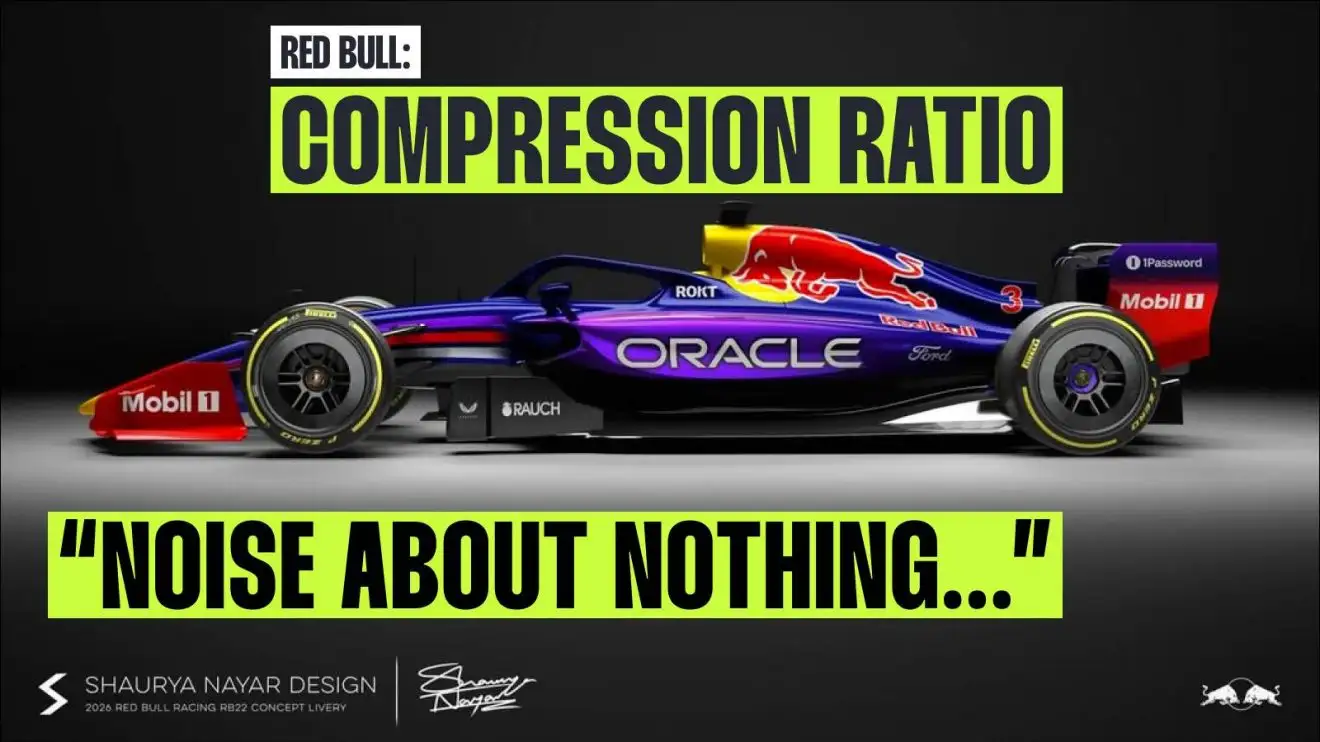
Red Bull RB22 livery concept by Shaurya Nayar (Instagram: shauryanayar.design)
Red Bull Powertrains’ technical director is confident of having a fully legal engine in 2026, amidst speculation regarding compression ratios.
Ahead of a planned meeting with the FIA on the 22nd of January, Red Bull Powertrains’ [RBPT] technical director Ben Hodgkinson says he suspects recent paddock chatter about compression ratio trickery is “a lot of noise about nothing”.
Red Bull: F1’s new compression ratio ‘too low’
Want more PlanetF1.com coverage? Add us as a preferred source on Google to your favourites list for news you can trust
Over the last few weeks of 2025, speculation regarding a potential grey area in the new power unit regulations suggested that one or two of the power unit manufacturers may have discovered a way to run at a higher compression ratio than prescribed in the technical regulations, while still adhering to the FIA’s checks.
The regulation, Article C5.4.3, states this as “No cylinder of the engine may have a geometric compression ratio higher than 16.0. The procedure to measure this value will be detailed by each PU manufacturer and executed at ambient temperature.
“This procedure must be approved by the FIA technical department and included in the PU manufacturer’s homologation dossier.”
Ahead of that homologation date, March 1st, it’s believed one or two of the power unit manufacturers have found a way to achieve this compression ratio at ambient temperature, while running at a higher compression ratio at higher temperatures, ie. while on track.
The speculation has pointed to Mercedes’ new power unit, with the Brixworth-based manufacturer at High-Performance Powertrains supplying three customer teams this year as well as the factory squad.
The rumour mill also suggests that the first offering from Red Bull Powertrains has also capitalised on the grey area in the wording of the regulations, with the other three manufacturers said to be concerned about the interpretation of the regulation, with a higher compression ratio allowing for a small performance advantage due to the ability to extract more power from the same amount of fuel.
Given the FIA’s range of variables on the electrical front, with the ability to reduce the amount of permitted harvesting and deployment as it sees fit at each circuit, such a small performance advantage on the internal combustion engine could prove decisive.
The FIA is set to meet with the power unit manufacturers on the 22nd of January, with the governing body confirming to PlanetF1.com the intent of the meeting.
“As is customary with the introduction of new regulations, discussions on the 2026 iteration covering power unit and chassis are ongoing,” an FIA spokesperson stated.
“The meeting planned for 22 January is between technical experts.
“As always, the FIA assesses the situation in order to make sure the Regulations are understood and applied in the same manner between all the participants.”
Under the previous regulations, the compression ratio was set at 18.0, but this has been reduced to 16.0 for the new-generation 1.6-litre V6 hybrids.
According to Hodgkinson, who has overseen the development of Red Bull Powertrains’ power unit for 2026 over the past four years, this limit is too low but, regardless, is confident that Red Bull’s solution is fully legal.
“From a purely technical point of view, the compression ratio limit is too low,” he told select media, including PlanetF1.com, ahead of Red Bull’s RB22 livery launch in Detroit.
“We have the technology to make combustion fast enough that the compression ratio is way too low.
“We could make 18:1 work with the speed of combustion that we’ve managed to get, which means there’s performance in every tenth of a ratio that you can get.
“So every manufacturer should really be aiming at 15.999… as far as they dare when it’s measured.”
Formula 1’s season of change: F1 2026 explained
F1 2026 tech analysed: The future of overtaking and biggest car advantage identified
Explained: How F1’s new ‘overtaking mode’ will work in 2026
While fully aware of the speculation that has circulated in recent weeks, Hodgkinson downplayed the matter and said that, as with every manufacturer, RBPT is taking its efforts to the very limit of permissibility under the regulations – as would be expected of any engineering challenge in F1.
“I think there’s some nervousness from various power unit manufacturers that there might be some clever engineering going on in some teams,” he said.
“I’m not quite sure how much of it to listen to, to be honest. I’ve been doing this for a very long time, and it’s almost just noise. You just have to play your own race, really.
“I know what we’re doing. I’m confident that what we’re doing is legal. Of course, we’re taking it right to the very limit of what the regulations allow.
“I’d be surprised if everyone hasn’t done that. So my honest feeling is I suspect it’s a lot of noise about nothing. I expect everyone’s going to be sitting at 16, that’s what I really expect.”
After four years of build-up and anticipation, the first power unit out of Milton Keynes to hit the track will be slotted into the back of the Red Bull and Racing Bulls cars for pre-season testing in Barcelona and Bahrain over the next month.
The power unit that will be used in 2026 is the sixth-generation power unit created at the RBPT facility, and Hodgkinson said it’s impossible to gauge just how much of the potential of the regulations has already been reached at this early stage.
“I’ve been designing racing engines for 27 years now, and even in the last set of regulations, which started in 2014 and went right until the end of last year, every year there was a big step forward,” he said in response to a question from PlanetF1.com.
“So, how much potential is there to come? There was over a decade’s worth of about half a second every year. So my job is literally based on the fact that there is no such thing as optimum, and you’re done.
“I’ll always make it better, given more time, so it’s tricky to answer how much more potential there is.”
Want to be the first to know exclusive information from the F1 paddock? Join our broadcast channel on WhatsApp to get the scoop on the latest developments from our team of accredited journalists.
You can also subscribe to the PlanetF1 YouTube channel for exclusive features, hear from our paddock journalists with stories from the heart of Formula 1 and much more!
Read Next: Red Bull launches merchandise reveal countdown for F1 2026 season