
Sainz doubles down on scathing FIA claim as ‘worst’ mistake explained


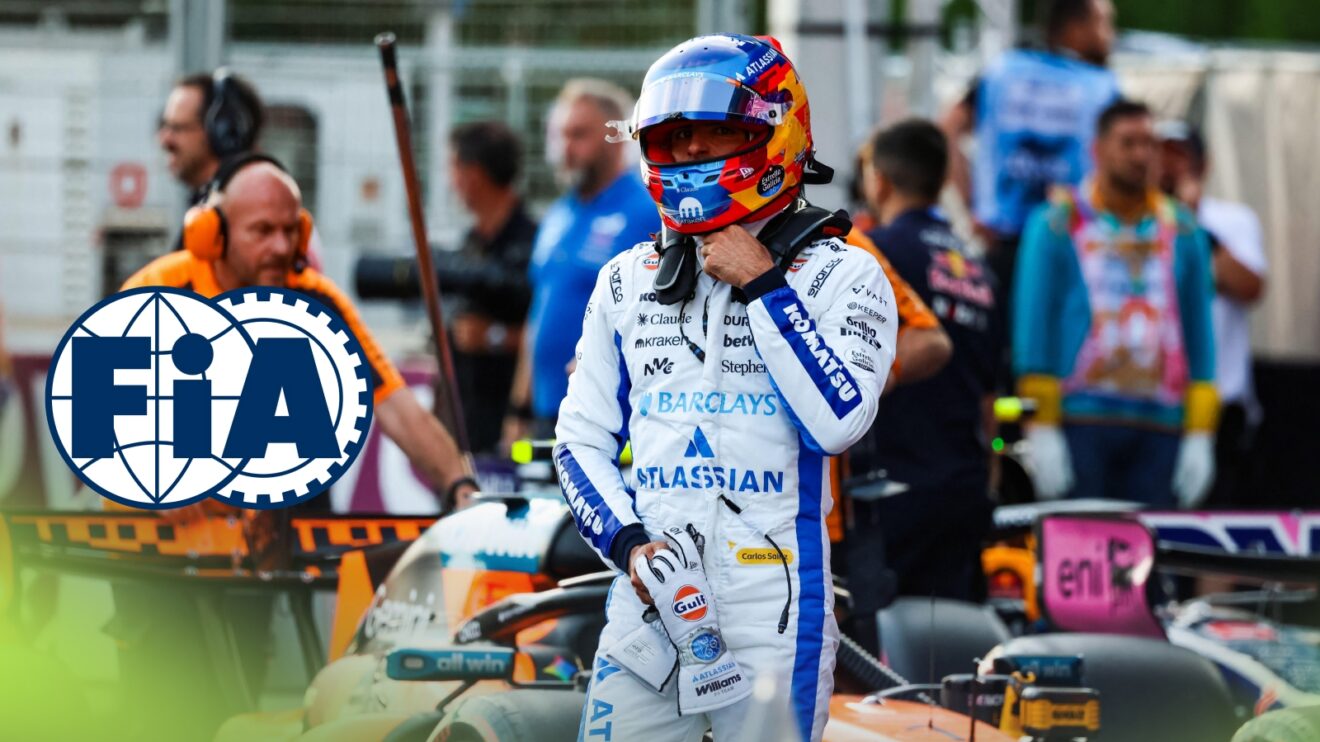
Carlos Sainz has doubled down on his FIA criticism
SINGAPORE – Carlos Sainz has doubled down on his claim that the FIA and Formula 1 did not apply sporting fairness when only some drivers had Overtake Mode’s power boost late in SQ1 in Singapore.
The Williams driver scathingly claimed that it was because “they didn’t care that much” about Williams, a team struggling to score points.
Carlos Sainz doubles down on scathing ‘didn’t care’ claim
Friday’s Sprint qualifying at the Marina Bay circuit was red flagged when Sergio Perez, having tagged a wall at Turn 4, drove over his broken front wing as he tried to return to the pit lane.
When the session resumed with just over six minutes remaining, a “human error in Race Control” meant Overtake Mode was unavailable to the drivers.
When it became apparent that it was not active, it was then activated, but only for 27 seconds before it was deactivated again.
That meant for 27 seconds only some drivers had Overtake Mode and its additional 0.5 mJ of energy, which is a significant pace advantage.
Sainz was among the drivers who did not have the advantage, and qualified slowest of all in 22nd place.
The Spaniard called out the FIA for a lack of sporting fairness.
“For whatever reason,” he said on Friday night, “the FIA didn’t decide to do sporting equity, and were happy to do half of the cars in quali with a higher power than the other half of the cars.
“So I’d be confused why the sport keeps doing different things depending on who is out in Q1 or who is out in lap one.”
A day later, the four-time Grand Prix winner demonstrated his one-lap pace in Grand Prix qualifying, reaching Q2 and recording the 14th-fastest time.
However, even then it was a case of what could have been had he not been impeded by Nico Hulkenberg, with the German escaping a grid penalty in “extraordinary mitigating circumstances” due to yet another timing issue.
Sainz told PlanetF1.com and other accredited media that FIA single-seater director Nikolas Tombazis had apologised to him and the other drivers affected by the error in Sprint qualifying.
He even, according to Sainz, admitted that it wasn’t fair.
But the Williams driver still wants to know why it was deemed okay to allow the result to stand given the start procedure at the Bahrain GP in Malaysia was suspended when some drivers, not all of them, suffered power unit issues due to the slow speeds on the formation lap.
“Nikolas came to apologise,” Sainz said in response to a question posed by PlanetF1.com’s Thomas Maher, “acknowledging there was a human error but also acknowledging that the decision being taken between Q1 and Q2 was the wrong one because, admitting there was sporting unfairness, that should have never happened.
“Very confused, still very amazed by the fact that, still being aware of the sporting unfairness, they decided to throw it under the bed like nothing happened.
“Surprised especially with how different it went compared to Malaysia, where something very similar happened.
“Still don’t understand it. I will never understand how that decision was taken.
“But,” he cuttingly added, “we are not fighting for a championship. We’re not fighting for points even. So I guess that’s why also they didn’t care that much.”
More on the Singapore Grand Prix SQ1 issue
‘Equally as embarrassing’ – Martin Brundle slams F1 failures in Singapore
FIA issues statement after ‘human error’ sparks Singapore GP qualifying issue
FIA admits SQ1 is ‘the worst thing’
Speaking to Sky Deutschland, Tombazis acknowledged that Friday’s issue during Sprint qualifying with the Overtake Mode was the “worst thing” that could have happened as it impacted the results.
Sharing more information about the error, he explained that “somebody” had not reacted to a message that had popped up on their computer, and it wasn’t until they heard the drivers complaining that they realised there was a problem.
Tombazis insisted the FIA would learn from Friday’s mistake.
“Normally it is a manual process to re-enable it, because clearly when it gets re-enabled we want to make sure from a safety point of view it’s okay to do so,” he said.
“Unfortunately, there was a pop-up window that came on somebody’s computer that was not acted on quickly enough or when it should have. And then under the time pressure and the general other pressure, this was forgotten, unfortunately.
“We then went into quite an intense analysis about, was there some other issue, because we could hear, of course, the drivers complaining and saying what’s happening. We realised where the problem was.
“At that time there was an erroneous decision to briefly turn it on again, but that was sort of not exactly the correct decision in order for fairness. And then it was turned off again.
“We’re not happy about it, because it affected some drivers more and some drivers less.
“So as a result, just in the first session of the Sprint, we felt this problem interfered with the results – which for us as FIA is probably, in some ways, the worst thing, because our top priorities are always safety and fairness.
“Of course, to have a situation where a result is not fair or incorrect is for us not good. Of course, it is a complicated job, and people do make mistakes, and we need to be conscious of that.
“But we also need, when we do make mistakes, to analyse them and to make sure they don’t happen again – which is what we’re doing.”
Additional reporting by Thomas Maher
Want to be the first to know exclusive information from the F1 paddock? Join our broadcast channel on WhatsApp to get the scoop on the latest developments from our team of accredited journalists.
You can also subscribe to the PlanetF1 YouTube channel for exclusive features, hear from our paddock journalists with stories from the heart of Formula 1 and much more!
Read next: Lewis Hamilton Singapore GP gamble traced to crucial Ferrari mistake